Where the Desert Meets the Sea
“Enough O Sea” and the Fragile Origins of Modern Kuwait

A movie review: Bas Ya Bahr (The Cruel Sea). 1972
“The desert on the other side was, most of the time, flat, hard and desolate, nothing and no one came from its depths except rarely. The bedouin who at first refused to go near the sea … were soon won over. It seemed to them curious, arousing and somewhat risky, and before long they went closer to the sea. They did hesitantly, in stages, with a sense of experimentation and secrecy … but their fear never left them, for “water is treacherous, a swallower who never is satisfied.” Later on they waded into the shallow water. It was enticing caressing their fear with its coolness and density, and with the passing of time they did not hesitate to bathe in the sea.”
-- Abdelrahman Munif, Cities of Salt (1987; orig. in Arabic Mudun al-Milh, 1984). Translated by Peter Theroux
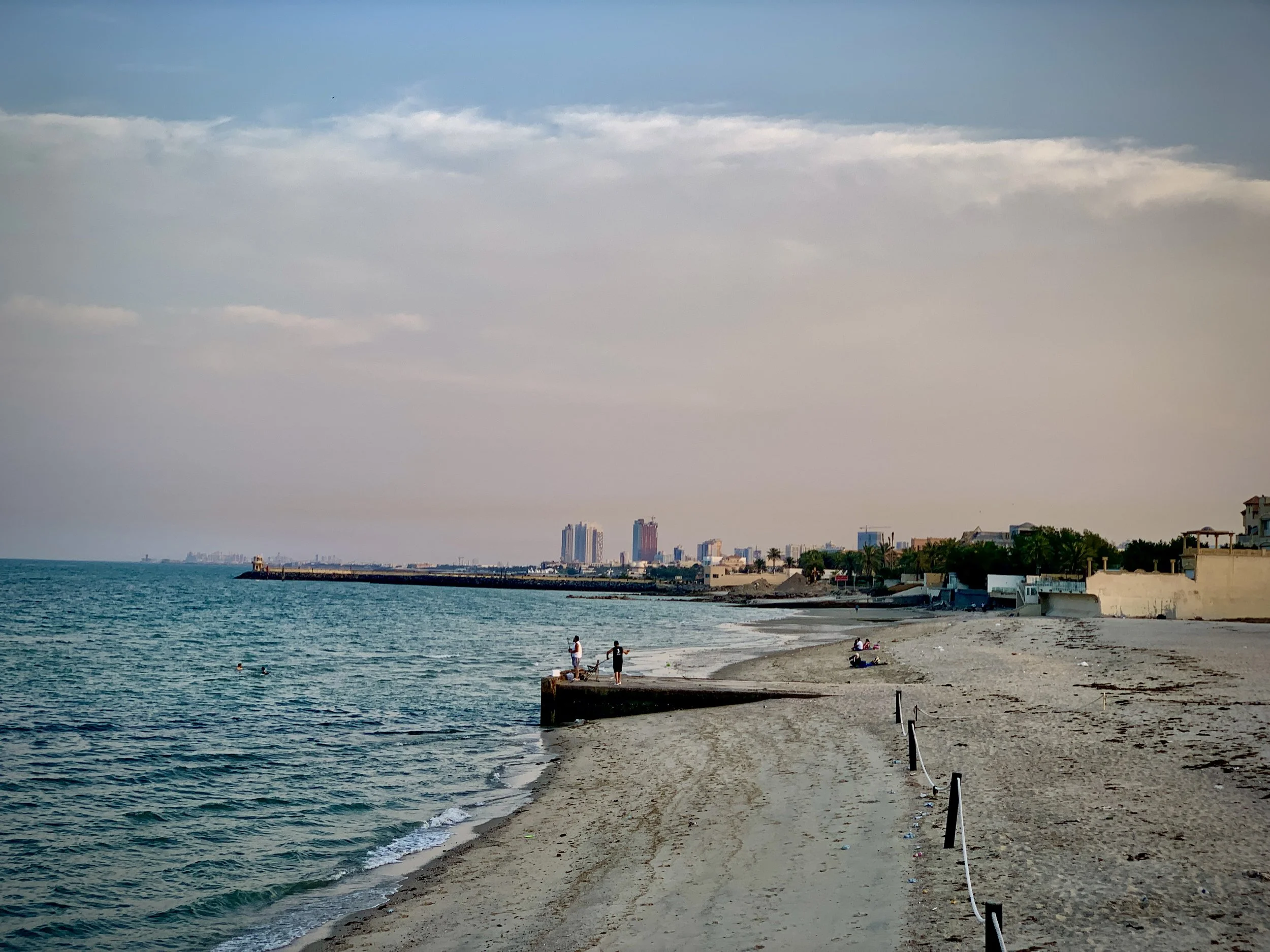
Seafront. Kuwait. 2023 (Elsheshtawy)
To understand the transformations that have reshaped the Arab Gulf over the past few decades, we must first return to its past. In the case of Kuwait—and as a companion to my previous blog on the city—that past is inseparable from its enduring and often conflicted relationship with both the sea and the desert. Here, however, I want to focus on the sea, and specifically on Khaled Al-Siddiq's remarkable 1972 film Bas Ya Bahr (The Cruel Sea). The film is not simply a portrait of Kuwait before oil; it is a meditation on many of the same questions that continue to shape the country today: sacrifice, belonging, inequality, and the uneasy relationship between people and the spaces they inhabit.
The film begins with the haunting words of an old pearl-diving lament:
Enough, enough .... Oh sea
Four months .... And the fifth is on its way
Bring them, bring them .... Sailing, bring them
Aren’t you afraid of God .... Oh ocean
You took my son .... Oh ocean— Old Songs of Diving
Tawb Tawb ya Bahar," or "Enough, Enough, oh Ocean
Those words establish the emotional universe of the film long before a single image appears. The sea is not simply a setting but the central force around which life revolves. It offers sustenance while threatening destruction, promising prosperity while demanding unbearable sacrifice. Before Kuwait became associated with oil, highways, and glittering skylines, it existed in a far more precarious world, suspended between two unforgiving landscapes. The sea provided livelihood through pearl diving and trade, yet every departure carried the possibility of never returning. The desert offered protection but little abundance. Between these two extremes emerged a settlement whose architecture reflected necessity rather than spectacle. Narrow alleyways, coral-stone houses, shaded courtyards, and modest dwellings formed an urban landscape born of adaptation rather than ambition. Reading the opening pages of my Kuwait chapter in Arab Modernism(s) once again, I was struck by how closely Al-Siddiq's cinematic vision mirrors this forgotten city.
Although Bas Ya Bahr was filmed during Kuwait's post-independence building boom, when modern ministries, highways, and new neighbourhoods were rapidly reshaping the country, the film deliberately turns away from this emerging image of prosperity. Instead, it reconstructs the Kuwait of the 1930s and 1940s with remarkable restraint. Its camera lingers on dusty lanes, weathered walls, open courtyards, and simple homes whose quiet dignity contrasts sharply with the monumental architecture that would soon redefine the country. Looking at these scenes today, one cannot help but recognize that this Kuwait has almost entirely disappeared beneath concrete and glass. Yet the film does not mourn the loss of buildings alone. It mourns an entire way of life.
At the centre of the story is Musaed, a young man whose aspirations are painfully modest. He wishes only to earn enough money to marry Nora, the woman he loves, but poverty leaves him with few options. Like countless young men before him, he joins a pearling expedition, fully aware that the sea offering hope may also claim his life. His tragedy is not merely personal. It reflects an entire social order in which survival itself depended upon accepting extraordinary risks. Wealth, class, and patriarchy shape every decision. Nora's wealthy father refuses their union, while economic necessity drives Musaed toward an uncertain fate. Love, labour, and loss become inseparable.
What fascinated me most, however, was not simply the narrative but the spaces through which it unfolds. Musaed repeatedly moves through narrow alleys enclosed by blank walls before arriving beneath Nora's window, where their conversations take place in whispers and stolen glances. Architecture quietly reinforces the social constraints governing their lives. Nora watches from behind wooden screens and barred openings that separate her from the public world beyond. Musaed's modest family house, where his mother prepares meals seated on the floor, reflects both intimacy and hardship, while Nora's larger home embodies privilege yet simultaneously becomes a prison when her father boards up her room after she resists his authority. Throughout the film, buildings never function merely as scenery. They participate in the story, revealing how architecture can express affection, hierarchy, protection, and control all at once.
Equally powerful are the scenes aboard the pearling dhow, where labour, ritual, music, and superstition merge into a single social world. Particularly unforgettable is the sequence in which women immerse a cat in seawater while praying for the safe return of the divers, hoping that by inflicting suffering upon the animal they might persuade the sea to show mercy. Rationality yields to desperation because no other form of control exists. When Musaed finally drowns, his mother's decision to cast his precious pearls back into the sea becomes one of the most devastating moments in the movie. Her gesture rejects not only the sea that claimed her son but also the economic and social order that demanded such sacrifice from those who possessed the least.
Relating the movie to subsequent urban and architectural developments one is tempted to draw parallels, and perhaps elicit some explanations pertaining to inequality, exclusion and marginalization. But perhaps the larger lesson here is that cinema often understands cities more profoundly than any planning document ever can. Plans tell us how cities were imagined; films reveal how they were lived. Bas Ya Bahr preserves not only the appearance of a vanished Kuwait but also its rhythms, silences, fears, and aspirations. It reminds us that before Kuwait became one of the Gulf's wealthiest nations, it was a fragile settlement whose urban life revolved around uncertainty and collective endurance. Modernization transformed that reality almost beyond recognition, bringing remarkable prosperity while simultaneously producing new forms of exclusion that I explored in my previous blog. The film therefore becomes more than a historical reconstruction. It becomes a way of understanding the continuities that link Kuwait's past and present.
Returning to Bas Ya Bahr after reflecting on Kuwait's modern history, I came to see it less as a nostalgic account of a vanished world than as an indispensable companion to the city's contemporary story. If the Kuwait explored in my previous blog revealed how modern architecture could embody both hope and exclusion, Bas Ya Bahr reminds us that before concrete and glass reshaped the city, another relationship had already begun to transform it: that between the desert and the sea. Abdelrahman Munif captures this beautifully in Cities of Salt, where the Bedouin, initially fearful of the sea—"water is treacherous, a swallower who never is satisfied"—gradually approach it with curiosity, hesitation, and eventually familiarity. Long before oil altered Kuwait's fortunes, the sea had already become both a source of livelihood and a force demanding sacrifice, drawing people away from the certainty of the desert toward an uncertain future. In many respects, oil merely accelerated a transformation that the sea had begun generations earlier. Seen in this light, Bas Ya Bahr is not simply a film about a lost Kuwait but about the origins of a society learning to negotiate uncertainty itself. It reminds us that Kuwait's greatest narrative has never been its spectacular urban transformation alone, but the ordinary men and women who continually adapted to changing landscapes—first between desert and sea, and later between tradition and modernity—while searching for security, dignity, and belonging.
