Planning Middle Eastern Cities: An Urban Kaleidoscope

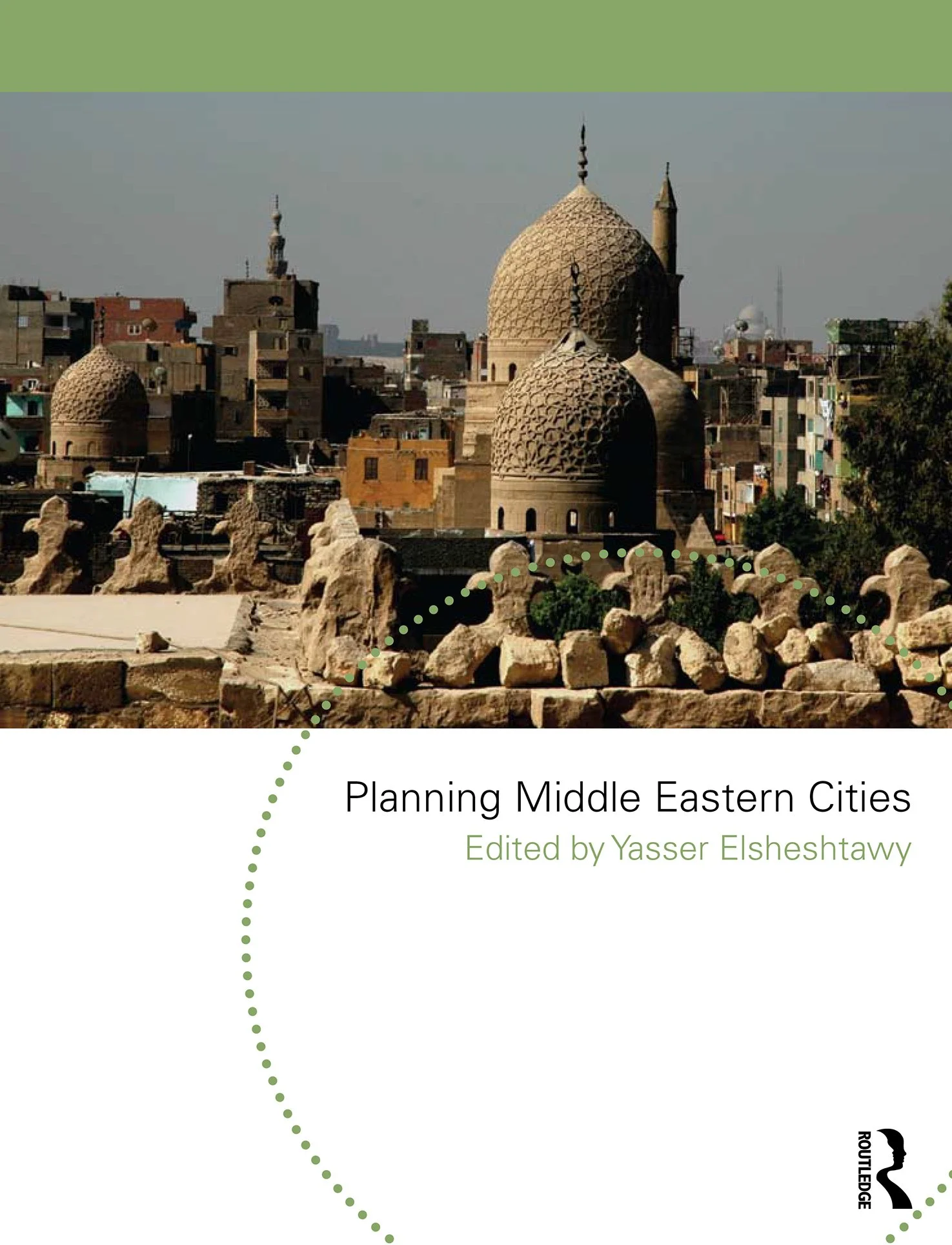
This is a book about what may be loosely referred to as ‘Middle Eastern’ or ‘Moslem/Arab’ cities. Cities in the Arab world are too diverse and hybrid to be lumped together as a single, arbitrary group. Rather they make up the urban kaleidoscope of the title, and the diversity of the six cities included here supports that contention. They range from cities rich in tradition, the ones one would immediately conjure up on hearing the phrase ‘Middle Eastern’ (Cairo, Tunis, and Baghdad), to cities that have not been explored sufficiently, or ‘forgotten’ cities (Algiers and Sana’a), to newly emerging ‘oil-rich’ aGulf cities (Dubai).
The authors are all young Arab scholars and architects educated either in Britain or the United States, but most importantly all belong to, were raised in, or are a citizen of the city they describe and so they provide a ‘local voice’ not previously heard and an understanding which no outsider could achieve.
As Yasser Elsheshtawy says in his Introduction, he and his contributors move away from the exclusively ‘Islamic’ reading of Arab cities – an approach they regard as outdated and counterproductive. Instead, they explore issues of identity, globalization, hybridity, colonization and the struggles, strategies and solutions offered by each city from the late nineteenth century to the present day. Their focus is on the built environment and its change over time and under different influences and their discussions are supported by extensive illustration.
Reviews
“Planning Middle Eastern Cities is both an important book for scholars and a useful book for practitioners. Its contributors, all from the Middle East, present an insider’s narrative with a broad focus that illustrates how scholars from the region problematize both their work and their practice.”
Nezar AlSayyad. Professor and Chair, University of California at Berkeley
“This is a fascinating book in which Elsheshtawy and his contributors argue that local traditions can have a healthy impact on architecture usually associated with the alien impact of globalisation. Reading it made me much more positive about the cultural future of cities such as Cairo and Algiers, even of Baghdad. The analysis of ‘Occidentalist’ experiments such as the Dreamland complex built for Cairo’s rich make the book’s findings highly original. Only time will tell if Baghdad can find a new architectural identity.”
Trevor Mostyn, whose eight published books include Coming of Age in the Middle East (1987) The Cambridge Encyclopaedia of the Middle East & North Africa (1988) and Egypt’s Belle Epoque: Cairo 1869–1952 (1989).

“This volume provides a nonspecialist audience with a thorough overview of issues and approaches to contemporary Middle Eastern urbanism.” Sophia Shwayri, Traditional Dewlling and Settlements Review, Spring 2005
“Will inspire further critical investigation on the sites and cities of the Middle East that have until now been marginalized in the debates regarding globalization and urban change.” Mrinalini Rajagopalan. Journal of Architectural Education
“This book is a very informative and lively read that certainly adds fresh perspectives to the study of Arab cities… This collection could be an interesting text for undergraduate and graduate courses in Middle East and urban/cultural studies.” Petra Kuppinger. International Journal of Middle East Studies
“The essays collected by Elsheshtawy raise as many questions as they answer, but this is also a strength of the book, which provides insights into places often grounded in an idealized past, both in their architecture and their architectural history.” Wendy Shaw. Journal of the Society of Architectural Historians
“This is a laudable collective effort with an excellent choice of case-studies which make a compelling argument in favour of the ‘urban kaleidoscope. This certainly provides food for thought for architects, planners, urban specialists and historians working on and in the Middle East.” Nellida Fuccaro. Urban History Journal
Mashary Al Naim (2005) The Arabic architectural magazine Al-Benaa; 25:174, pp. 41-42. PDF