The Nile Hilton
A Love Story, Memories, and My Cairo

“As a little girl, I believed there was only one bar in all of Cairo, perhaps the whole world, and that was the bar at the Nile Hilton. Though most people ended their day at a bar, it was often our first stop when my father and I set out in the morning, the place where we went to get our day going. In the months before we left Egypt, my father and I began going to the Nile Hilton more frequently, almost every day …”
-- Lucette Lagnado. The Man in the White Sharkskin Suit: A Jewish family's exodus from Old Cairo to the New World. (New York: Harper Perennial, 2007)
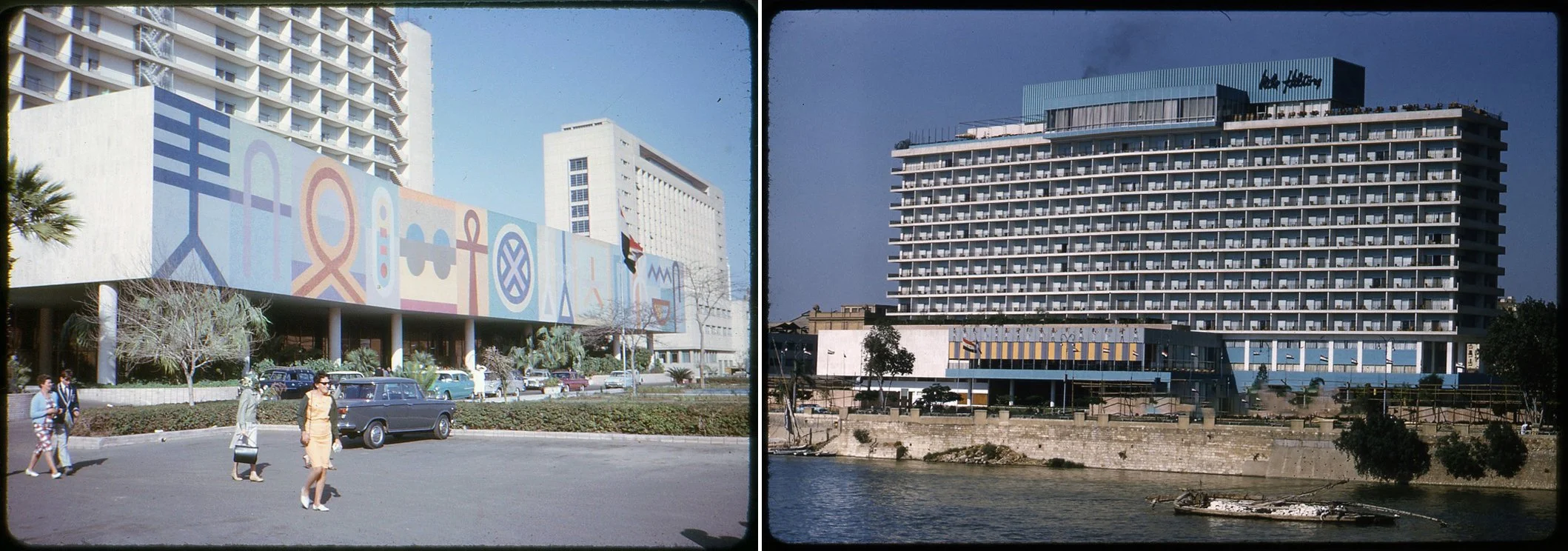
L: A 1965 image showing the Nile Hotel from the back (Source: Ben W Smith & R: General View. 1960s (Public Domain)
While writing My Cairo: A Cartography of Belonging and Everyday Urbanism (AUC Press, 2027), I recalled one particular building. It is neither the oldest building in Cairo nor, architecturally speaking, the most important. Yet few places have occupied such a central place in both my family's history and my own memories as the Nile Hilton. Like many buildings in Cairo, it has lived several lives. It has witnessed revolutions, welcomed presidents and celebrities, changed names, undergone extensive renovations, and outlived the political optimism that accompanied its birth. Yet for me none of these histories are quite as significant as a much smaller story, one that began in 1962, when my father, then a young architecture student at Ain Shams University, decided to take my mother there during their engagement.
Both my parents came from a small provincial town in the Nile Delta. Cairo represented opportunity, sophistication, and the promise of another life. Wanting to impress the woman he loved, my father chose what was then one of the city's most fashionable destinations. The Nile Hilton cafeteria overlooked Tahrir Square and attracted diplomats, affluent Egyptians, and visitors from around the world. Taking my mother there was undoubtedly a romantic gesture, but it was also an expression of hope. He wanted to show her the city that had captured his imagination, and perhaps also the future he imagined they would build together.
Their visit coincided with an extraordinary moment in Cairo's history. Nasser's revolution had begun transforming not only Egypt's political landscape but also its social geography. Downtown Cairo, long associated with European residents, colonial officials, and the Egyptian aristocracy, was becoming increasingly accessible to Egyptians from all walks of life. The Nile Hilton itself embodied that transformation. Designed by Welton Becket and inaugurated in 1959 by Gamal Abdel Nasser together with Conrad Hilton and Josip Broz Tito, it introduced a distinctly modern architectural language to Cairo while projecting confidence in a newly independent nation looking toward the future. Even details that seem unremarkable today carried symbolic weight at the time. The hotel's cafeteria employed Egyptian women as hostesses, something that was itself regarded as a sign of a changing society.
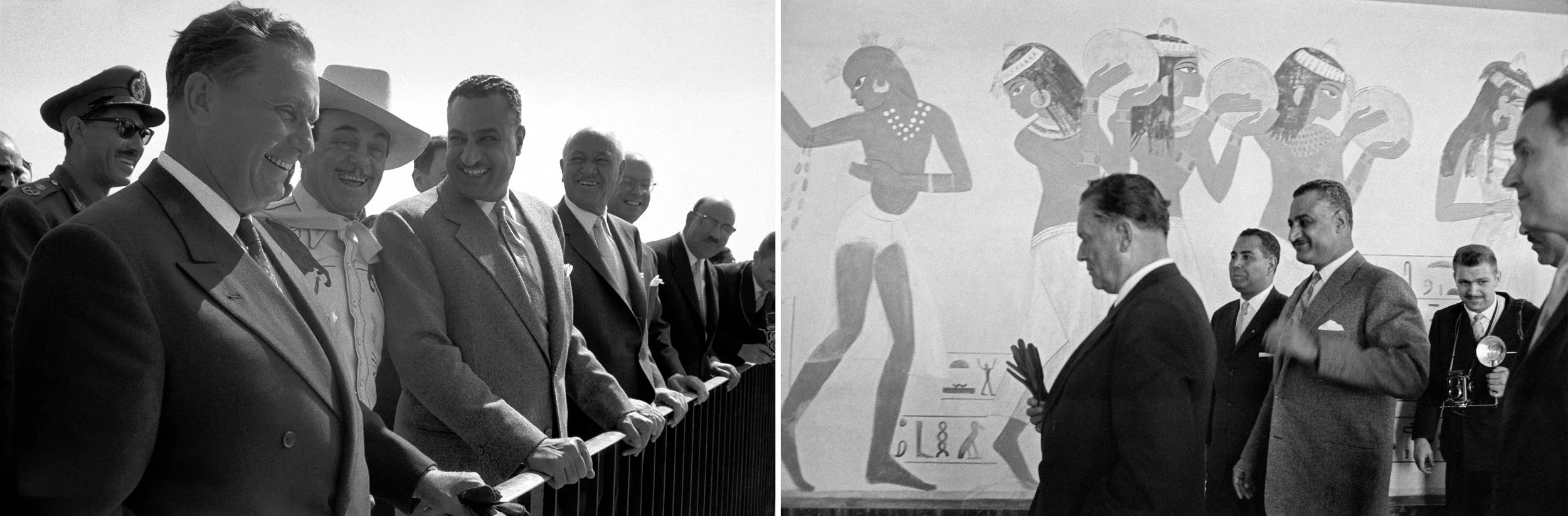
Presidents Nasser and Tito and Conrad Hilton during the opening of the Hotel in 1959. Second image shows them inside the hotel’s lobby (Source: Magnum Photos)
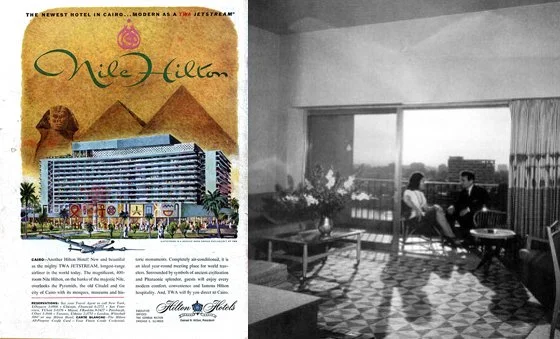
L: An advertisement from 1959 (Source: Time Magazine) & R: Couple sitting on a balcony overlooking the Nile (Source: Hilton)
My parents' afternoon at the Nile Hilton became part of our family lore. Throughout my childhood I heard the story repeated so many times that I eventually ceased distinguishing between memory and imagination. Whenever I visited the hotel during the 1970s and 1980s, I found myself mentally reconstructing that afternoon. I would picture my parents crossing the polished marble lobby, entering the cafeteria, smiling awkwardly at one another while speaking about a future neither could possibly foresee. They could not have imagined that life would eventually carry them to Zürich, Hannover, back to Cairo, then to Riyadh, and Amman, before returning once more to Cairo, where our home in Maadi would become the center of our family and my own youth.
Over time, however, the hotel acquired an entirely different significance because it gradually became part of my own Cairo. My uncle Osama occasionally took me to its celebrated pizzeria, where I enjoyed what I still remember as among the finest pizzas in the city. Years later another corner of the hotel became the setting for a different chapter of my life. My late friend Amr and I spent countless evenings at the Taverne, talking, laughing, and postponing the moment when we would have to return home. One evening an American expatriate stood next to the Karaoke machine and launched into Frank Sinatra's My Way. It was one of those moments that seemed almost trivial at the time yet somehow became unforgettable. As I recount in My Cairo, for a while Amr and I also tried to do things our way. Life eventually led us along different paths, and today he is no longer here. Whenever I think of the Taverne, I cannot help thinking of him. May he rest in peace.
When I left Cairo for the United States in 1988, I never imagined that the Nile Hilton itself would soon disappear. The building did not vanish physically, of course, but its identity slowly changed. The hotel closed, underwent years of extensive renovation, and eventually re-emerged as the Ritz-Carlton. Much of the original structure survived, yet something fundamental had altered. The large forecourt -- a much-hated addition -- facing Tahrir Square disappeared, exposing the monumental façade decorated with Pharaonic motifs directly onto the square as was originally intended. During the long years in which the building remained under renovation, it acquired yet another unexpected role. It stood silently overlooking Tahrir during the 2011 Revolution, becoming the backdrop to another defining moment in Egypt's modern history, just as it had embodied the optimism of the Nasser era half a century earlier.
When I returned to Cairo in January 2026, curiosity eventually drew me back. I wanted to know whether the old magic had survived. An Uber dropped me along the Corniche. The first thing I noticed was security. Like so many important buildings in contemporary Cairo, the hotel had become heavily fortified. I managed to take a few photographs before entering through the main entrance, immediately discovering that another piece of Cairo had quietly disappeared. Jacky's Nightclub, which for years had been one of the city's discreet gathering places for Cairo's LGBTQ community, was gone. Inside, however, one reassuring detail remained. Standing in front of the reception desk were three elegant young Egyptian women welcoming arriving guests, continuing a tradition that stretched back to the hotel's earliest years.
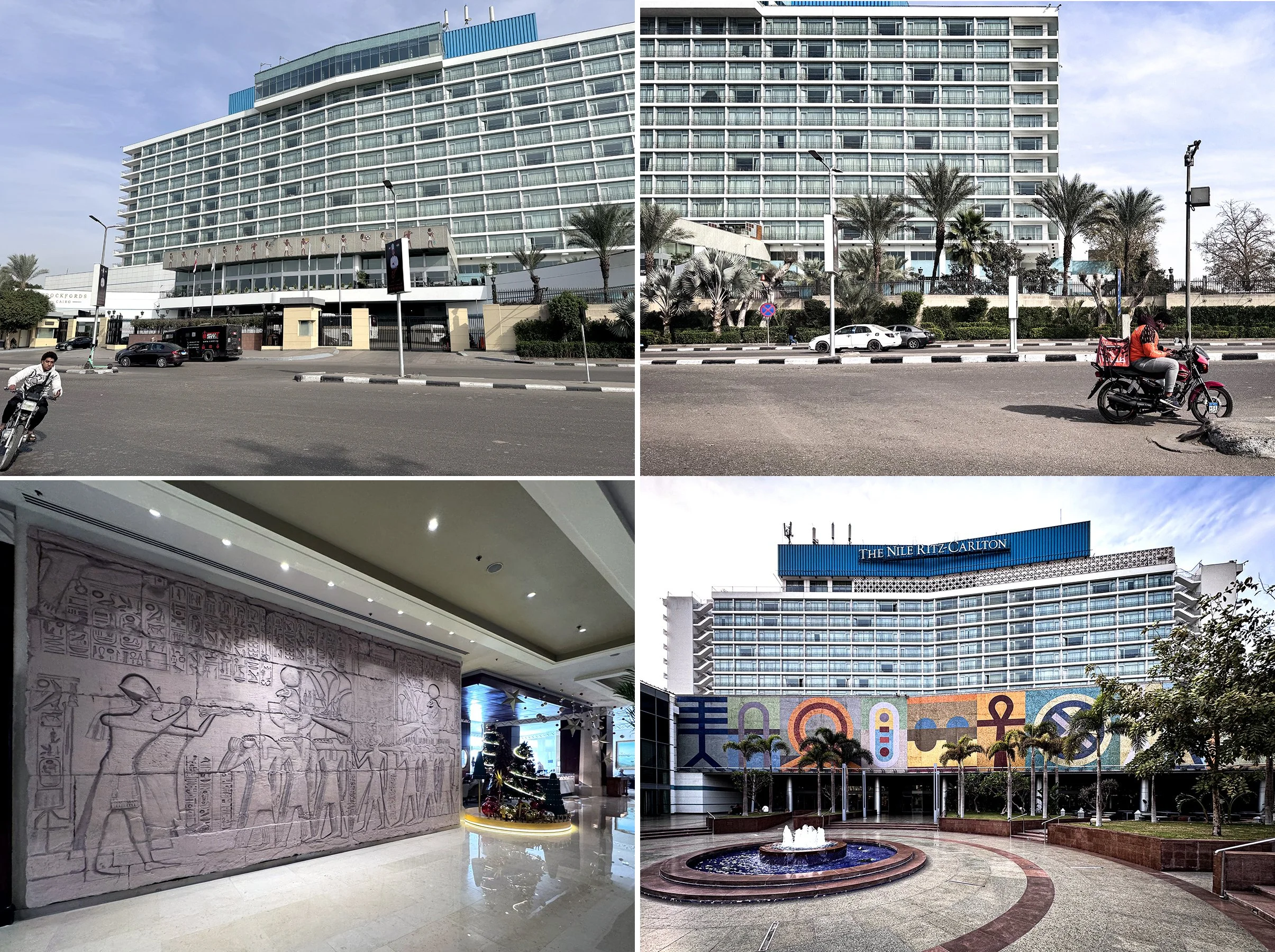
Images from visit. Clockwise: General View from the Nile Façade; Detail; Back Façade facing Tahrir Square; Inside the Lobby with the original Pharaonic Wall (Elsheshtawy)
Almost everything else had changed. The Taverne had disappeared. The bookshop had vanished. The pizzeria was gone. Miss Egypt, the clothing store I remembered from countless visits, had also departed. In their place stood a spacious lobby café. I ordered an espresso and sat watching tourists, business travelers, and hotel staff move through the space. The hostesses remained as gracious as ever, representing that warmth and elegance I have always associated with Cairo. Yet despite the familiarity, the hotel no longer possessed the atmosphere I remembered. The building remained, but the accumulated layers of memory seemed somehow less accessible beneath its carefully polished luxury. This was, after all, the same hotel where Nasser had inaugurated one of modern Egypt's great architectural symbols alongside Tito (former president of Yugoslavia) and Conrad Hilton. It was also the place where he held one of his final meetings before his sudden death, following Black September with Yasser Arafat, King Hussein, and Muammar Gaddafi. History still lingered inside those walls, but it no longer revealed itself as easily as before.
Leaving through the rear entrance, I emerged once again into Tahrir Square. The great hieroglyphic wall remained exactly where I remembered it, but the newly redeveloped plaza beyond felt strangely empty. A handful of young Egyptians from modest backgrounds wandered through the space taking photographs while the Mugamaa, the Ministry of Foreign Affairs, and the Arab League headquarters continued watching over the square as they always had. Before meeting my friend and former colleague Mohsen, I found myself circling Tahrir Square almost instinctively, following a street I had walked countless times before, as if the city itself were gently leading me back through my own past. Passing what is now El Tahrir Cafe, once Wadi El Nil Cafe, I was relieved to discover that it remained a genuine ahwa sha'abi, where ordinary Cairenes continued drinking tea, smoking shisha, and talking without urgency. From there I walked to La Poire café, occupying the former offices of TWA. I smiled as I remembered coming there in the late 1980s to purchase my ticket to the United States, unaware that I was about to leave Cairo for far longer than I had ever imagined. Mohsen eventually arrived, and over sandwiches we laughed, reminisced, and spoke about old friends before parting ways. As I waited for my Uber on Qasr El Nil Street, another memory resurfaced. Directly opposite stood what had once been Qasr El Nil Cinema, where I had watched an ABBA documentary in the late 1970s, in addition to countless other movies. Beside it had been an elegant Moroccan restaurant, long since shuttered. Today the cinema survives only as a theater.
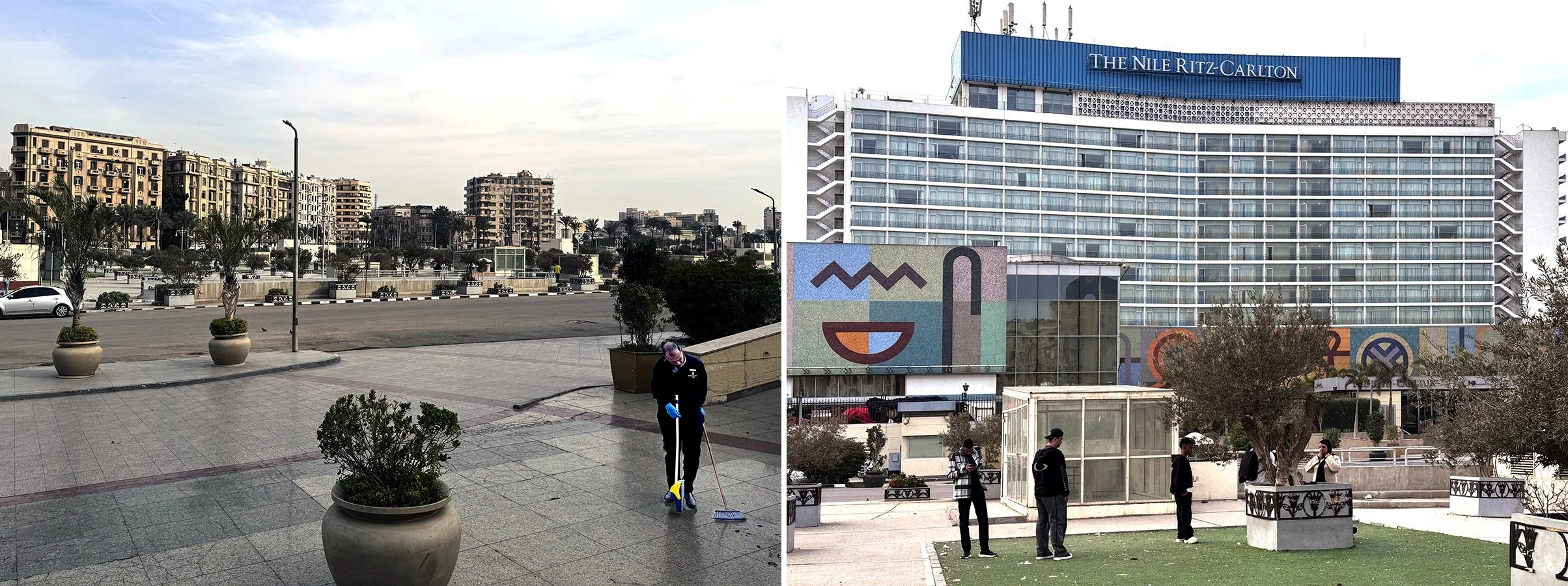
Redeveloped Tahrir Square Plaza (Elsheshtawy)
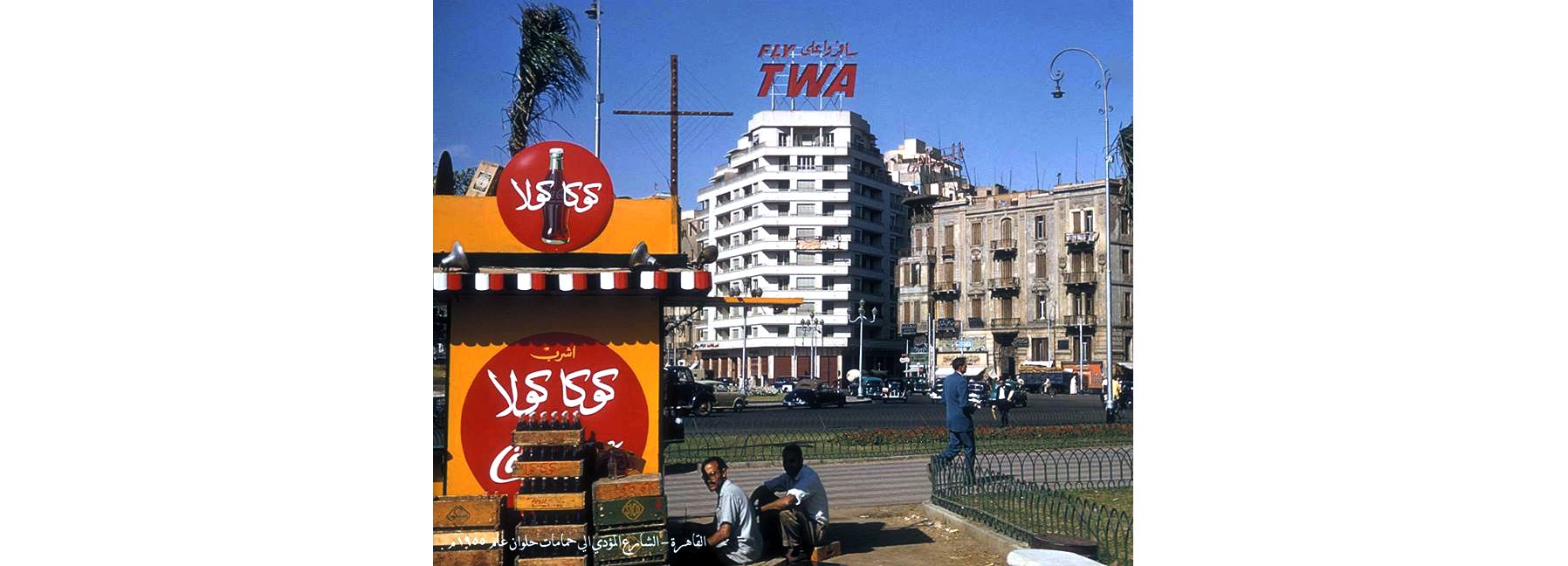
Tahrir Square. 1970s. TWA Building in the Background (Public Domain)
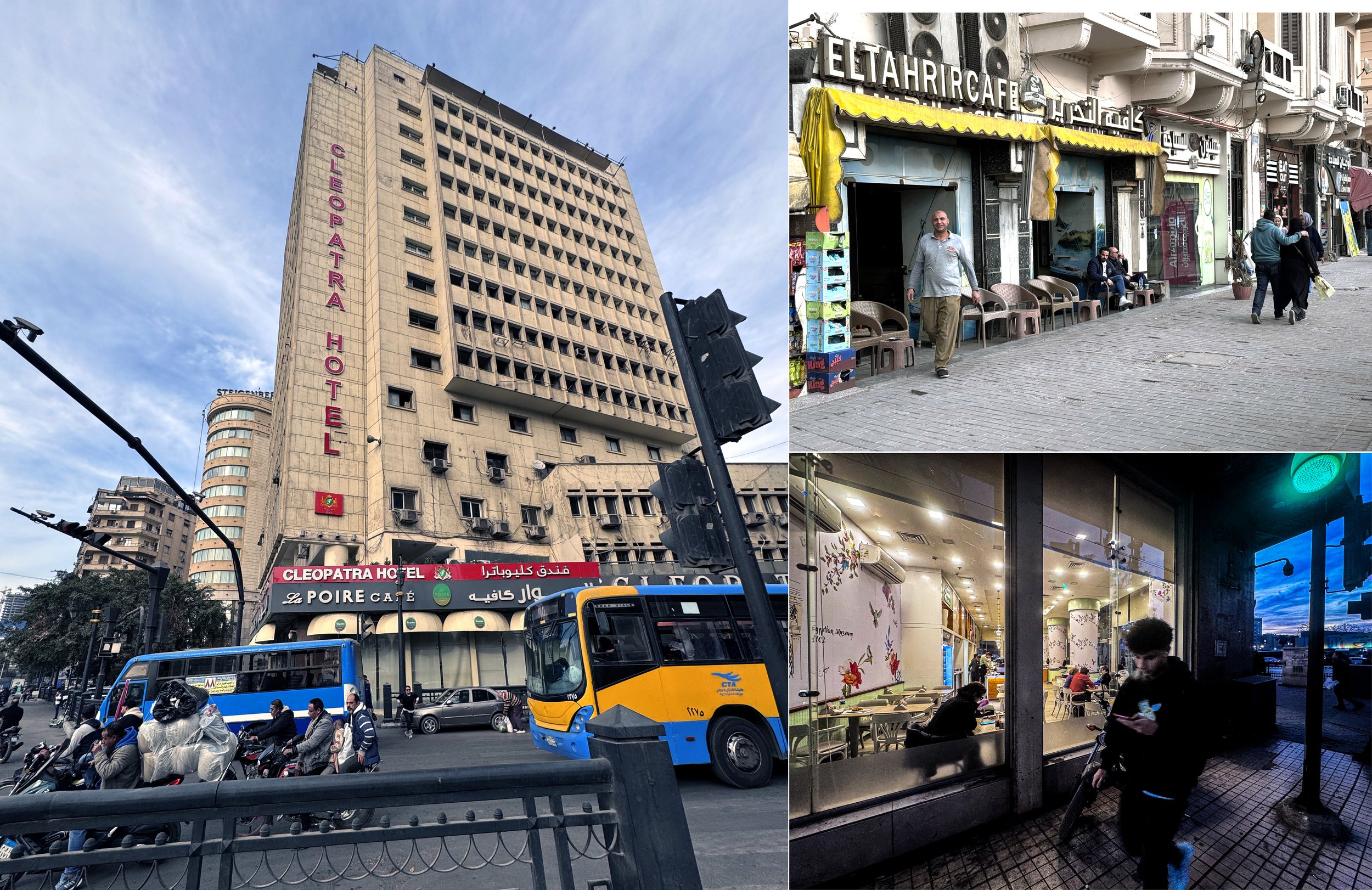
Tahrir Square. 2026. Clockwise L: Old TWA Building with La Poire Café. El Tahrir Cafe. La Poire Café Interior (Elsheshtawy)
Before returning to Maadi, I turned once more toward the Nile Hilton. I refuse to think of it by any other name. Standing there across Tahrir Square, everything around me gradually faded. The traffic receded, the noise disappeared, and for one fleeting moment all I could see were my father and mother walking across that marble lobby in 1962, looking into one another's eyes and dreaming of a future that would indeed be filled with happiness, laughter, journeys, and giving them a family and a home in Maadi.
While writing My Cairo, I increasingly realized that this is the city I have been trying to recover all along. Not simply the Cairo of monuments, revolutions, or architectural masterpieces, but the Cairo of deeply personal stories that quietly unfold within them. Buildings matter because people fill them with meaning. Long after names change, cafés disappear, and hotels become something else, those memories continue to inhabit the city.
Wherever life has taken me since leaving Cairo, the city of my youth has remained my truest home. It lives not only in its streets and buildings, but also in my heart.
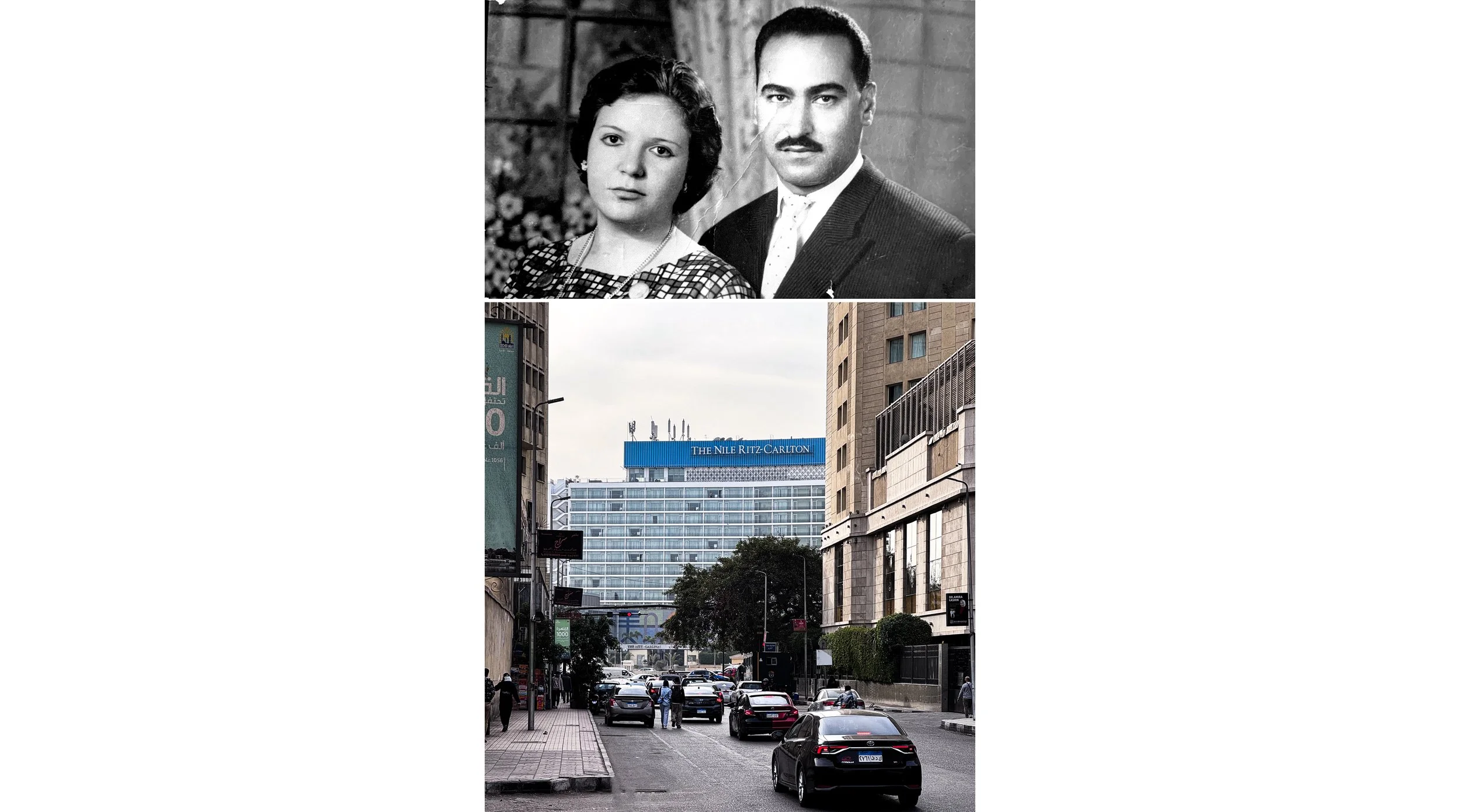
My mother and father. 1962. Nile Hilton from Qasr Al Nil Street. 2026
(The quote at the start of this blog is by Lucette Langlado who recounted her last days in Cairo, in the 1960s before leaving for the US where she became a well-known writer; her recollection of how the Nile Hilton became a refuge in those days resonate strongly with my memories; it is indeed a powerful rumination on how buildings embody memories that can never be erased).
