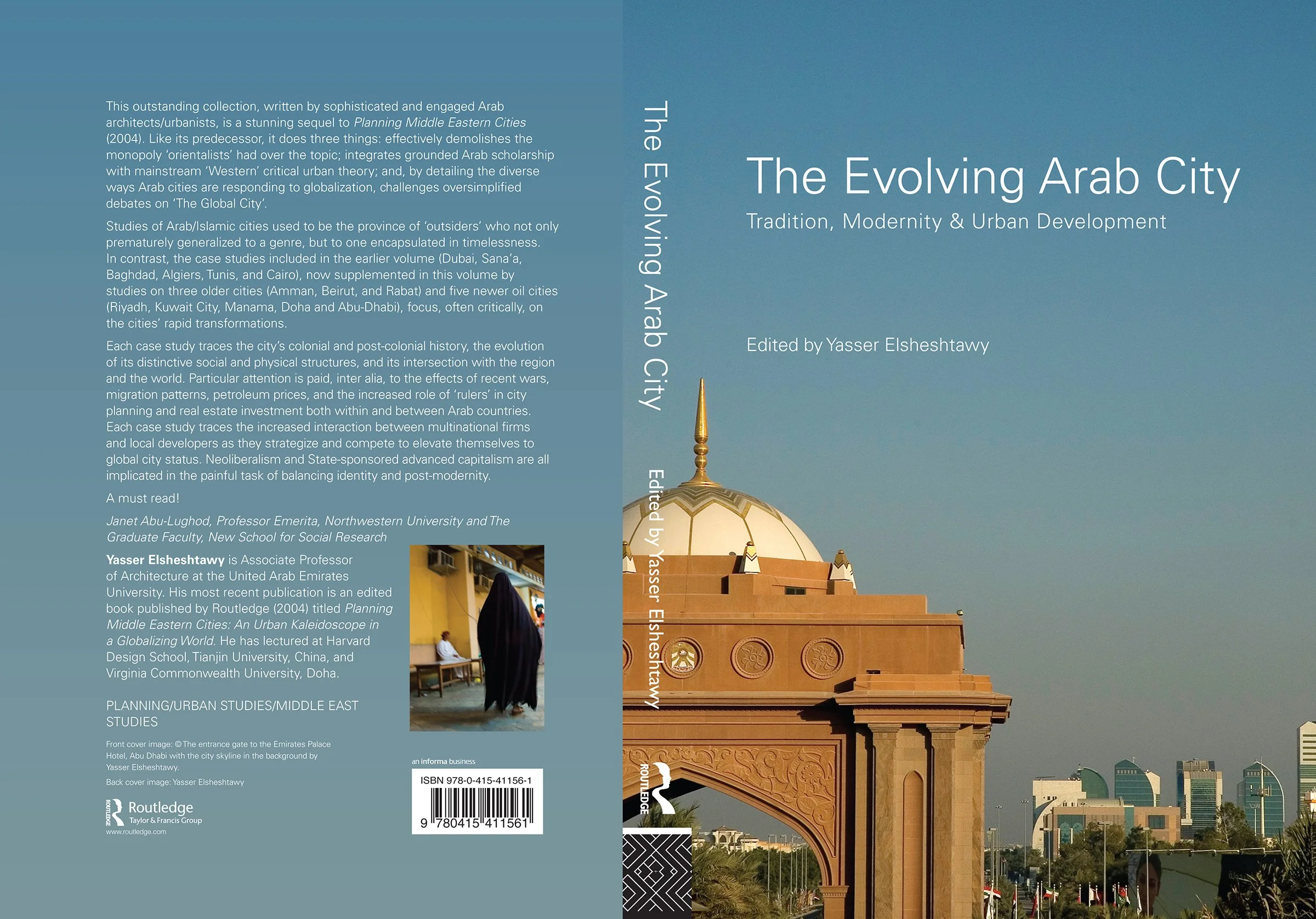
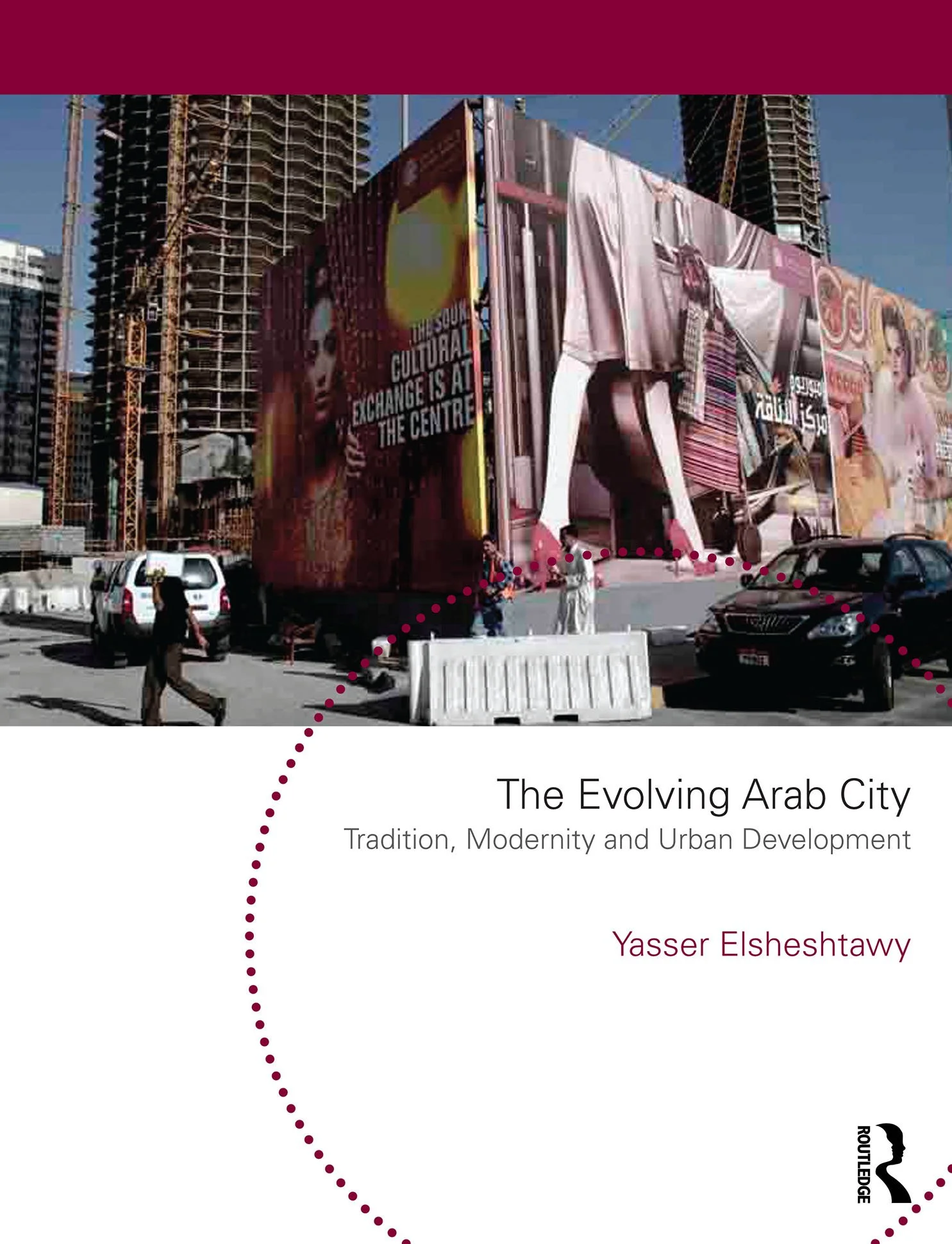
The Evolving Arab City: Tradition, Modernity & Urban Development
“Arab cities are caught between a variety of worlds, ideologies and struggles’, so argues Yasser Elsheshtawy in his introduction to The Evolving Arab City. Moreover cities of the Arab world are too often ignored in discussions of global city theory. Elsheshtawy and his contributors set out to redress this imbalance and to enrich the study of urbanism and of globalizing processes, at the same time providing an accompaniment of sorts to the earlier book, Planning Middle Eastern Cities. In their chapters on Rabat, Amman, Beirut, Manama, Kuwait, Riyadh, Doha, Abu Dhabi, the eight authors, all closely affiliated with their respective cities, reflect on urban development of each city from the nineteenth century to the present day – a time-frame chosen to illustrate the impact of colonialism (or foreign protection) on the cities’ morphology and contrast this with the impacts of globalization. These studies suggest that a great rift is emerging between cities in the oil rich Gulf and the traditional centres and reveal the potential danger of ignoring this. But, Elsheshtawy concludes, not all is gloom: there are signs for the emergence of a ‘new Arab metropolis’ and, more significantly, a growing number of civic institutions which are beginning to question authorities and planners.”

Janet Abu-Lughod, Professor Emerita, Northwestern University and The Graduate Faculty, New School for Social Research
“This outstanding collection, written by sophisticated and engaged Arab architects/urbanists, is a stunning sequel to Planning Middle Eastern Cities (2004) Like its predecessor, it does three things: effectively demolishes the monopoly ‘orientalists’ had over the topic; integrates grounded Arab scholarship with mainstream ‘western’ critical urban theory; and, by detailing the diverse ways Arab cities are responding to globalization, challenges oversimplified debates on ‘The Global City’.
Studies of Arab/Islamic cities used to be the province of ‘outsiders’ who not only prematurely generalized to a genre, but encapsulated it in timelessness. In contrast, the case studies included in the earlier volume (Dubai, Sana’a, Baghdad, Algiers, Tunis, and Cairo), now supplemented in this volume by three older cities (Amman, Beirut, and Rabat) and five newer oil cities (Riyadh, Kuwait City, Manama, Doha and Abu-Dhabi), focus, often critically, on their rapid transformations.
Each case study traces its colonial and post-colonial history, the evolution of its distinctive social and physical structures, and its intersection with the region and the world. It pays particular attention to, inter alia, the effects of recent wars, migration patterns, petroleum prices, noting the increased role of ‘rulers’ in city planning/real estate investment both within and between Arab countries. Each traces the increased interactions between multinational firms and local developers as they strategize and compete to elevate themselves to global city status. Neoliberalism and State-sponsored advanced capitalism are all implicated in the painful task of balancing identity and post-modernity.
A must read!”
“As a whole, The Evolving Arab City is a richly illustrated collection of well-researched essays illuminating development in portions of our world still under-considered in contemporary urban studies and histories. It should be of interest to sociologists, political scientists, architects, and historians studying the ramifications of rapid urbanization and development in newly wealthy and post-colonial contexts.”
Colette Apelian. H- Urban, H-Net Reviews
“The objective of connecting such a range of embedded and conceptual perspectives is an important one, and will hopefully catalyze similar efforts in what is emerging as a deeply trans-disciplinary body of research on cities and contemporary urban change in the region. Urban scholars across the social.”
Michelle Buckley (2009). International Journal of Urban & Regional Research. 33:4, pp. 1087-1088.
“The Evolving Arab City is an excellent addition to the existing literature on Arab cities. It is an engaging read and invaluable for those who seek a deeper understanding of the massive urban transformations occurring in Arab cities in recent decades. As with Elsheshtawy’s previous edited collection, The Evolving Arab City is a substantial and accessible contribution to the scholarship on contemporary Arab cities and provides fascinating critical insight into a dynamic and rapidly-changing region. The book will be an important resource for planners and architects working in the region as well as students and scholars of urban studies, Middle East area studies, and urban geography.”
Sarah Moser (2009). Cities. 26, pp. 377-378.
“Because most of the case studies were written by architects, they are particularity sensitive to questions of architectural design, physical master planning, and other aspects of the regulation and organization of the built environment, which should make the book particularly attractive to people working in these areas. Beyond that, though, the book constitutes an excellent source of information n each of these cities for a wider audience interested in the current urban development of Arab cities.”
Mona Fawaz (2009). Urban Land Magazine-Middle East.
“The insights and interpretations remain stimulating and invite us to imagine in the future exchanges with researchers from the "North" also interested in metropolitan transformations in the Arab world.”
Pierre-Arnaud Barthel (2009). Géocarrefour, Comptes rendus inédits