Riyadh Rediscovered
Memory, Modernity, and My Father’s City

“We travelled to the city of Yamama, which is also called Hajr … a beautiful city, verdant, with rivers and trees; inhabited by Arab tribes, most of whom belong to Bani Hanifa.”
— Ibn Battuta, 1331
“Before us stretched a wild open valley... lay the capital, large and square, crowned by high towers and strong walls...”
— William G. Palgrave, 1863
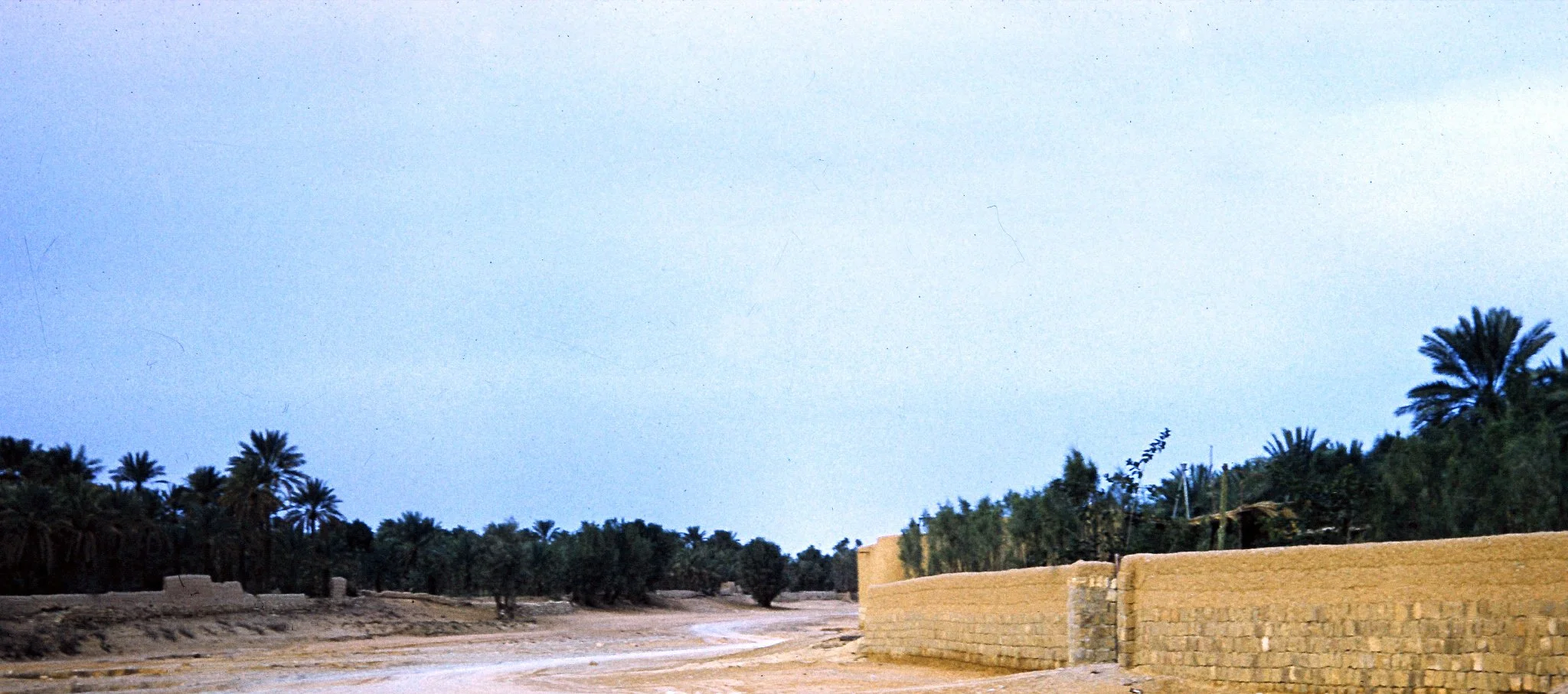
Wadi Hanifa (Keith Wheeler)
Riyadh is unlike any other city in the Gulf. ّt is inseparable from my childhood, from my father’s career, and from some of my earliest memories of the Arabian Peninsula. He arrived there in 1974 to teach architecture at what was then Riyadh University; later that year my mother, my brother, and I joined him from Cairo. Since then, Riyadh has accompanied me in unexpected ways, disappearing for decades before returning to occupy an increasingly central place in both my research and my understanding of the Gulf.
As I reflected on my Riyadh chapter in Arab Modernism(s): Cities, History and Culture, I found myself thinking about the continuity suggested by the two quotations that open this essay. Ibn Battuta encountered a flourishing oasis city defined by water, trees, and the people of Bani Hanifa. More than five centuries later, William Palgrave described a fortified desert capital rising above a broad valley. Their cities appear entirely different, yet both capture Riyadh at moments of profound transformation, much like my own encounters with the city. Rather than recount them chronologically, I assembled a short video to accompany this blog. Structured around three moments—Arrival, Return, and Rediscovery—it combines family photographs, archival images, and scenes from recent fieldwork to tell a story that is at once personal and unmistakably urban.
I Arrival
The video opens with an aerial view as my plane descends over Riyadh, a seemingly endless city surrounded by the vastness of the Najdi landscape. The scene then shifts to Wadi Hanifah, the valley that has shaped Riyadh for centuries. Set to traditional Najdi music, the Arrival sequence begins in 1974 with photographs that today seem almost unbelievable: the old Riyadh airport, a modest one-storey terminal comprised of small rooms, standing where King Salman Park now stretches across the city; Wazir Street, then among Riyadh’s most fashionable thoroughfares, lined with boutiques, restaurants, and bookshops, where I remember walking with my father and watching Yemeni street vendors spread their goods across the pavement, only to vanish the moment police appeared. Another image shows my mother, my brother, and me beside my father’s Volkswagen Beetle near the city’s iconic water tower, then almost at the edge of town. Looking at those photographs today, it is astonishing how compact Riyadh once was. Other photographs record desert excursions with Jordanian colleagues from the university, and the view from the terrace of my father’s apartment in Al-Badi’ah, overlooking King Saud’s former palace. The apartment was simple, yet to my childhood eyes it seemed spacious, filled with marble floors, sunlight, and possibility — a Riyadh that existed long before the city acquired its present global profile.
II Return
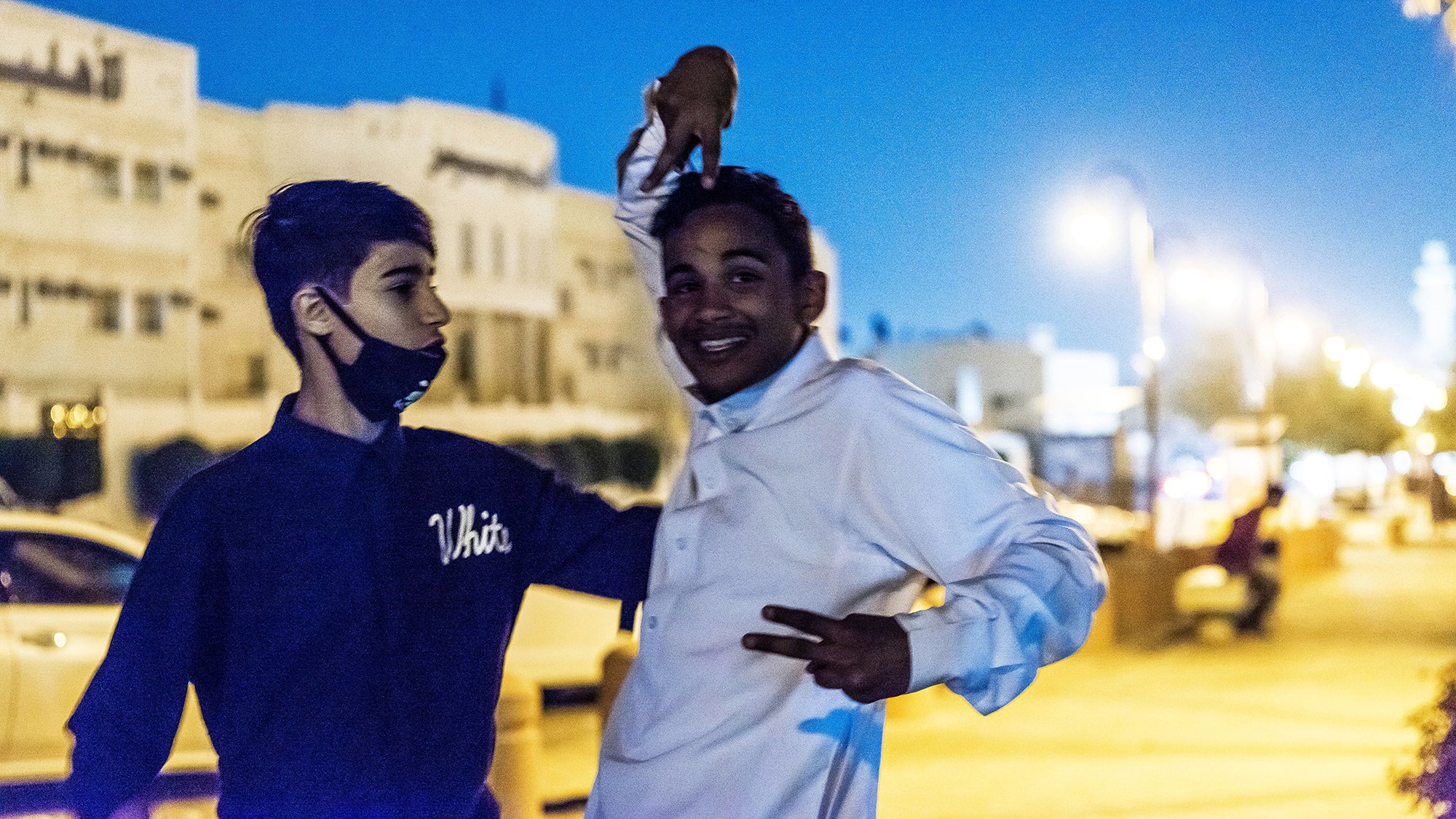
Kids. East Riyadh. 2018 (Elsheshtawy)
The video’s second section, Return, begins in 2018. More than forty years had passed since my first visit, and as the plane descended toward King Khalid International Airport I found myself asking the questions that accompany every long-delayed return: What had changed? Would I recognize the city? Had Riyadh become just another Gulf metropolis, or had it followed its own path? The visit came at the invitation of my father’s former students, among them Prince Abdulaziz bin Ayyaf, the former mayor of Riyadh; the Provost of Prince Sultan University; and Zahir Sultan, formerly head of the university’s Center for Local Governance. Over the next few days they introduced me to a city at once unfamiliar and strangely comforting — conversations that, looking back, marked the beginning of another journey, one that eventually led me to write an entire book about Riyadh.
The video follows that rediscovery through glimpses rather than monuments. Entering along Olaya Street, the futuristic silhouette of Al Faisaliah Tower rises in the distance, announcing a new Riyadh while still acknowledging the one I remembered. Yet my attention was repeatedly drawn elsewhere: a brightly lit food cart glowing in an ordinary neighbourhood; Pakistani migrants playing cricket beside Al Futah Park, one of Riyadh’s oldest public spaces; in the Hiraj, the city’s celebrated used-items market, the rhythmic voice of the muharej — the auctioneer — filling the air as crowds gathered around second-hand goods with histories as varied as their owners. Inside Al Khozama Hotel, whose elegant lobby no longer exists after its demolition a few years later, another chapter of Riyadh’s modern history quietly lingered. Two young boys in eastern Riyadh stopped me to ask if I would photograph them, posing with the uninhibited confidence of childhood. At a small farmers’ market in the north of the city, a vendor danced beside his produce while porters threaded through graffiti-covered columns carrying vegetables and fruit for customers.
These scenes revealed a Riyadh far removed from the one usually portrayed in glossy brochures — a city whose greatest strength lay not in spectacular architecture but in its ordinary public life. Nowhere was this more apparent than along Tahlia Street, Riyadh’s answer to the Champs-Élysées. Once dominated by cars, it had become a lively pedestrian boulevard where families gathered, cafés spilled onto generous sidewalks, and women occupied public space with a confidence unimaginable during my first visit in the 1970s. The video then moves south to Okaz Environmental Park, itself a story of urban reinvention: what had once been a garbage dump had become a green landscape where families spent their evenings, its edges lined with informal vendors selling snacks, drinks, toys, and household goods.
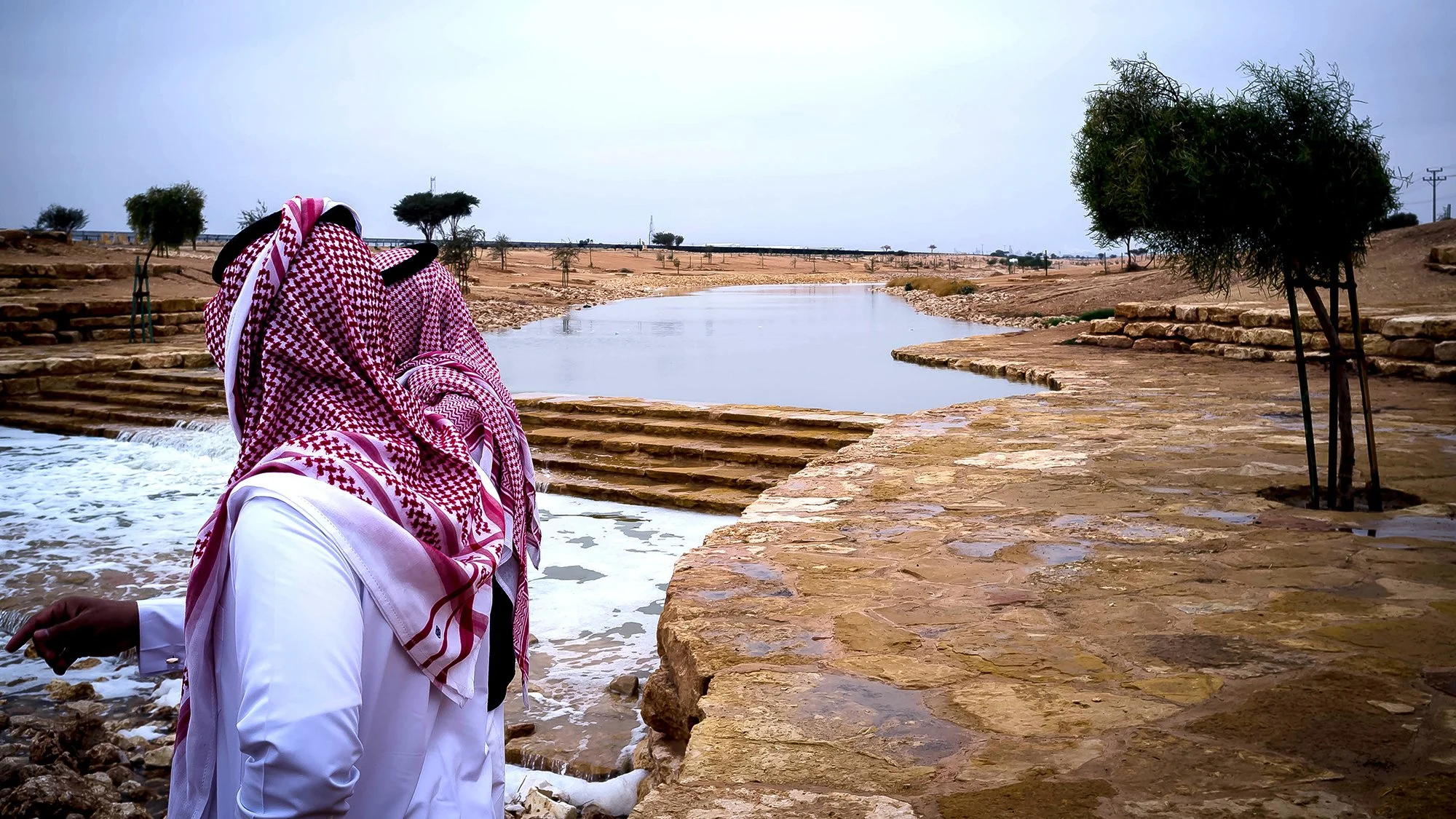
Wadi Sulay. 2018 (Elsheshtawy)
The final images in this section capture what may become one of Riyadh’s defining landscapes. On my last day, we drove to the southern edge of the city to the beginning of the Wadi Sulay project, an environmental corridor that will eventually extend north toward the airport. Heavy rain had fallen that morning, and for a brief moment the wadi filled with water — a glimpse of the landscape that shaped this region before urban expansion obscured it. Watching the water flow through the ancient riverbed, I thought again of Ibn Battuta’s description of Yamama as a place of rivers and cultivated land. Perhaps Riyadh was not inventing an entirely new future after all, but rediscovering one of the oldest landscapes it had always possessed.
III Rediscovery
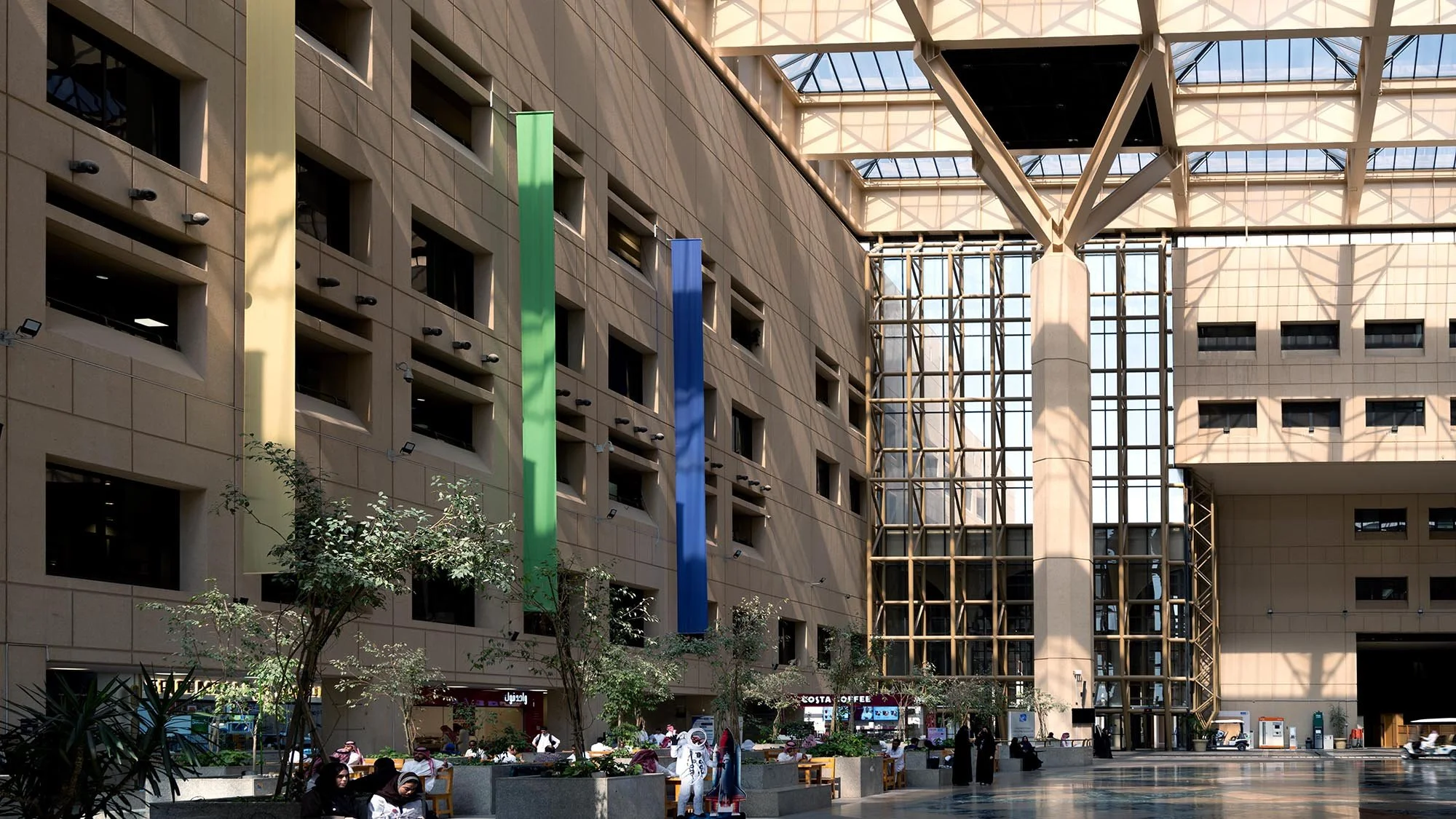
King Saud University. 2024 (Elsheshtawy)
The video’s third and final section, Rediscovery, reflects what was, in many respects, the most meaningful of my three encounters with Riyadh. By the time I returned in 2024, I was no longer simply revisiting a childhood city or documenting an urban transformation. Without quite intending it, I found myself retracing my father’s footsteps, revisiting the places where he had lived, worked, and built his life during his final years in the city.
The section opens in Batha, a district that reveals a side of Riyadh rarely featured in promotional images: crowded streets, vegetable and meat markets, musical instrument shops, and covered passageways animated by one of the most diverse migrant communities in the Kingdom — energetic, chaotic, and deeply human. Scenes include the Fahd bin Mohammed residential building, one of the city’s overlooked modernist landmarks, located near Thumairi Street, and the InterContinental Hotel, where I remember coming with my father as a child to watch films in one of its meeting rooms converted to a cinema, because they were banned throughout the Kingdom. I also recall its soaring atrium. The hotel still stands, though its once commanding presence is now overshadowed by the buildings around it.
From there the journey follows my father’s professional life across the city. The twin towers, designed by Kenzo Tange, of the King Faisal Foundation appear on the skyline, recalling the period he worked there after leaving Riyadh University. Furthermore, for the first time, I visited the King Saud University campus designed by HOK, a place I had known only through his stories; he often joked that male students gathered in its central atrium to watch female medical students crossing toward the laboratories. I also visited the original university in Malaz, where he had taught in the 1970s; modest compared with its successor, I could still picture him walking its corridors, stopping to speak with students between lectures.
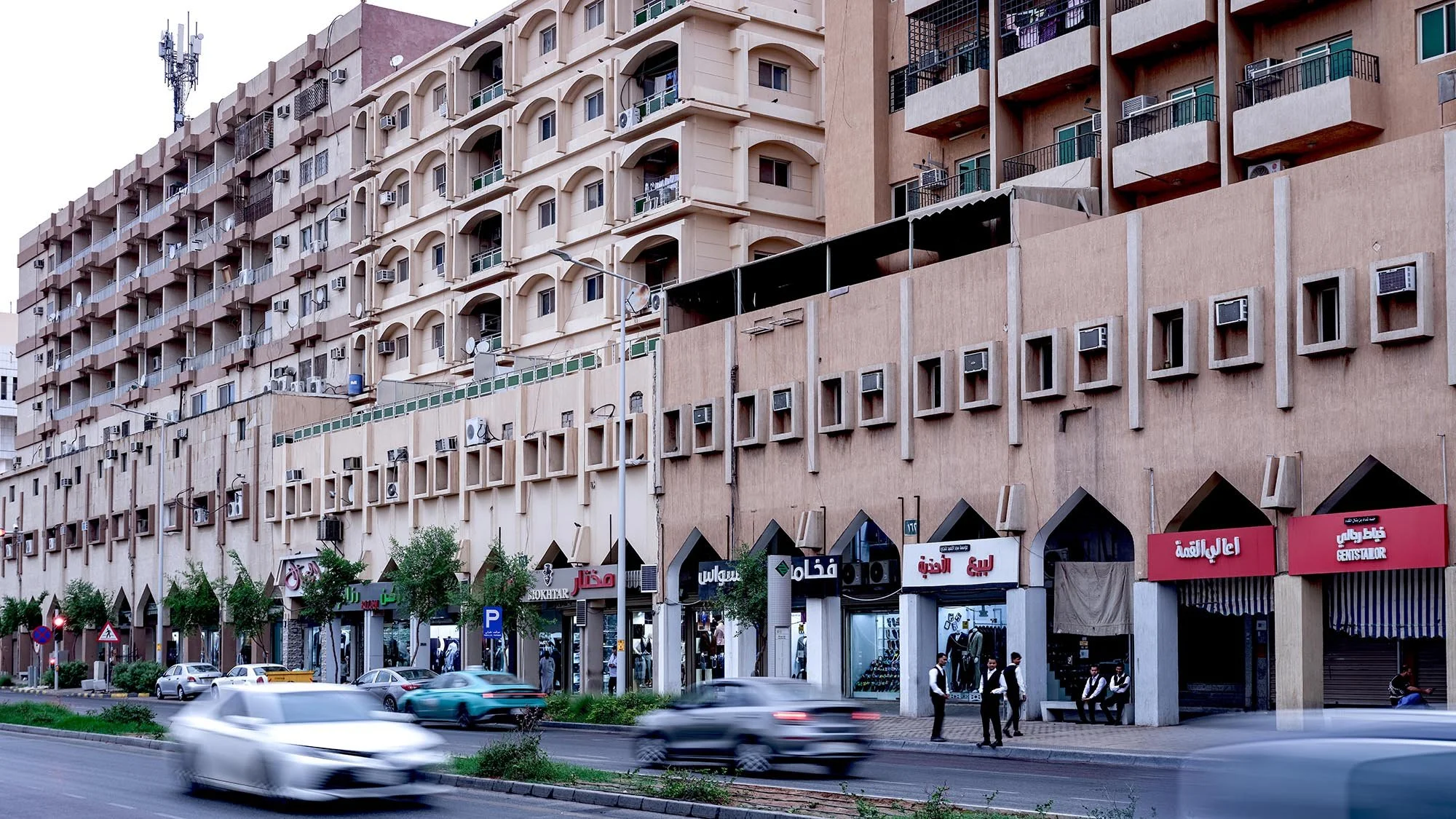
Rosay’yis Building. 2024 (Elsheshtawy)
The journey grew more personal as I searched for the buildings where he had once lived. After his first apartment in Al-Badi’ah, he moved to the Rosayyis Building on Wazir Street, then one of Riyadh’s most prestigious addresses. I had never visited him there as a child, yet seeing the building today — remarkably intact, still retaining its modernist character — let me imagine that chapter of his life. Later he lived in the Queens Building, a residential complex connected to a hotel. Standing there, I finally understood why he had chosen that neighbourhood: close to Al Futah Park, surrounded by lively streets and migrant communities whose vitality still distinguishes central Riyadh from its newer suburbs.
IV Coda
I want to close this blog not with a building but with an encounter. During fieldwork, my co-researcher and I interviewed several Saudi architects, among them Ali Al-Shuaibi, co-founder of Beeah. As our conversation ended, he paused and asked, “Are you the son of Hassan Elsheshtawy?” When I said yes, his expression softened. “We worked together at King Saud University in the 1970s,” he said. “He was such a kind and generous man.” Before we left, he handed me a monograph on his work, signed with a dedication to my late father. We shook hands, stepped into the bright Riyadh afternoon, and I walked away carrying the book, moved by an encounter I had never anticipated.
Looking back, I realize that this unexpected moment is the true conclusion — not only to the video, but to the story I have been trying to tell in my Riyadh chapter. Cities endure because of the people who inhabit them and the memories they leave behind. My father often reminded me that architecture is never simply about buildings; it is a setting for life, a framework within which ordinary stories unfold. Perhaps that is what I have been searching for across these three journeys — not the Riyadh of monumental projects or spectacular skylines, but the quieter city that exists within memory, friendship, generosity, and everyday encounters. It is that Riyadh, above all, that continues to accompany me, and that I hope this short video, together with my chapter in Arab Modernism(s): Cities, History and Culture, succeeds in capturing.
(For further writing on Riyadh please see my book — Riyadh: Transforming a Desert City)
