Mosques Without Minarets
Hidden Faith and the Architecture of Belonging

"The earth has been made for me a place of prayer and a means of purification; so, whenever the time for prayer overtakes any man from my Ummah, let him pray."
-- Saying attributed to the Prophet Mohammed
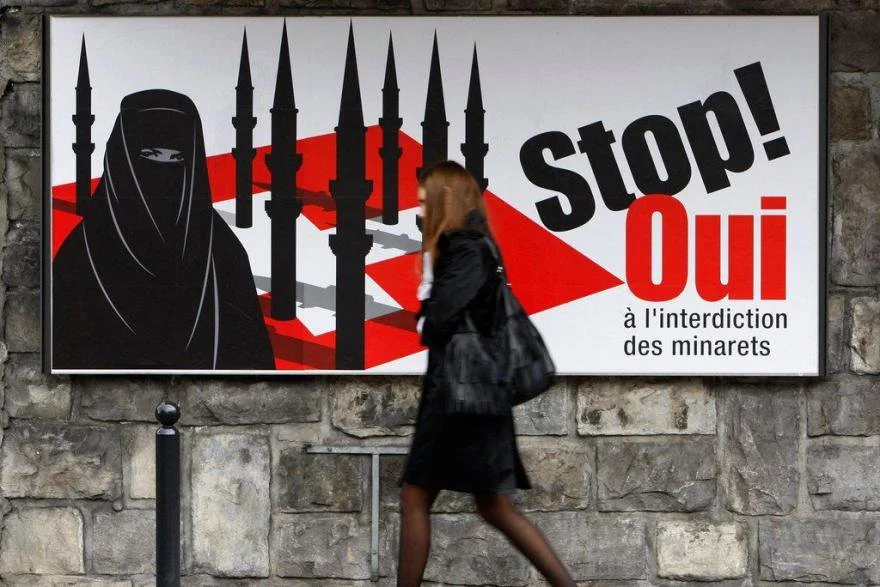
A controversial poster from the Swiss People's Party's successful anti-minaret campaign in 2009 (Keystone)
I recently found myself in Liège, serving as an external examiner for a doctoral dissertation on the spatial distribution of mosques in Belgium authored by Mohamed El Boujjoufi. It was an excellent thesis, meticulously researched and thoughtfully argued. Yet what stayed with me after the defense was not a statistical finding or methodological insight, but a question that permeated the discussion: visibility. The issue is hardly trivial. Across Europe, the visibility of Muslim communities has become increasingly contentious. The rise of anti-immigrant sentiment, the electoral success of right-wing parties, and growing anxieties about identity and belonging have all transformed seemingly mundane architectural questions into political battlegrounds. Should mosques have minarets? Should they be visible landmarks? Should they blend into their surroundings?
Yet as I listened to the discussion, I found myself asking a different question altogether. Why do some Muslim leaders insist on reproducing architectural symbols such as domes and minarets as markers of religious presence? Why must visibility be expressed through forms that are often presented as timeless and essential to Islam, when in fact they are neither? The question is particularly relevant today because the old language of majority and minority increasingly feels inadequate. We live in a world of overlapping identities and multiple belongings. In many cities, everyone is a minority in one way or another. Furthermore, as Stefano Allievi, a member of the examination committee, argued that conflict is a necessary condition for a healthy functioning society.
More importantly, there is no liturgical requirement in Islam for a mosque to have a dome or a minaret. A mosque can be almost anywhere. It can occupy a room, a courtyard, a warehouse, a storefront, or a corner of a house. The notion that there exists a singular and recognizable "Islamic architecture" is largely a myth. Historically, mosque architecture evolved through adaptation. Early Muslims appropriated and transformed existing architectural traditions. The celebrated Umayyad Mosque in Damascus emerged from the site of a Roman temple and later a Christian Basilica. The conversion of Hagia Sophia in Istanbul is another well-known example of architectural continuity and reinterpretation. What we often regard as immutable so called “Islamic forms” are, in reality, products of cultural exchange and historical circumstance.
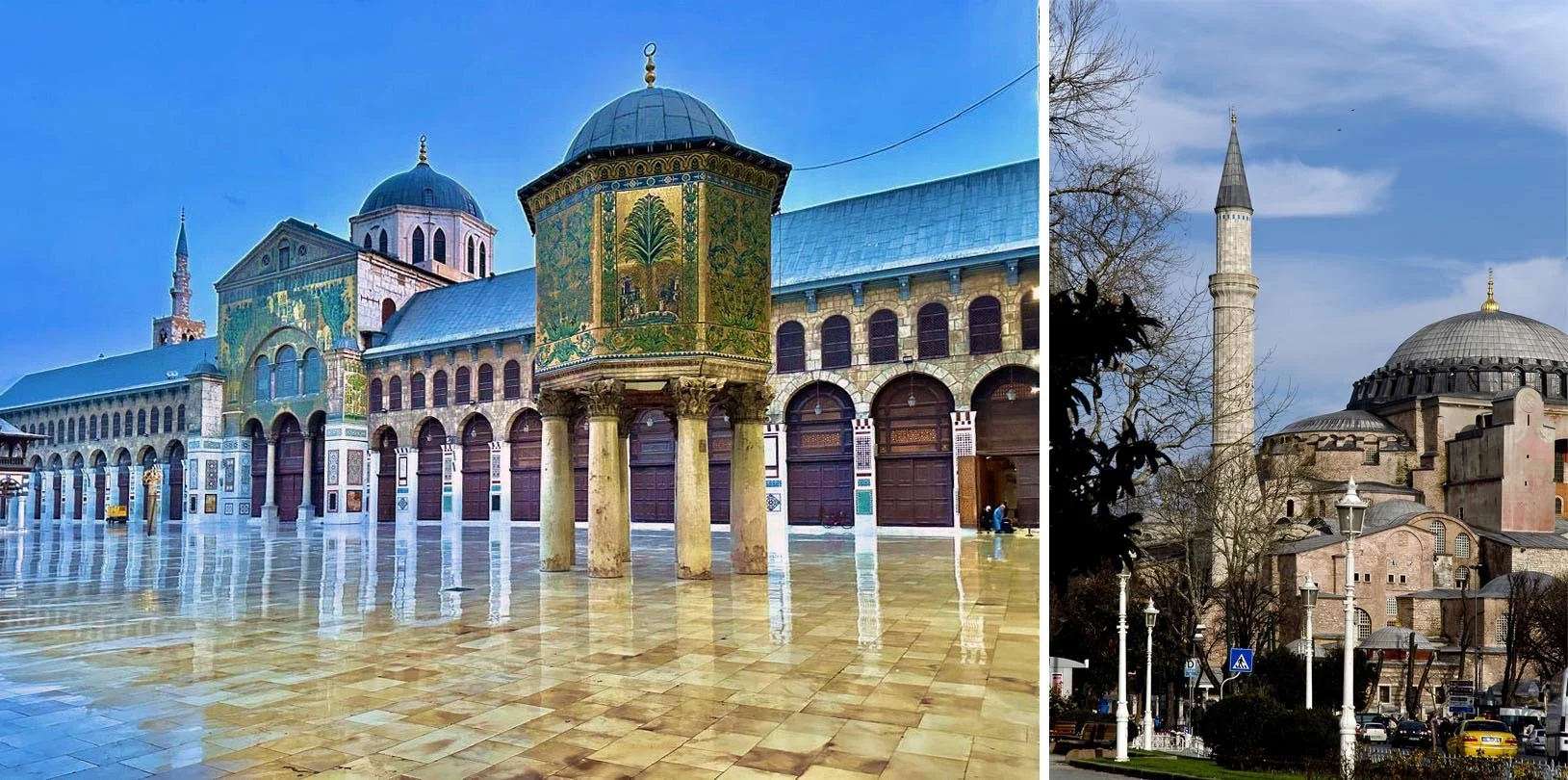
Umayyad Mosque (Wikipedia) & Hagia Sophia (Elsheshtawy)
I was reminded of this many years ago during a visit to Beijing. The Niujie Mosque, also known as the Oxen Street House of Worship, or the Oxen Street Mosque, is the oldest mosque in Beijing, China, built in 1442, which looks remarkably like a traditional Chinese temple. Its roofline curved elegantly upward. Decorative elements included dragons. There was no grand minaret announcing its presence. Only upon closer inspection did subtle clues emerge: Arabic calligraphy rendered in forms that almost resembled Chinese characters and a discreet minaret hidden within the complex. The message was unmistakable. The Muslims who built this mosque were not seeking to assert difference. They were expressing belonging. Their architecture was not confrontational but conversational. It acknowledged its surroundings while preserving its faith. A gesture of connection and co-existence.
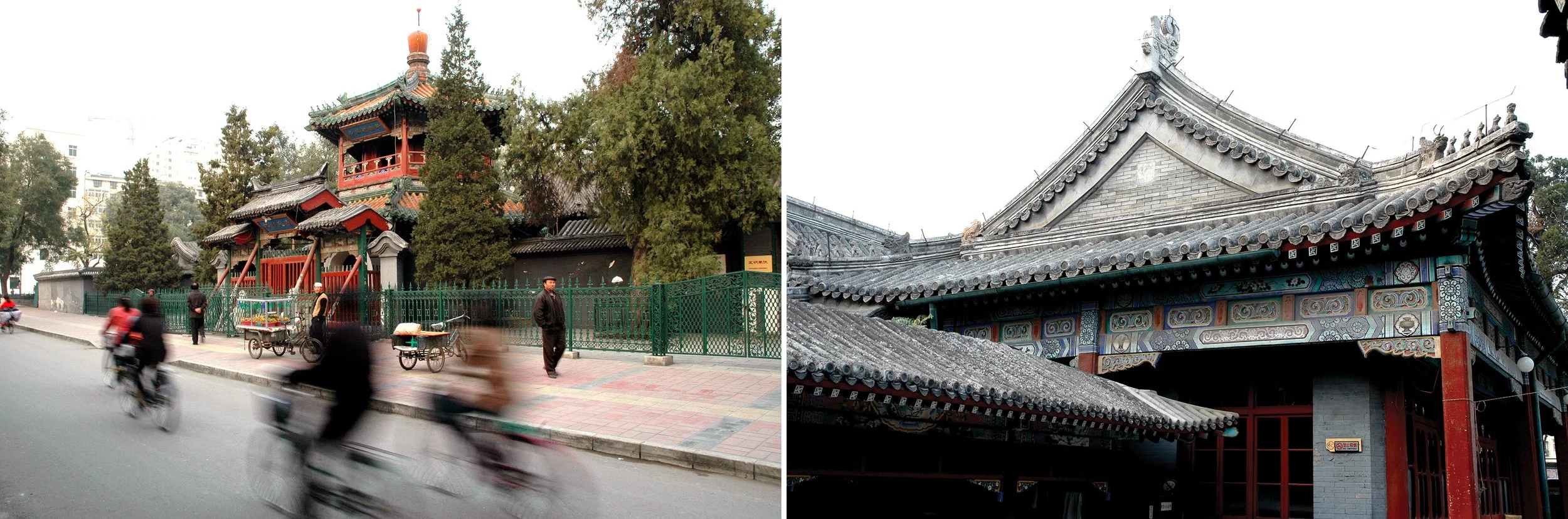
Niujie Mosque (1442). Beijing (Elsheshtawy)
That memory returned to me in Liège.
But before returning to Belgium, another image comes to mind.
Several years ago, I encountered a remarkable book by photographer Nicolo Degiorgis entitled “Hidden Islam.” It remains one of the most powerful explorations of Muslim life in Europe that I have seen. The book's design is ingenious. Each page initially presents a stark black-and-white image of an ordinary building exterior. A warehouse. A garage. A storefront. An apartment block. Nothing appears remarkable. Yet the pages unfold to reveal vibrant color photographs of the interiors. Suddenly the mundane exterior gives way to a rich spiritual world filled with worshippers, prayer rugs, calligraphy, and community life. The visual effect is profound. What appears invisible from the outside contains an entire universe within. The book documents the reality of contemporary Italy, where millions of Muslims have access to only a handful of officially recognized mosques. As a result, worship often takes place in improvised spaces: former factories, warehouses, garages, and shops. Another equally impressive book was about mosques in New York City titled “New York Masjid.” The book features photographs, essays, and interviews documenting the mosques that New York’s Muslim communities have built at their center, revealing the ways these buildings reflect and create identities for Muslims within a dense and diverse urban fabric.
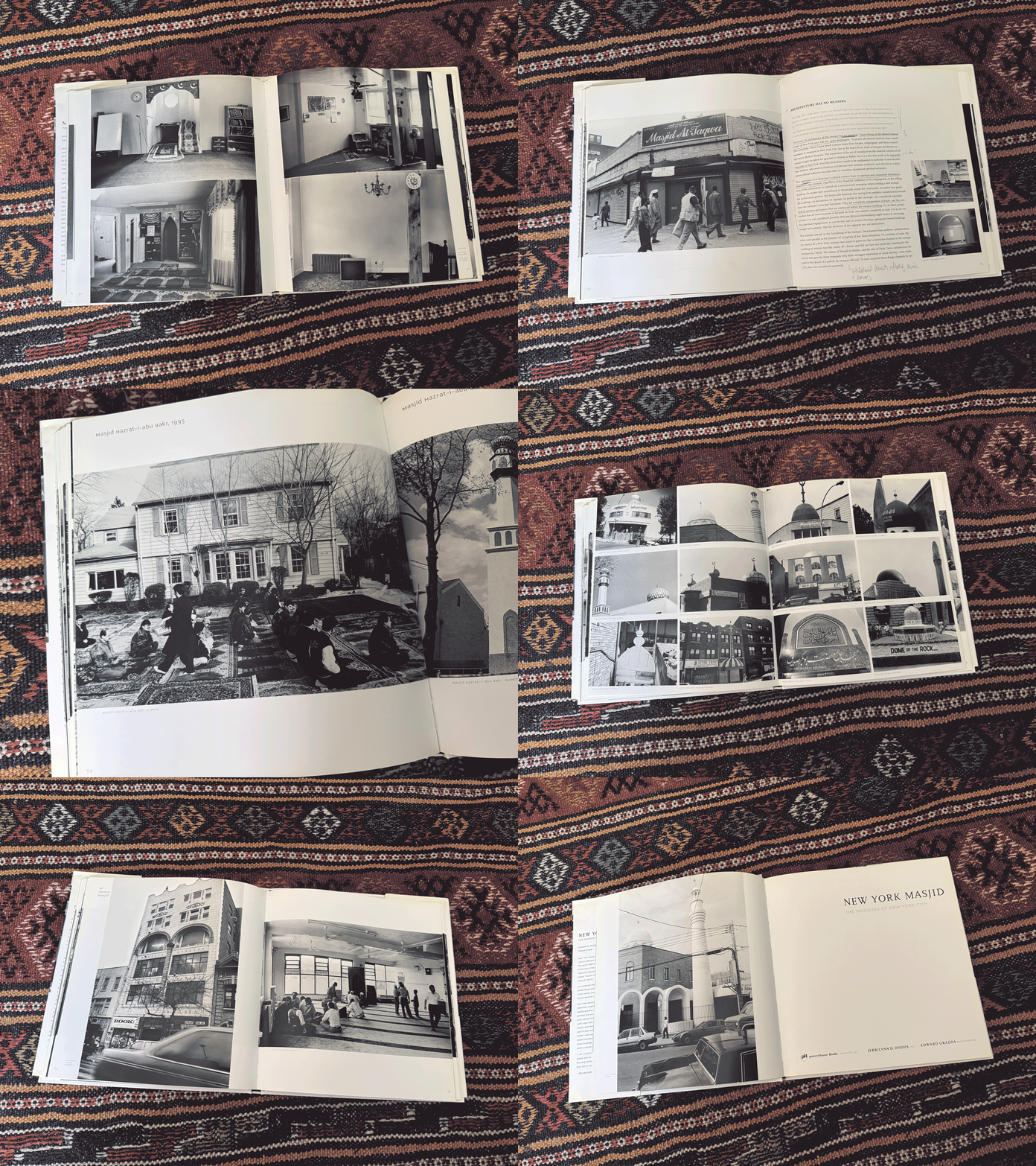
The photographs reveal an important truth. There are hidden cities, but there are also hidden mosques. Invisible spaces often emerge not because communities wish to hide, but because circumstances leave them little choice. The implications are significant. When legitimate and accessible spaces of worship are unavailable, religious life retreats underground. Prayer rooms appear in basements, storage spaces, and improvised facilities hidden from public view. History shows that such invisibility can sometimes produce unintended consequences. One thinks of the so-called Hamburg Cell, whose members played a central role in planning the September 11 attacks in NYC. Their activities developed largely outside public visibility and scrutiny.
This does not mean that informal mosques are inherently problematic. Far from it. Indeed, some of the most authentic and moving places of worship I have encountered were entirely informal. In Cairo I have seen worshippers transform residual urban spaces beneath overpasses into functioning mosques. In Abu Dhabi prayer spaces emerge spontaneously between buildings or along sidewalks, created by communities responding to immediate needs. On Riyadh’s Tahlia Street, one of the city's most fashionable commercial corridors, a simple box containing prayer mats sits unobtrusively on a street corner. When the call to prayer is heard, the mats are laid out on the pavement and an impromptu mosque appears, only to disappear again minutes later. Such places possess a remarkable quality. They are built by people, for people, without architects, committees, or grand ambitions. They remind us that a mosque is ultimately an act rather than an object, a gathering rather than a building.
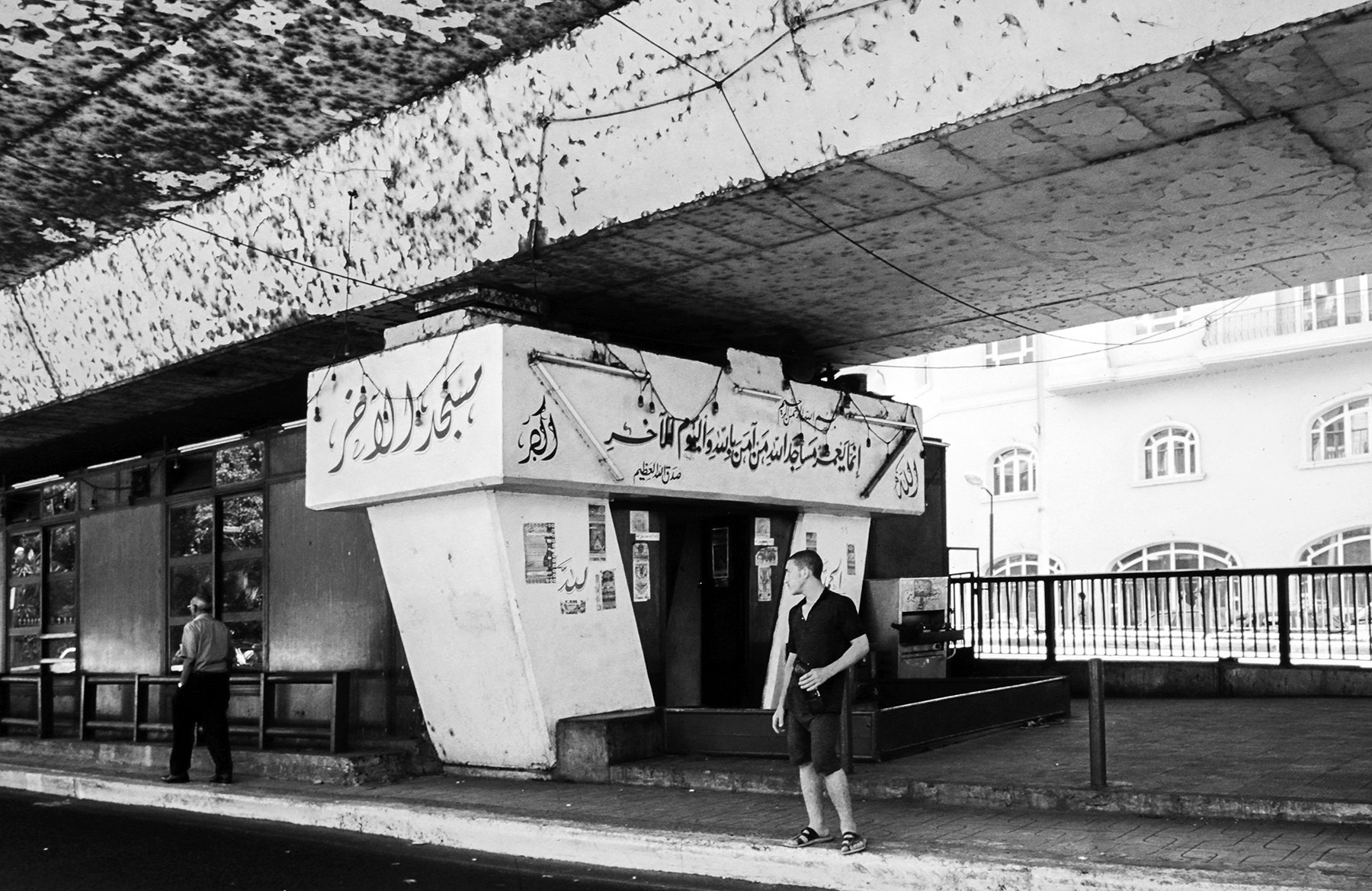
Mosque under the 6th of October Bridge. Zamalek. July 26th Street. 1994 (Elsheshtawy)
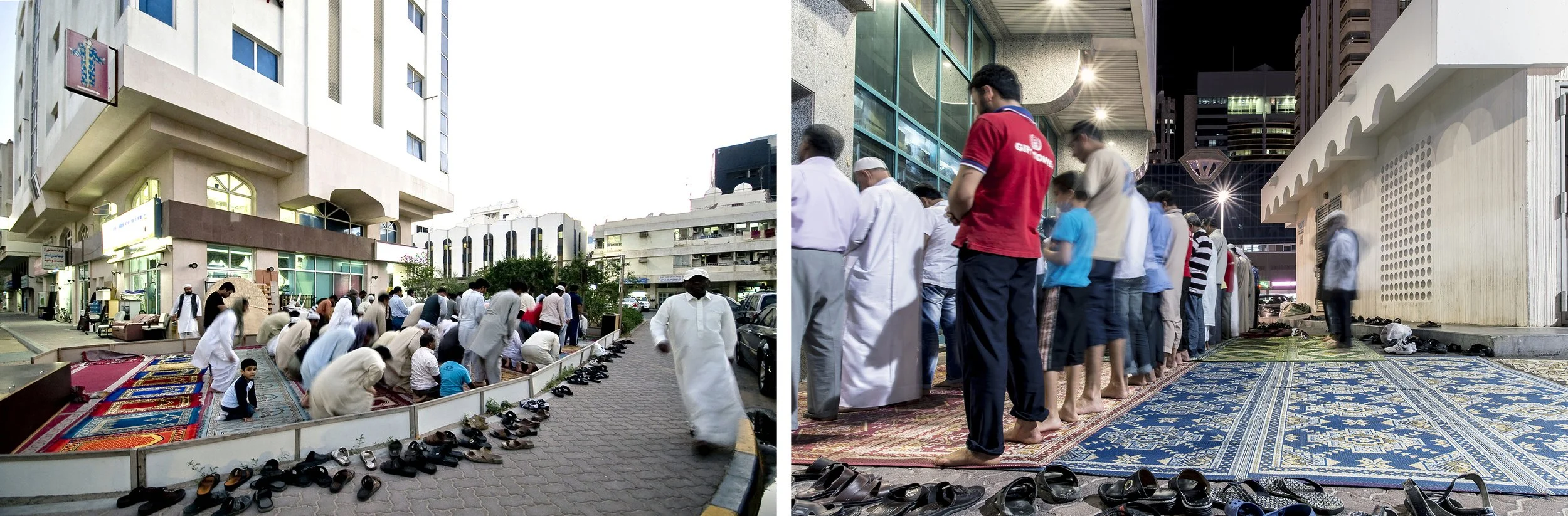
Informal Mosques in Abu Dhabi (Elsheshtawy)
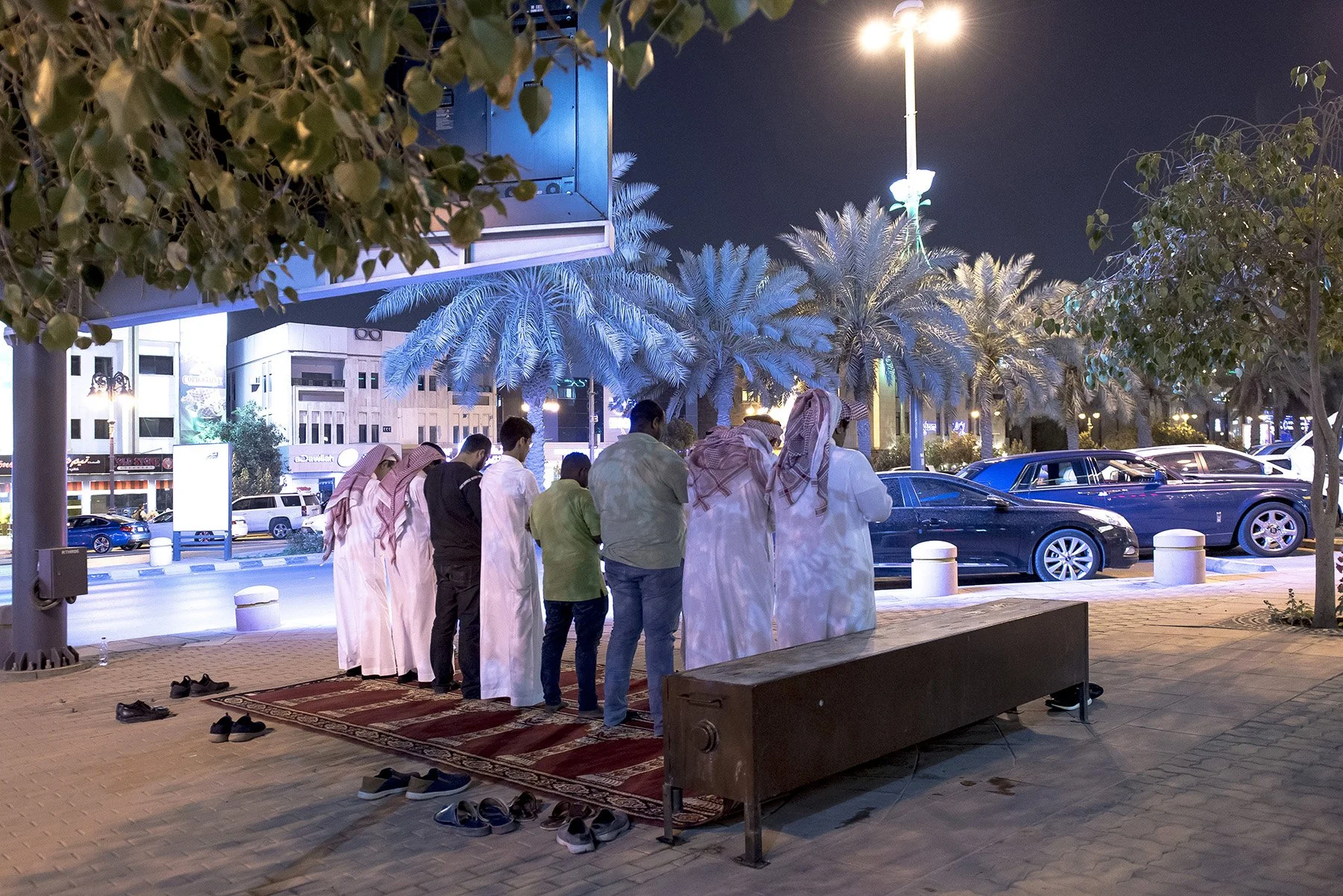
Informal Mosque. Tahlia Street. Riyadh (Elsheshtawy)
Yet the tension remains. How does one create visible spaces of worship without transforming architecture into a symbolic battlefield? The question becomes even more intriguing once we recognize that there is no single model for mosque design. Some of the most compelling contemporary mosques deliberately challenge conventional expectations. The Namaz-Khaneh (prayer room) in Tehran’s Farah park is little more than a minimalist cubic volume. The Grand National Assembly Mosque in Ankara employs glass in its mihrab, opening the prayer space to expansive views beyond. In Dubai, the Al-Madiya Mosque reinterprets the traditional Emirati kandura, transforming clothing into architecture. Meanwhile, Riyadh's KAFD Mosque explores innovative structural forms that bear little resemblance to historical prototypes. These projects remind us that architecture is interpretation rather than replication.
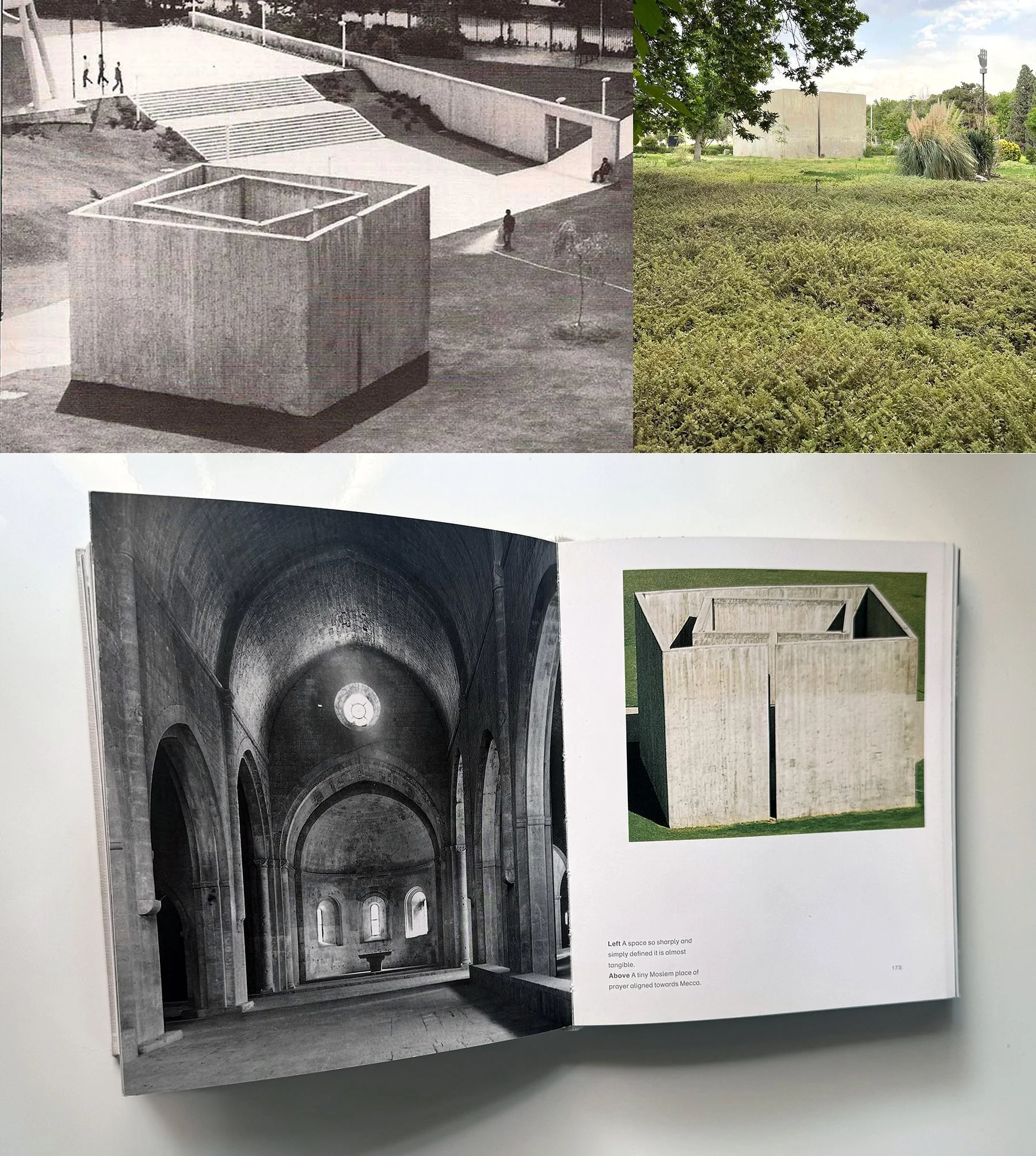
Namaz-Khaneh (prayer room) (kamrandiba.com)
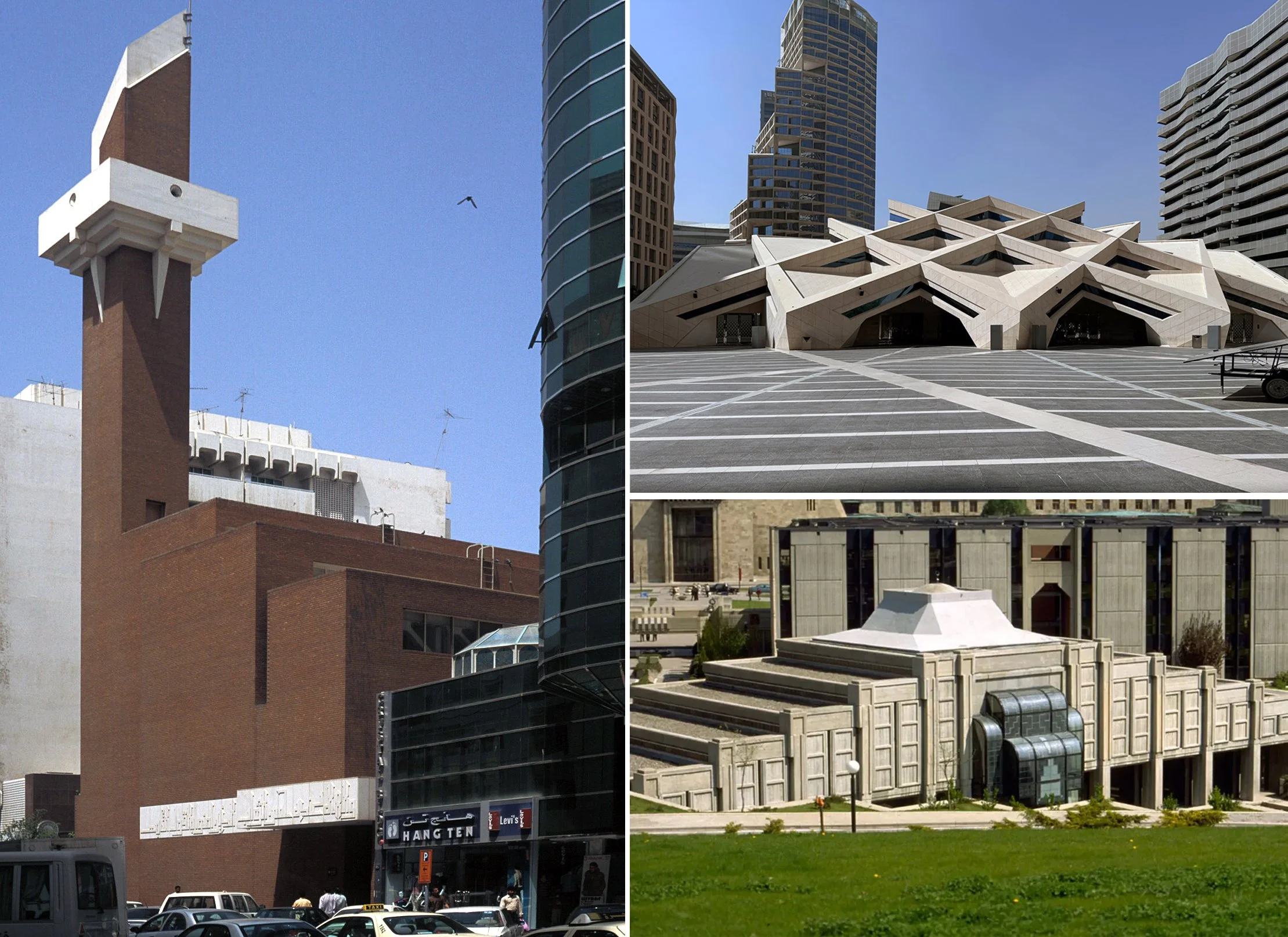
L-R (clockwise): Madiya Mosque. Dubai; KAFD Mosque. Riyadh (Elsheshtawy); Grand National Assembly Mosque. Ankara (Archnet)
Which brings me back to Liège.
After the successful dissertation defense, I spent the afternoon walking through the city with Mohamed and his supervisor, Jacques Teller. Liège is not usually associated with grand European tourism. It lacks the international visibility of its nearby neighbor Brussels, Paris, Amsterdam, or Barcelona. Yet it possesses a quiet charm. We climbed steep stairways tracing the route of ancient city walls. We encountered churches and cathedrals displaying layers of architectural history accumulated over centuries. We wandered through narrow streets lined with handsome buildings that spoke of prosperity, decline, and reinvention. At one point we arrived at a large public square where a magnificent cathedral once stood. Today the structure is gone. Only symbolic markers embedded within the urban landscape indicate its former presence.
Nearby stands the imposing Palace of Justice.
The site carries painful memories. Years ago, a Moroccan immigrant launched an attack from an elevated terrace that left multiple victims dead and wounded. Like many European cities, Liège bears scars of violence, migration, misunderstanding, and social tension. Yet perhaps the most revealing moment occurred not in a cathedral or public square, but in a side street. There, almost hidden in plain sight, stood a completely ordinary building. Nothing distinguished it from its neighbors except Arabic writing on its glass windows. Behind that modest facade was a fully functioning mosque.
No minaret. No dome. No dramatic architectural statement. And yet it operated openly, legally, and with the full approval of the city. A hidden mosque, perhaps. But also a successful example of coexistence.
Later we enjoyed a delicious meal in a small vegetarian restaurant before making our way back. The next day I was seated on a train departing from Liège-Guillemins, Santiago Calatrava's spectacular transportation hub. As the train accelerated toward Brussels Airport where I continued my journey towards Berlin, I watched the city recede into the distance. Liège appeared calm and unassuming. A city often overlooked by visitors. A place absent from most tourist itineraries. Yet beneath its surface lay countless stories: migration, memory, faith, conflict, adaptation, and belonging.
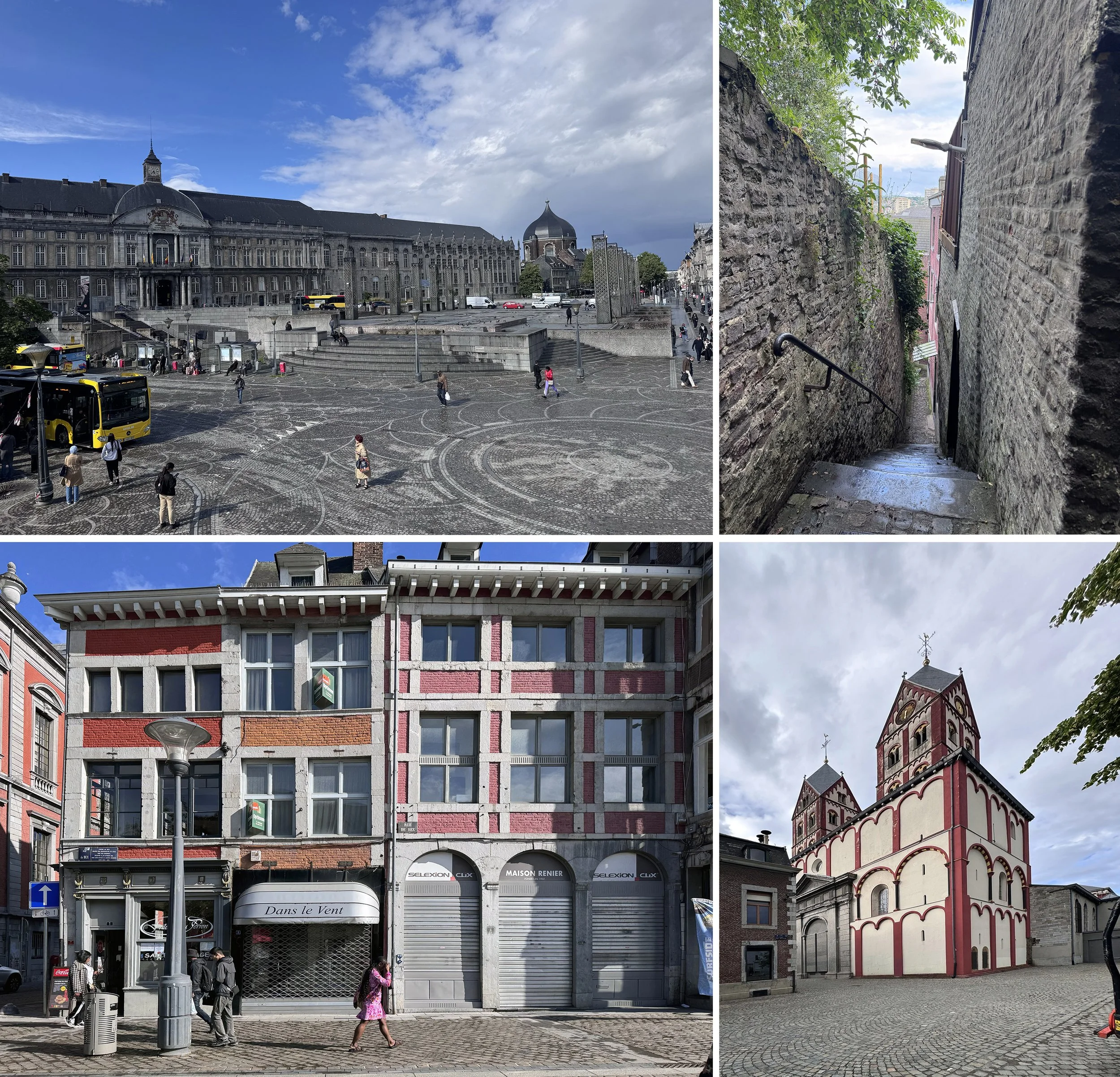
Liège Old City Center
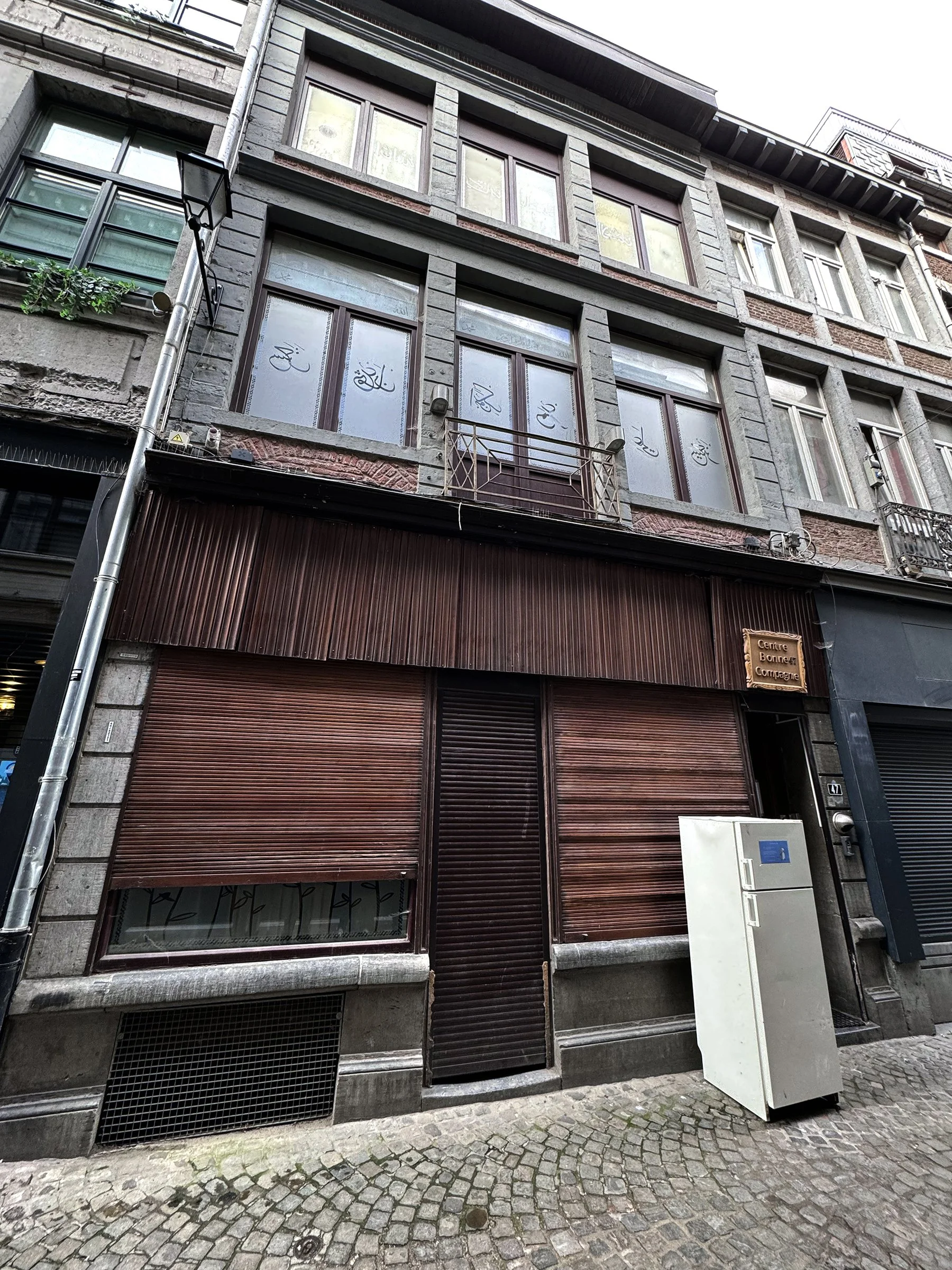
A Hidden Mosque in Liège
Hidden cities are rarely truly hidden. Their stories are simply overlooked. The same may be said of hidden mosques. Ultimately, the question is not whether a mosque possesses a dome or a minaret. Nor is it whether it announces its presence through spectacular architecture. The more important question is whether it fosters belonging.
This theme has accompanied much of my recent work. It appears in Arab Modernism(s), where architecture becomes a lens through which to understand identity and cultural negotiation. It informed my research on Temporary Cities in the Gulf, where migrant communities create meaningful places within transient environments. It shaped my upcoming personal memoir and ode to my city, My Cairo, where belonging emerges not from monuments but from everyday encounters and shared memories.
Perhaps this is the lesson of Liège.
Faith does not require visibility to exist. Yet neither should it be forced into invisibility.
Between assertion and concealment lies a more difficult path: coexistence.
And sometimes that path begins not with a minaret rising above the skyline, but with a modest doorway on a quiet side street, inviting those who know where to look to enter, reflect, and find a measure of peace.
"The earth has been made for me a place of prayer.”
