Encounters: Cairo, Friendship, and the Places That Become Home

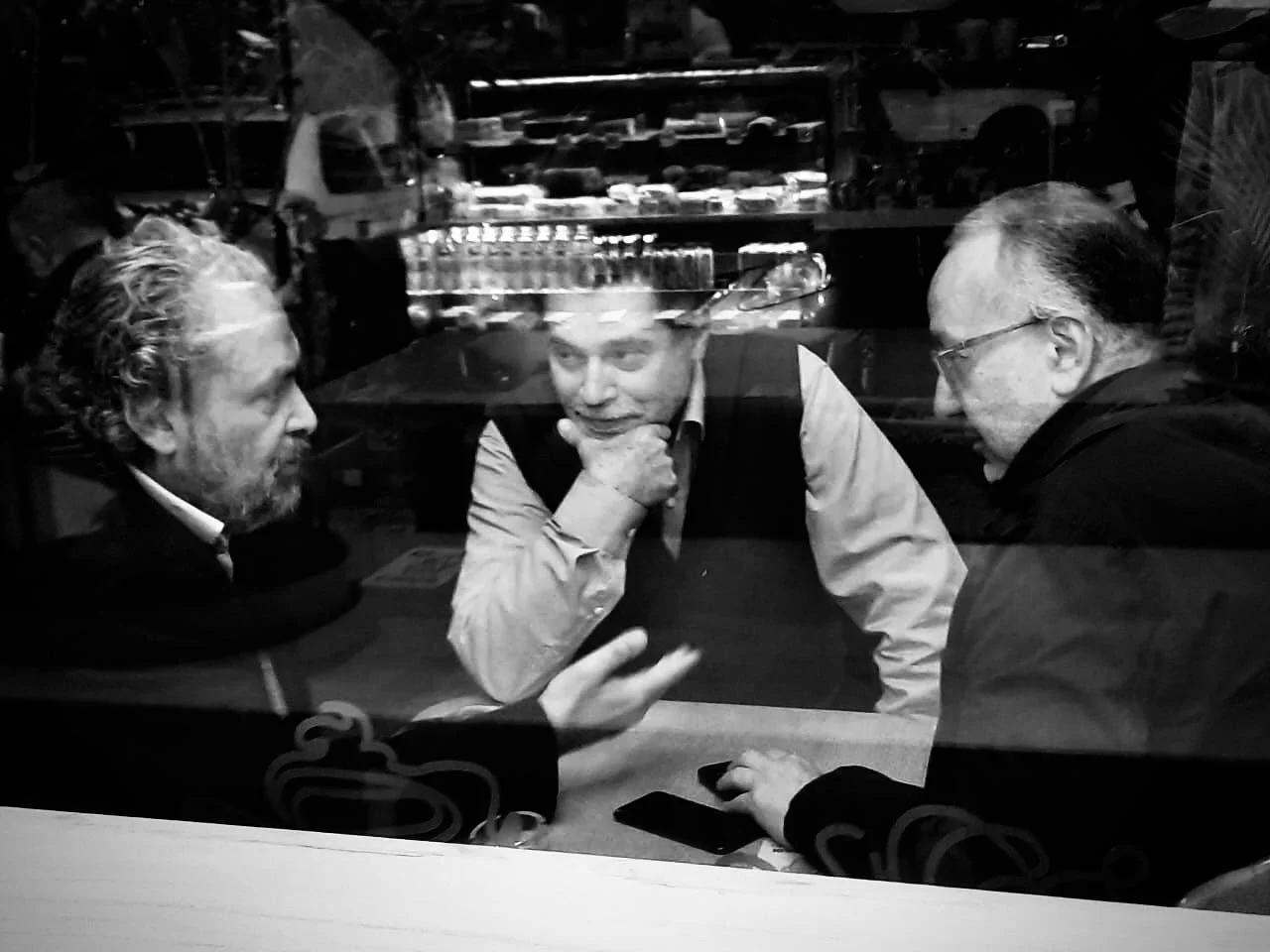
With my childhood friends from the German School, Nasser (l) & Hussein (m) at the Maadi Cilantro Cafe
There is a song by Majida El Roumi, Ma’a Garida (With a Newspaper), written by Nizar Qabbani, that has stayed with me for years. A woman sits across from a man in a café. He removes a newspaper and a box of matches from his coat, orders coffee, dissolves two cubes of sugar in the cup, and without realizing it, transforms the emotional universe of the woman watching him. Nothing happens, really. No declaration of love. No dramatic event. No climax. Only a fleeting encounter lasting perhaps a few minutes. Yet within those few moments entire worlds unfold: longing, imagination, desire, memory, possibility, melancholy. The man eventually leaves, disappearing into the crowd, while the woman remains behind, alone with the newspaper he abandoned and the emotions he unknowingly awakened.
Then after a few moments,
Without seeing me,
Without knowing the longing that had overtaken me,
He took his coat and disappeared,
Vanished into the crowd,
Leaving behind the newspaper alone—
Alone, like me
What always fascinated me about this song was not simply its romantic yearning, but the way it understood the city. Cities are often made meaningful not through monuments or skylines, but through brief encounters whose significance exceeds their duration. A glance through a café window. A conversation that stretches late into the night. The familiarity of a face across a table. A moment suspended in time. Such moments linger within us long after cities and places fade away.
I thought about this song last January while sitting with two old friends at the Cilantro coffee shop in Maadi, the Street 9 branch.
Street 9 has always occupied a special place in my mental map of Cairo. It is Maadi’s main commercial drag, a place where the neighborhood in the evening and nighttime slows down and turns into a place of leisure and enjoyment. Cafés spill onto sidewalks. Young couples walk aimlessly beneath the lights. Students carrying laptops move from one coffee shop to another. Vendors linger at corners. Cars crawl through the traffic circle at the top of the street while fragments of conversation drift through the evening air.
Cilantro itself was unremarkable in many ways. A contemporary chain coffee shop like countless others scattered across Cairo. There was no waiter service. One had to queue at the cashier to order coffee and cake. Inside, students sat silently before glowing laptop screens. We chose instead to sit outside overlooking the roundabout where the lights of passing cars mixed with the soft yellow illumination of the cafés and shops surrounding us.
I arrived first. Then Nasser appeared. Shortly afterward Hussein joined us.
The three of us had first met as children at the German School in Cairo. From 1973 until 1981 we inhabited the same classrooms, shared the same jokes, fears, routines, and fragments of adolescence. Years drifted by. Lives diverged. Countries intervened. Careers unfolded. Families emerged. Parents passed. Yet there we were once again seated together as if time itself had returned us to our childhood.
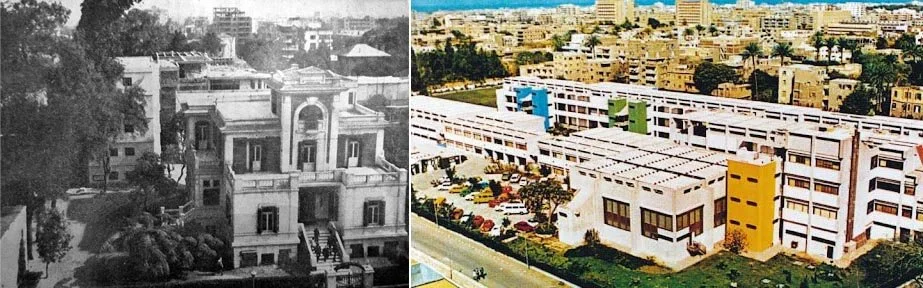
German School in Cairo. Zamalek (l) 1973-1978; Dokki (r) 1978-1981
At one point Hussein asked one of the waiters to take our picture. The photograph was taken from inside the café through the glass façade looking outward toward us seated together in conversation. I have looked at this image repeatedly since returning to the United States. There is something strangely cinematic about it. The reflections on the glass. The muted lights. The slight blur of movement in the background. The three of us leaning toward each other in deep concentration discussing one subject after another.
The image possesses what Roland Barthes might have called a punctum — a detail that wounds you unexpectedly, that captures you and holds you and does not let go. Looking at it, I realized that for a brief instant we had become children again. Of course we had aged. Our faces carried the patina of years that had passed, and history. But in that brief moment we were no longer older men navigating the anxieties of the present. We were once again classmates sharing stories after school.
And perhaps that is what cafés truly are.
Throughout my work, and especially in my upcoming book My Cairo: A Cartography of Belonging, I have returned repeatedly to the idea of the “third place,” a concept developed by sociologist Ray Oldenburg to describe spaces that exist between home and work: cafés, streets, clubs, bookstores, tea shops, parks. Places where belonging emerges informally through repeated encounters and shared rituals.
In Cairo these spaces carry extraordinary significance. They become extensions of domestic life. Temporary shelters from loneliness. Stages for memory and conversation. Moments of companionship amidst the overwhelming scale and turbulence of the city.
This was not my first memory associated with that particular coffee shop. I had met Nasser there years earlier after my father passed away in 2006. During visits to Cairo, I often worked inside while conducting research, resting between interviews, observations, and walks through the city. Like many cafés in Cairo, it slowly accumulated layers of personal history.
Back in the United States I spend considerable amounts of time in coffee shops as well. I meet doctoral students, colleagues, and faculty members. Sometimes I advise students struggling with dissertations or life decisions. Sometimes I simply sit alone working quietly for hours. Yet despite their comfort, these spaces rarely produce the same sensation. There remains a persistent feeling of estrangement — of being, as the phrase goes, a stranger in a strange land.
Perhaps because home is never merely a tangible, physical space.
This realization also brought to mind other works centered around conversation and fleeting encounters. My Dinner with Andre is a movie which consists almost entirely of two men speaking over dinner in a New York restaurant, yet through conversation an entire universe emerges. In Woody Allen’s Midnight in Paris cafés become portals through time where the protagonist encounters writers, artists, and lost histories. The city transforms into a place of enchantment. Inspired perhaps by the Japanese book Before the Coffee Gets Cold which revolves around the possibility that a café might momentarily suspend time itself.
The opposite condition appears in the painting Nighthawks. Hopper’s diner is also illuminated at night, but there the figures remain isolated despite their proximity. Modern urbanity becomes alienation rather than connection.
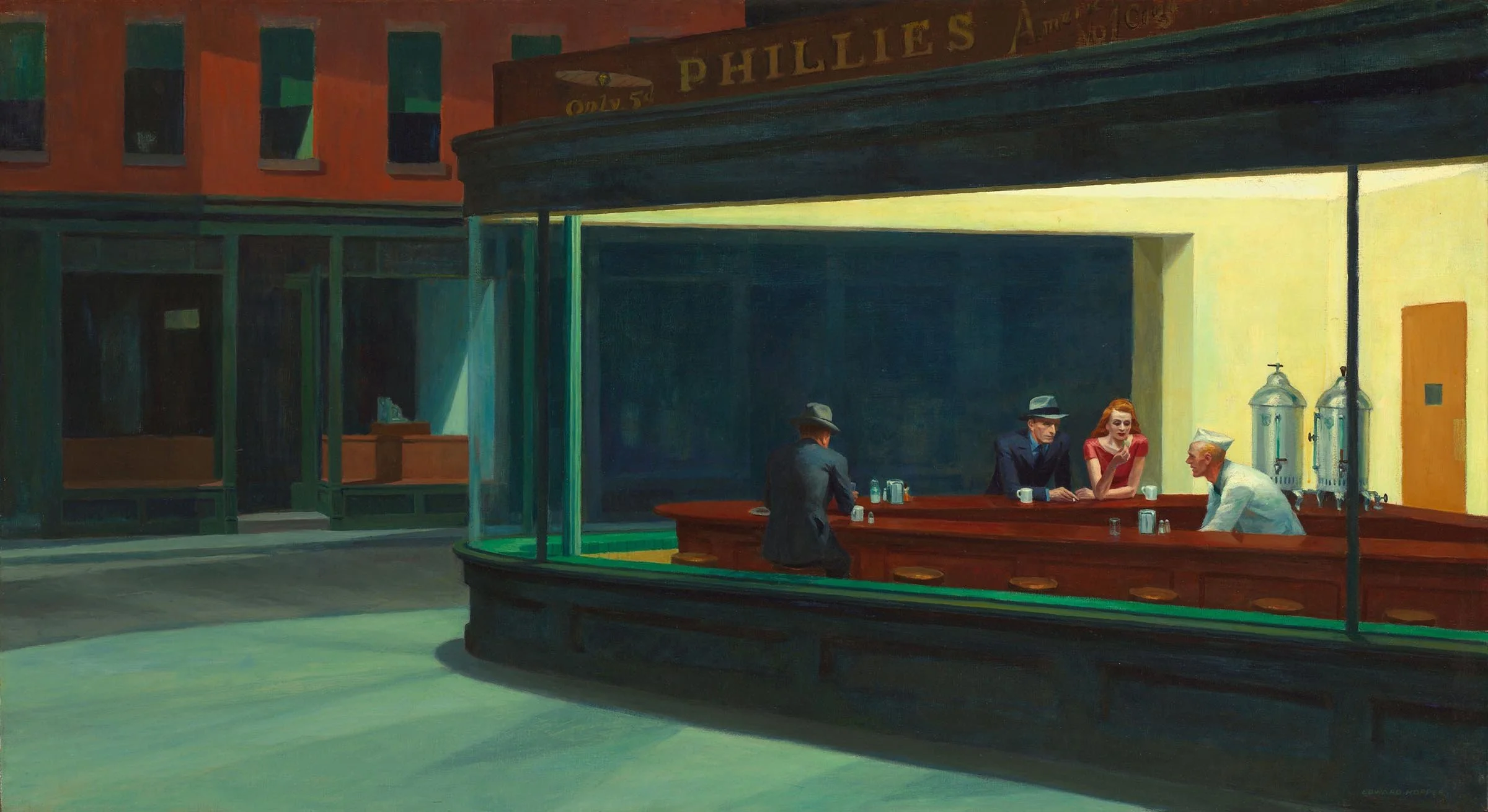
Nighthawks. Edward Hopper. 1942
Our table at Cilantro felt like the antithesis of Hopper’s world.
What the photograph captured was not simply friendship, but continuity in an age of fragmentation. A fleeting moment of human connection within a turbulent and uncertain world. A moment I wished would continue indefinitely. Yet eventually the evening ended. We stood, embraced, and walked away into separate lives once more.
Still, something endured.
I realized afterward that what I had experienced was not nostalgia in the conventional sense. It was recognition. Recognition that home does not necessarily reside in permanence, property, or geography. Home emerges through relationships and encounters. Through those rare moments when time briefly slows enough for us to feel fully seen.
This is why I keep returning to Cairo in my writing. Not because I seek an unchanged city — Cairo changes constantly, often painfully — but because scattered across its streets remain these fragile points of emotional continuity.
Toward the end of the evening, another song came to mind: “Home Is Me and You” by Hrishikesh Hirway.
Places change and fade away
But one thing that stays true
Home is me and you
These refrains stayed with me long after I left Cairo.
Because in that ordinary chain coffee shop in Maadi, the noise slowly receded into the background. The colors of the city were muted and desaturated. The surrounding crowd disappeared. And all that remained were three old friends talking about their lives as if no time had passed at all.
In that fleeting moment, I was home.
And Cairo — the city I left behind long ago — continued to live quietly inside me, preserved forever in that perfect black-and-white image behind the café glass storefront.
Someone once said that home is “not where you want to live but where you want to die.” This is incorrect.
Home is simply me and you.
