A Dubai Apparition in New York
New York's Hudson Yards Is Dubai—And Not in a Good Way

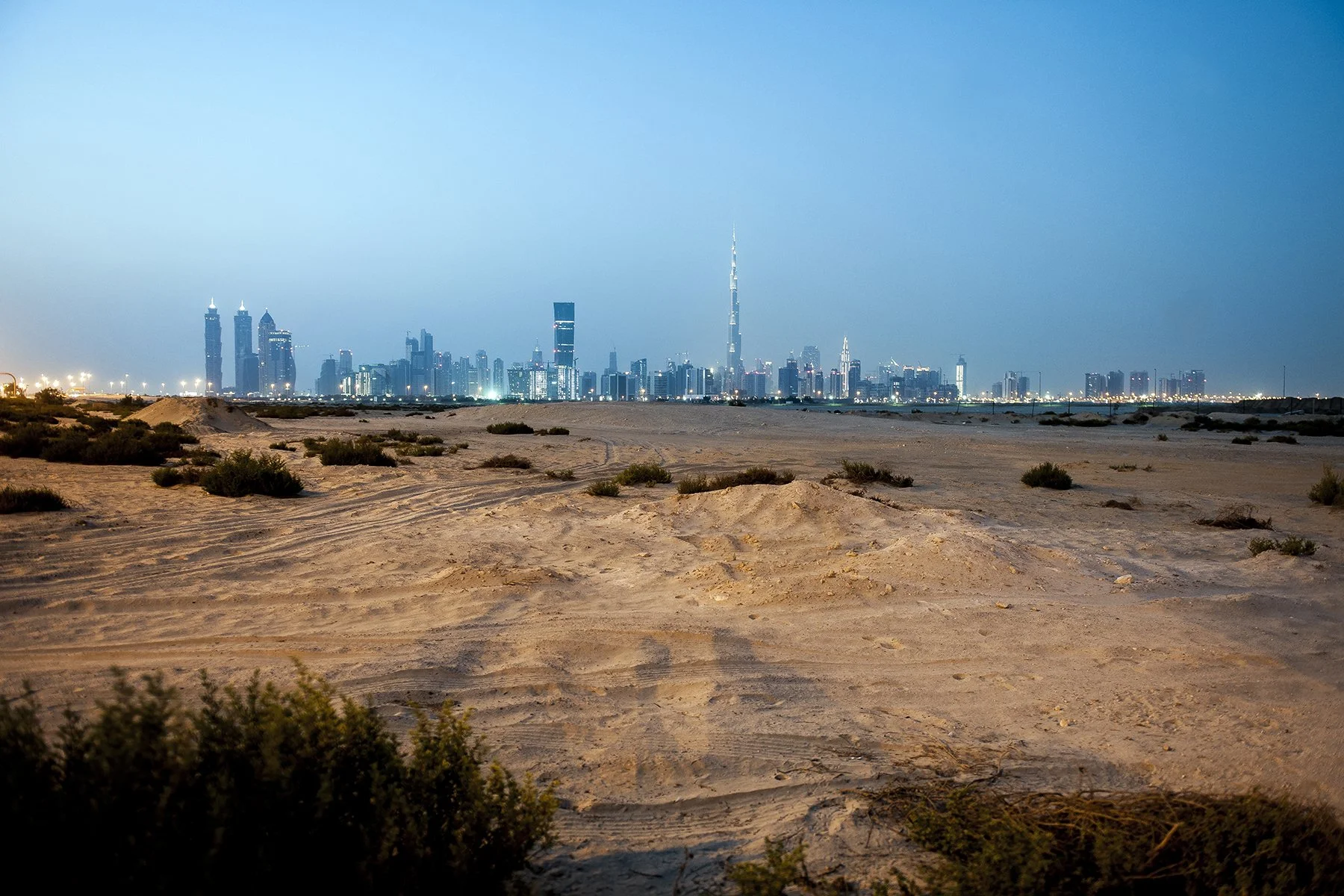
Dubai Skyline. A “Mirage” in the desert (Elsheshtawy)
There is a peculiar moment that has happened to me more than once over the past few years. I am walking in a city that could not appear more different from Dubai when, suddenly, Dubai materializes before me. Not literally, of course, but as an apparition.
The first time this occurred was in Milan. Walking through the city's historic center along its narrow streets, flanked by centuries-old buildings, my gaze was unexpectedly drawn toward a distant high-rise. For a brief moment, I could have sworn I was looking at the Burj Khalifa. It was a strange sight. The tower seemed somehow smaller, as though someone had produced a miniature version of Dubai's most recognizable landmark and carefully inserted it into northern Italy. The district was Porta Nuova, sometimes referred to locally as "Little Dubai." Ironically, the development owes much of its existence not to Dubai but to Qatari investment. Yet that hardly matters. Whenever a city acquires a cluster of spectacular towers, luxury residences, signature architecture, and high-end consumption, it is almost inevitably described as another "Little Dubai."
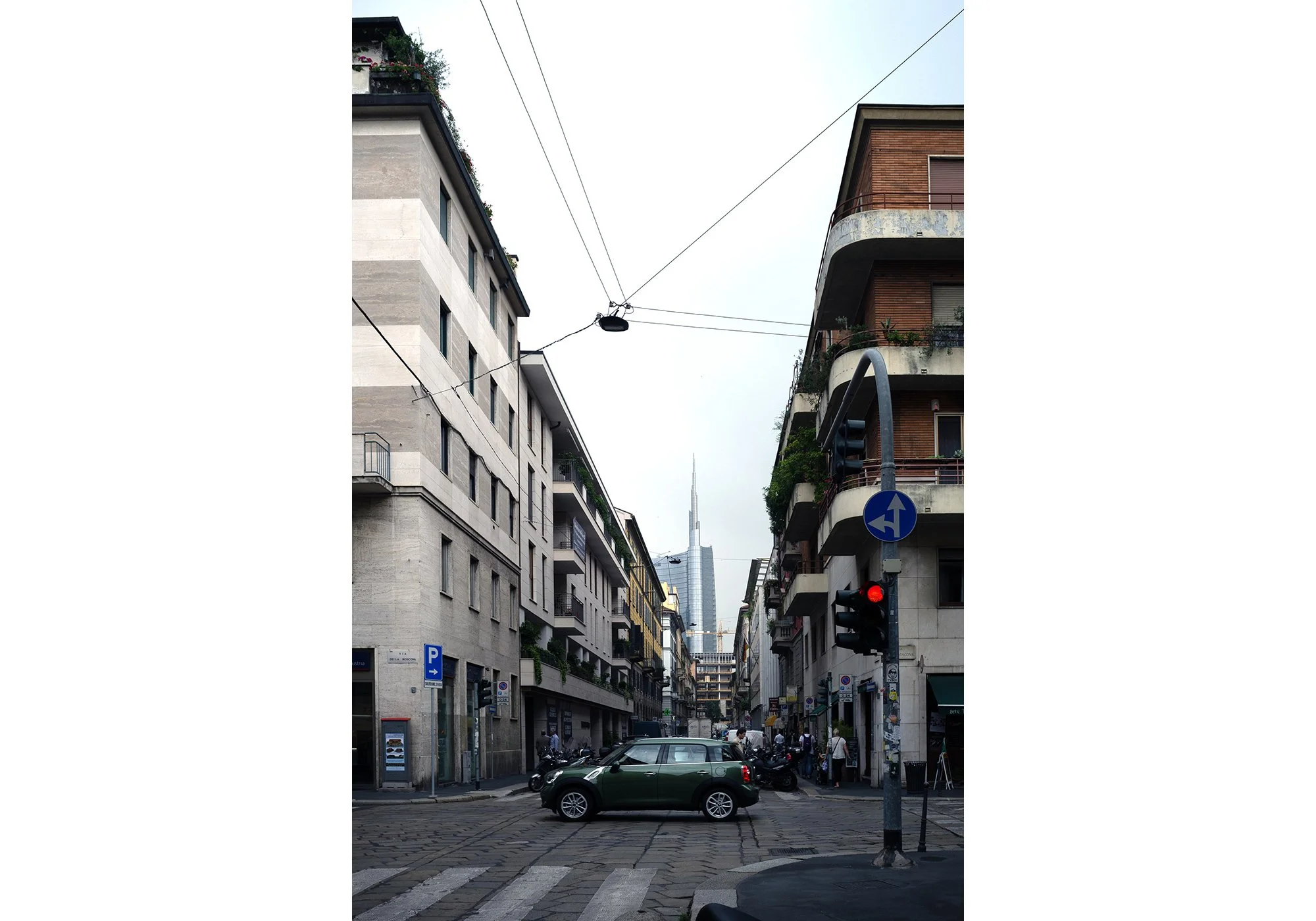
Downtown Milan (Elsheshtawy)
This says less about Dubai itself than about the remarkable power of the Dubai brand. It has become shorthand for glamour, ambition, luxury, and futuristic skylines. Yet it has simultaneously acquired another, rather different meaning. Increasingly, "Dubai" functions as a warning—a visible sign of a certain kind of urbanism characterized by spectacle, exclusivity, and a detachment from everyday urban life.
A similar apparition appeared before me recently in New York. Arriving from the High Line, I entered Hudson Yards expecting little more than another contemporary mixed-use development. The towers were sleek, the public spaces immaculate, the shopping mall luxurious, and the apartments commanding prices in the tens of millions of dollars. It was only after spending a little time there that something began to feel subtly but unmistakably wrong. The sensation reminded me of the seven-and-a-half floor in Being John Malkovich, where everything appears perfectly normal yet somehow slightly distorted. Individually, none of the details seemed remarkable. Together, however, they generated an overwhelming sense that I had entered a place governed by a different set of rules.
I sat on a planter near the Vessel, Thomas Heatherwick's now-famous structure, which continues to strike me as one of the most incomprehensible urban objects ever constructed. Even locating its entrance proved oddly difficult despite knowing perfectly well that one existed. While resting there, a woman suddenly approached and began speaking rapidly and rather angrily in Spanish. She gestured repeatedly toward something behind me. Nearby stood what appeared to be a film crew. I apologized, explained that I did not understand, and tried to determine what she wanted. Before I could make sense of the encounter, she abruptly walked away, leaving me completely bewildered. For several moments I genuinely wondered whether I had accidentally wandered onto a film set or whether they had simply been waiting for me to leave. As I continued walking, another curious incident occurred. I passed a woman wearing what appeared to be an official uniform. She smiled warmly. It was an entirely ordinary gesture, yet within Hudson Yards even something as simple as a smile seemed oddly scripted. Once again, I found myself asking why I felt so unsettled.
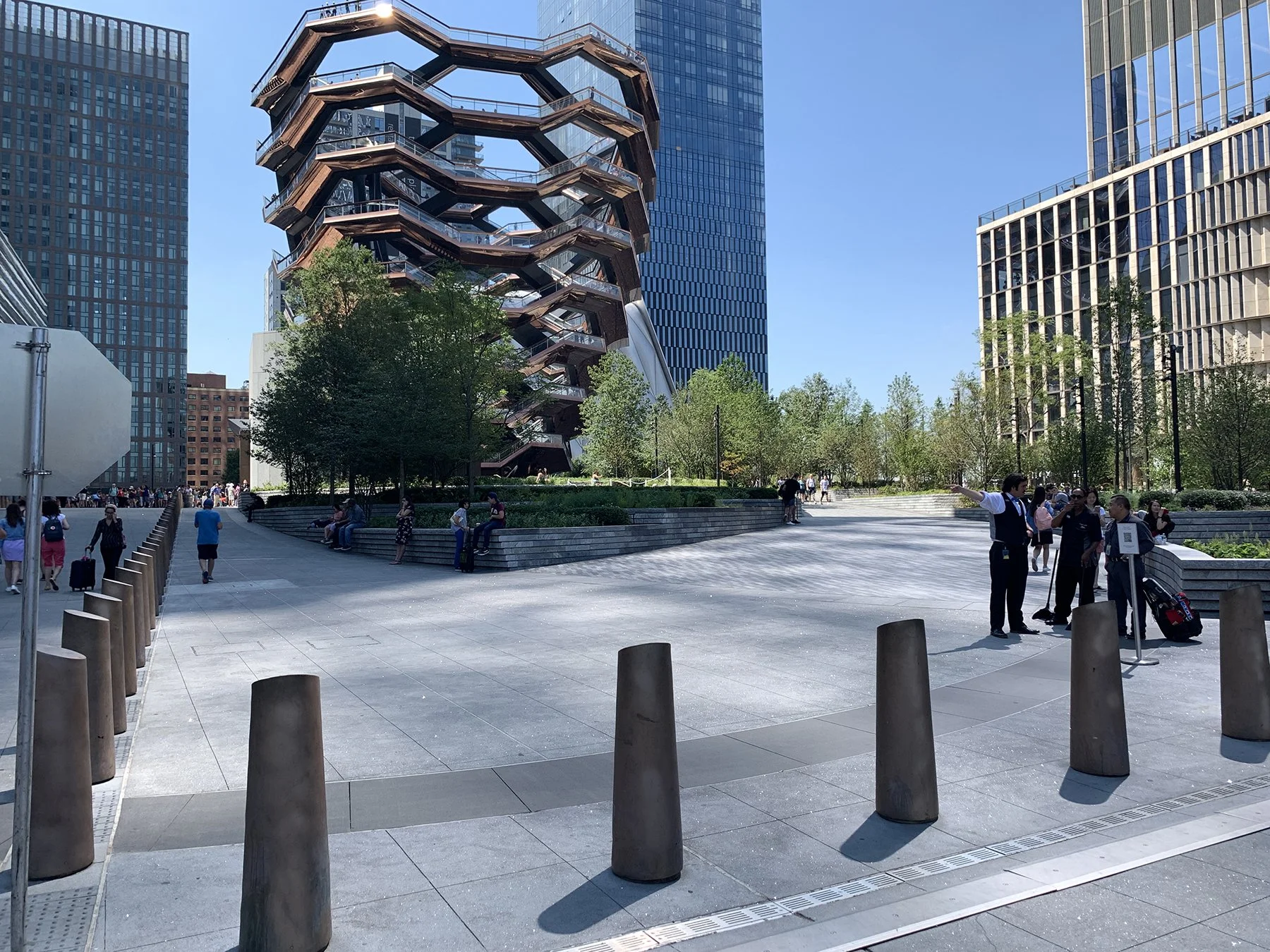
Hudson Yards (Elsheshtawy)
The answer, I suspect, lay less in these individual encounters than in the environment itself. Everywhere there were discreet signs directing movement, subtle regulations governing behavior, carefully maintained landscapes, and a pervasive sense of surveillance without appearing overtly oppressive. Despite the presence of people, the entire district conveyed an overwhelming feeling of transience and anonymity. It resembled a public space without ever quite becoming one. There was something almost cult-like about the atmosphere, as though everyone had unconsciously agreed to participate in a carefully choreographed performance. Marc Augé's notion of supermodernity immediately came to mind. Hudson Yards embodies many of the characteristics associated with the non-place: spaces organized around consumption, movement, and efficiency rather than belonging. One could easily live there without ever needing to venture into the surrounding city. Luxury apartments occupy the towers above, while below lies an enormous shopping mall containing almost everything one might require. Offices, restaurants, entertainment, observation decks, fitness facilities, and retail are all seamlessly integrated into a single inward-looking environment.
The city itself becomes increasingly unnecessary. This is where Dubai enters the story.
It is not because Hudson Yards resembles Dubai in any literal architectural sense. Rather, both participate in what might be called the "Dubai syndrome," a condition in which cities increasingly reproduce a model defined by exclusivity, inwardness, luxury, and the gradual replacement of public urban life by carefully managed environments. Porta Nuova in Milan represents one manifestation of this phenomenon. Hudson Yards represents another. Similar developments continue appearing elsewhere across the world, regardless of whether Dubai had anything whatsoever to do with financing or designing them.
This was not the first time I had encountered the connection. Several years ago, while watching a documentary about Jane Jacobs, I was struck by its closing sequence. After recounting her successful campaign against Robert Moses' proposed Lower Manhattan Expressway, the film’s final scene of the proposed Lomex Expressway in lower Manhattan with its fantastic towers (never built) gradually fades then dissolves into an image of Dubai's Sheikh Zayed Road. Remarkably, Dubai is never mentioned by name. It does not need to be. The skyline alone conveys the intended message. It has become visual shorthand for an urban future to be feared rather than embraced.
Why has Dubai acquired this symbolic role? Part of the explanation undoubtedly lies in lingering Orientalist assumptions and a certain Western unease regarding rapid urban transformation elsewhere. Projecting dystopian anxieties onto a Middle Eastern city is often easier than acknowledging similar tendencies emerging at home. Yet I think another explanation is equally compelling. Dubai has distilled many of the defining characteristics of contemporary urbanism into their purest form: spectacle, transience, privatized public space, hypermobility, and consumption. It functions almost as an intensified laboratory for processes now spreading across the globe. The operative word here is neoliberal urbanism.
Science fiction anticipated this future decades ago. Films such as Blade Runner imagined cities where inequality divides insiders from outsiders, while Code 46 presented a world in which urban identities have dissolved almost completely. Watching Code 46, one frequently loses track of whether the story unfolds in London, Shanghai, Dubai, or somewhere else entirely. The cities blend seamlessly into one another. What once appeared speculative increasingly resembles the contemporary city.
Hudson Yards therefore is not Dubai. Yet it evokes Dubai because both have come to symbolize a particular trajectory of urban development. They present cities less as places of encounter than as highly regulated landscapes of consumption. Walking through Hudson Yards, I was repeatedly struck by how decisively the development turns its back on Manhattan. Even Zaha Hadid's nearby residential building, elegant though it undoubtedly is, seems primarily concerned with its own carefully designed world rather than engaging with the city around it. At one point I found myself sketching the Vessel. The drawing was less an attempt to capture the object than to understand why it disturbed me so much. Eventually I gave up. The Vessel itself was never really the issue. The problem lay in the urban condition it represented.
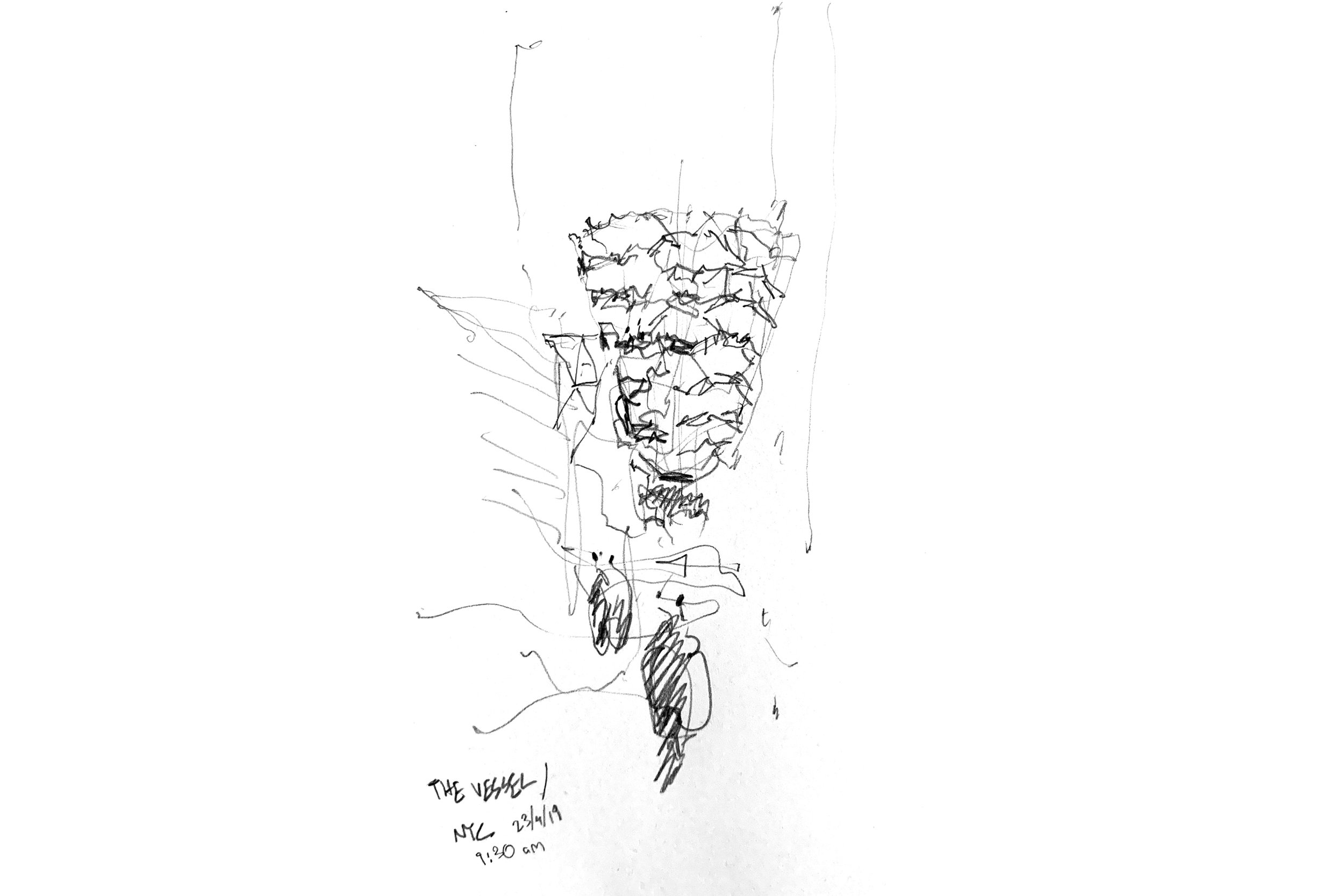
Sketch of the Vessel (Elsheshtawy)
Yet despite these misgivings, I left with an unexpected sense of optimism. Near the subway station, just beyond the carefully controlled boundaries of Hudson Yards, stood a modest shawarma stand. It was slightly untidy, somewhat improvised, and refreshingly ordinary. People lingered. Conversations overlapped. Customers waited without apparent urgency. Unlike almost everything surrounding it, the stall felt genuinely urban. It seemed poised, almost patiently, to invade Hudson Yards from its edges.
That, perhaps, is how cities ultimately resist. Everyday life slowly occupies spaces never intended for it. Vendors appear. Informality returns. Residents appropriate carefully designed landscapes in unforeseen ways until even the most controlled developments gradually become part of the city. Unless, of course, the opposite occurs—unless gates multiply, surveillance intensifies, and armed guards with dogs begin policing unsuspecting pedestrians.
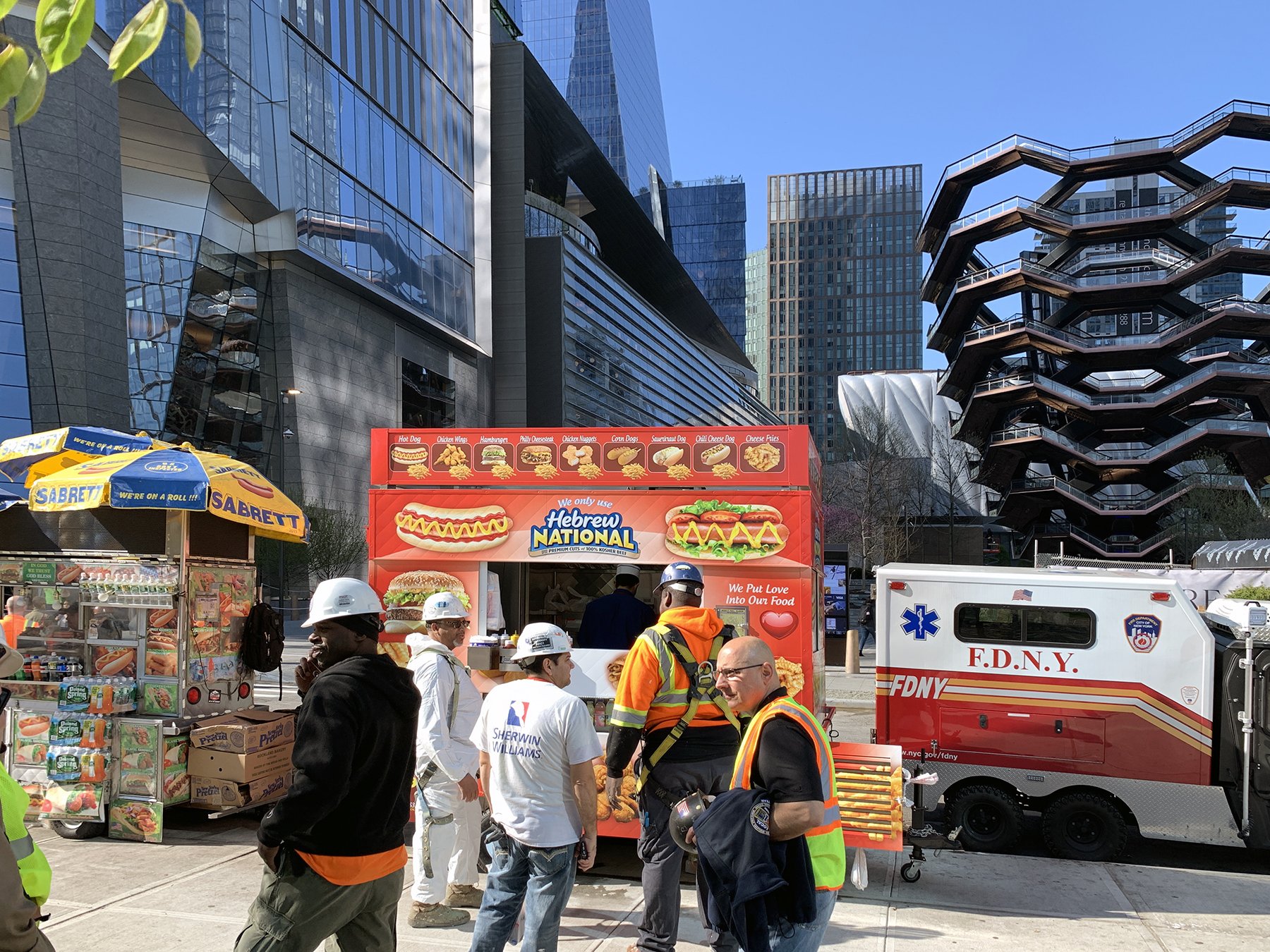
Food trucks opposite Hudson Yards (Elsheshtawy)
For now, however, the story remains unfinished. The Dubai apparition continues appearing in cities across the world, not because they are becoming Dubai, but because Dubai has become an unusually powerful metaphor for our urban future. Whether we interpret that future as glamorous or deeply troubling depends largely on where we stand. Either way, it is worth keeping our eyes on Dubai, for what happens there today increasingly foreshadows what may soon unfold elsewhere. We should watch carefully, not because Dubai is unique, but because it may be showing us ourselves.
We must remain vigilant.
