The Teddy Bear Beneath the Lamp
Doha, Belonging, and the Architecture of Transience

“Oh, our guest, if you visited us, you would find us
[Where] we are the guests and you are the master of the house
We love those who visit our homes
[But] it is embarrassing for those who visit us and do not leave”— Poem by Abu Abdullah Al-Hussein bin Hamdan Al-Khasibi. (873-968)
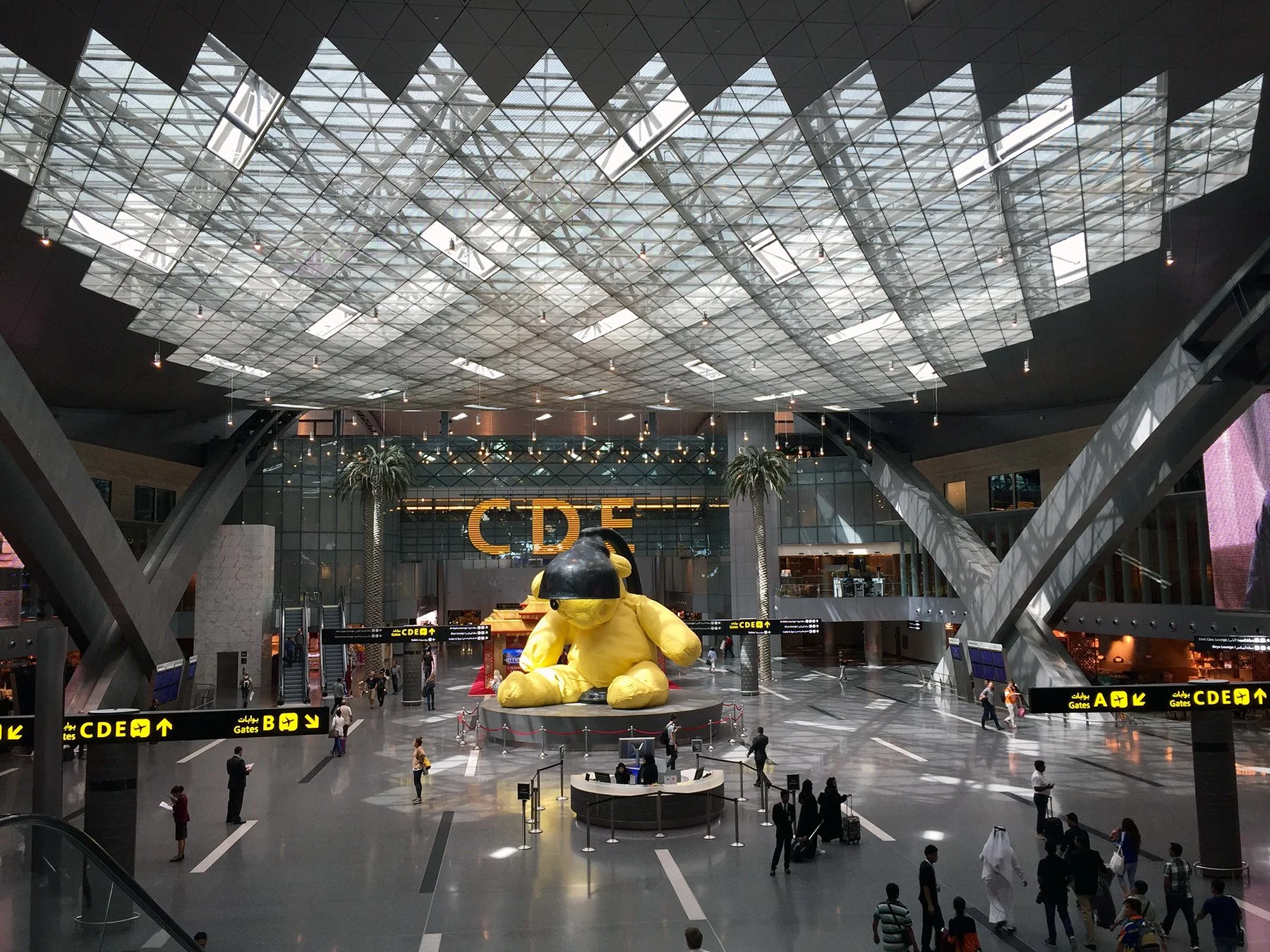
Doha Airport. Untitled (Lamp/Bear). Urs Fischer (Elsheshtawy)
A few years ago, while waiting for my flight home from Doha, I found myself standing in front of an enormous yellow teddy bear sitting beneath a lamp in the middle of Hamad International Airport. Officially titled Untitled (Lamp/Bear), the sculpture by Swiss artist Urs Fischer has become one of Qatar's most recognizable “cultural” landmarks. At first, I simply stared at it in bewilderment. It seemed out of place, another whimsical object inserted into what Marc Augé famously described as a "non-place"—an airport terminal through which thousands pass every day without ever really inhabiting it. It looked playful, perhaps intentionally absurd, but beyond that I struggled to understand why it had become such an icon. Only later did I discover that the sculpture was intended to evoke childhood, comfort, nostalgia, and above all, the feeling of home. Suddenly, what had initially appeared merely eccentric became something altogether more unsettling. Few places in the Gulf better embody the paradox of home than an airport. Millions arrive there seeking opportunity; millions eventually depart. For some, the airport is a gateway to prosperity. For others, it marks the end of lives spent building places that could never truly become their own, and a return to what ceased to be home.
As I reflected on the sculpture, I was reminded of a verse by the ninth-century Iraqi poet Abu Abdullah Al-Hussein bin Hamdan Al-Khasibi: "We love those who visit our homes... But it is embarrassing for those who visit us and do not leave." The poem captures the generosity of traditional Arab hospitality while simultaneously exposing one of the Gulf's deepest contradictions. Across the region, cities have been built by people who are, almost by definition, temporary. Construction workers, engineers, architects, academics, domestic workers, doctors, consultants—they occupy different positions within the same system, distinguished perhaps by salary or status, but united by the expectation that one day they will leave. The poem resonated with me for deeply personal reasons. I spent twenty years living and teaching in the United Arab Emirates, years that shaped both my academic career and my understanding of Gulf cities. I enjoyed extraordinary opportunities, generous colleagues, remarkable students, and a comfortable life. Yet beneath that comfort lay an unspoken certainty: I remained an expatriate whose presence was ultimately conditional. Retirement would eventually require departure. I chose to leave before reaching that point, returning to the United States fully aware that despite two decades in the Gulf I had never truly belonged. Looking back, I realized that the giant teddy bear was not really about home at all. It was about its absence.
Whenever I visit Doha, these thoughts inevitably return. They form the emotional thread running through my chapter on the city in Arab Modernism(s): Cities, History and Culture. Doha undoubtedly represents one of the Arab world's most ambitious urban transformations, yet beneath its spectacular architecture lies a more complicated story, one in which extraordinary modernity coexists with profound impermanence.
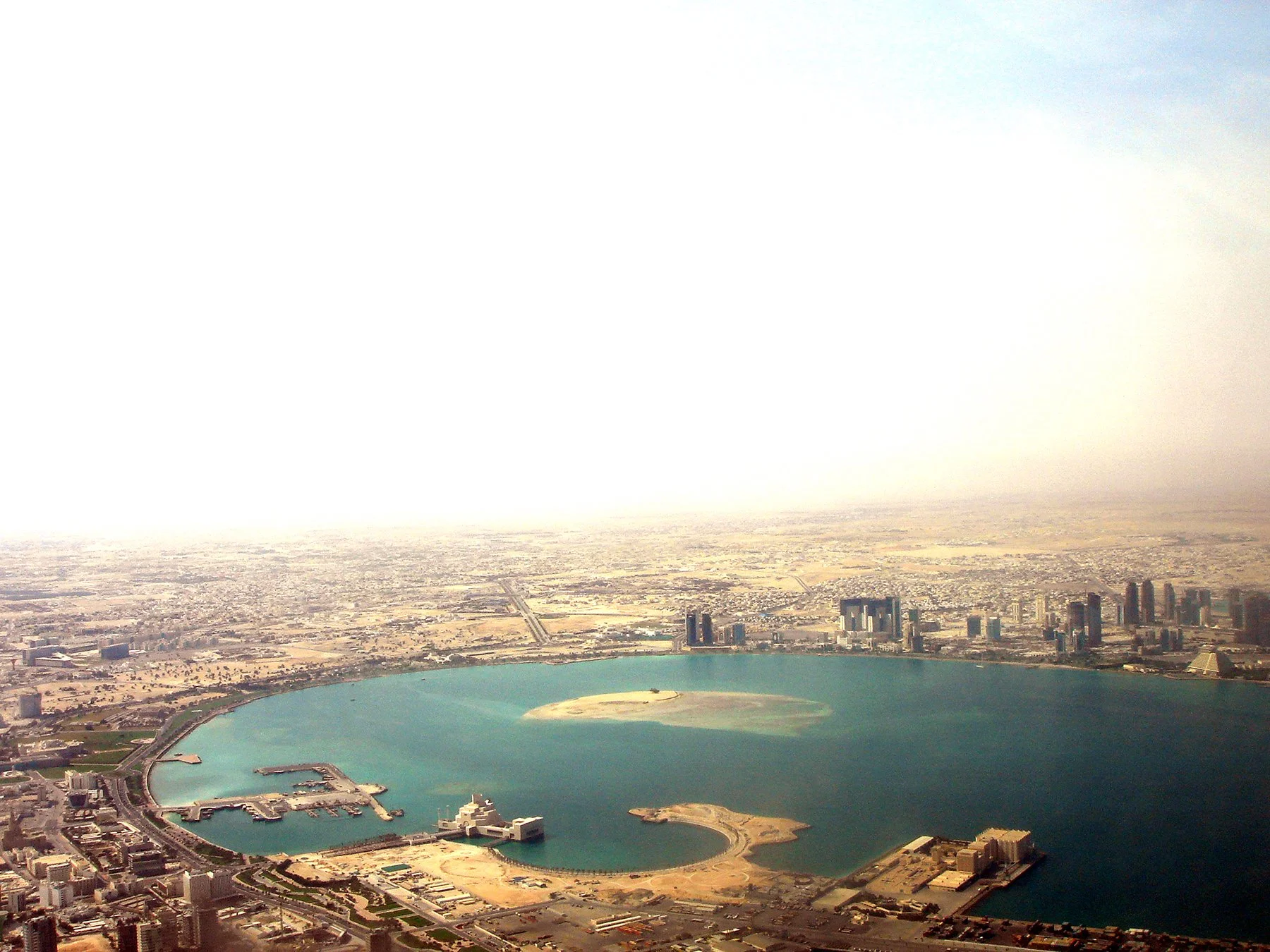
Aerial View. Doha (Elsheshtawy)
I found myself thinking about this while visiting The Ned during my most recent stay in Doha. Before becoming one of the city's most exclusive hotels, the building served as the Ministry of Interior, one of the finest examples of Gulf modernism. My taxi arrived after sunset, making it difficult to appreciate the building's exterior. It was only after stepping inside that its significance became apparent. The spacious lobby, carefully preserved interiors, elegant furniture, subdued lighting, and unmistakable mid-century atmosphere transported me back to the optimism of the 1970s, when modern architecture still promised a better future rather than merely a more luxurious one. Dinner was served outside while overlooking the Gulf. Beyond the terrace rose Doha's glittering skyline, its towers reflecting softly against the evening sky. It was an undeniably beautiful view, yet I could not escape the feeling that I was observing only one carefully designed version of the city. Everything visible from that terrace spoke of prosperity, refinement, and global aspiration.
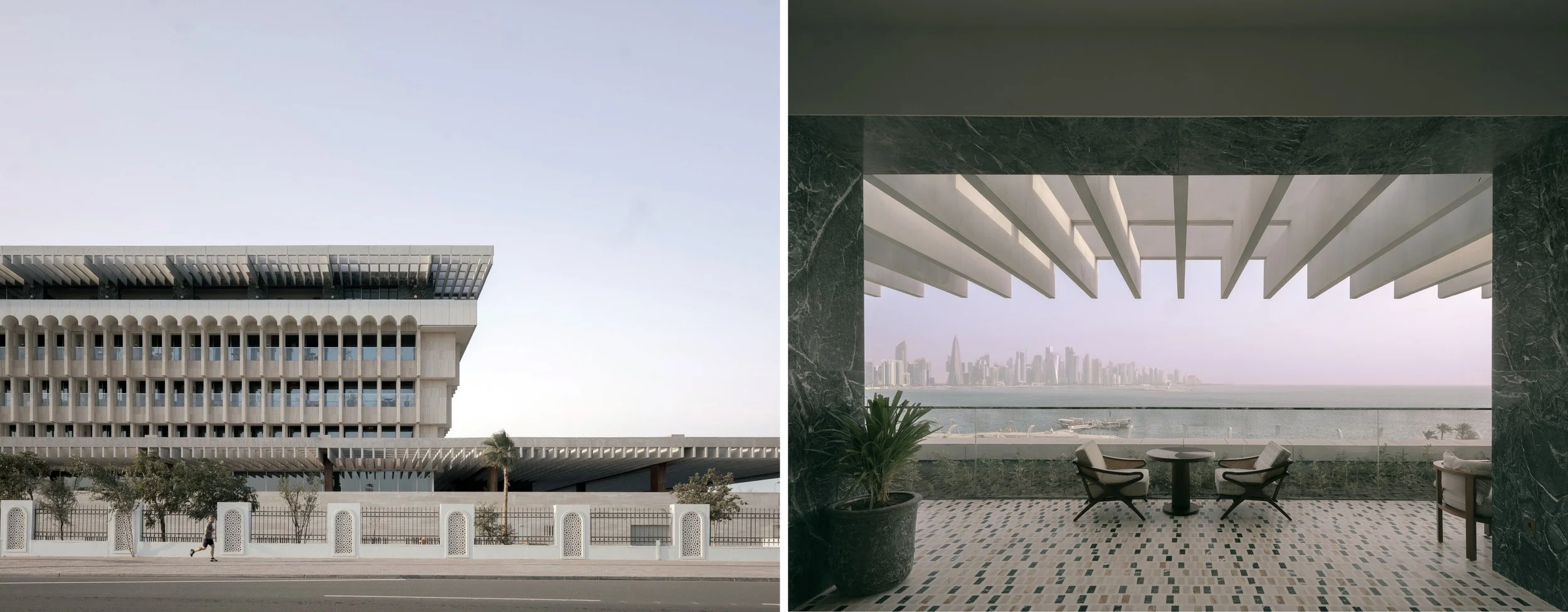
The Ned Doha (Simon Menges)
The following morning, I decided to take a walk.
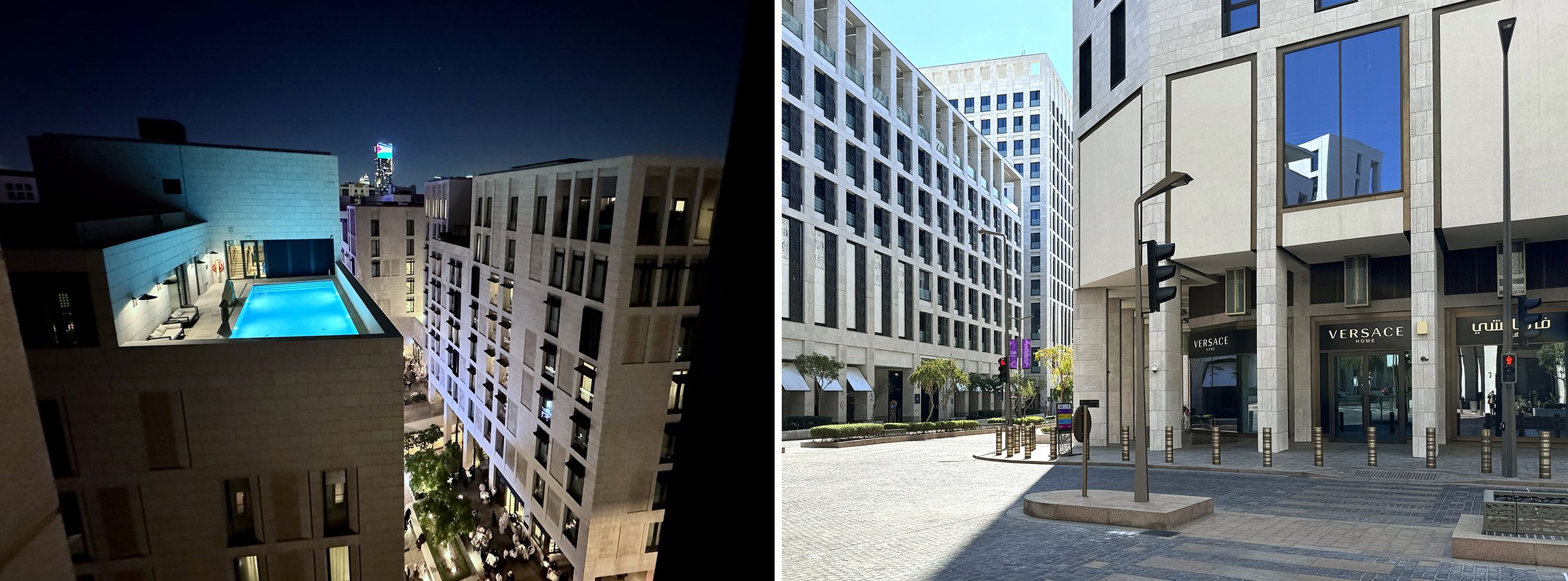
Leaving my hotel, The Mandarin in the luxurious district of Msheireb, behind, I gradually made my way toward Najada, a neighborhood I had first explored more than a decade earlier when Msheireb was still under construction. During that earlier visit the district had clearly been marked for demolition, yet it remained unmistakably alive. Narrow alleyways threaded between modest courtyard houses. Small groceries, inexpensive restaurants, and informal businesses served a largely migrant population. The architecture itself was a remnant of a past age, and the streets possessed something increasingly rare in Gulf cities: the accumulated texture of everyday life. Returning in 2024 was deeply disorienting. Almost everything had disappeared. The old houses were gone, the alleyways erased, and in their place stood anonymous apartment blocks that could easily belong to almost any rapidly growing city. Walking through the area, I found myself searching for familiar landmarks, only to discover that memory had become the only remaining anchor point.
As for Msheireb, it was celebrated internationally as a model of sustainable urbanism rooted in Qatari heritage. I have visited the development several times, first while it was still under construction and later during my stay at the Mandarin Oriental, where my hosts had set me up during a conference. There is much to admire. The district is walkable, environmentally responsive, and thoughtfully designed. Its narrow and shaded streets reinterpret traditional urban forms with remarkable sophistication. Yet the longer I spent there, the more uneasy I became. The neighborhood felt inward-looking, almost like a fortified enclave. The buildings were so visually consistent that I repeatedly lost my way while attempting to return to my hotel. More importantly, leaving the district produced the unmistakable sensation of crossing a threshold between two entirely different cities. Inside lay an immaculate architectural vision; outside unfolded the unpredictable complexity of everyday Doha. What troubled me most was not the architecture itself but what had disappeared to make it possible. The original site of Msheireb was largely save for an old building belonging to the Royal family. However right across Najada had been home to inexpensive cafés, Pakistani sweet shops, barbers, samosa vendors, and countless small businesses serving the city's migrant communities. These lives had quietly vanished beneath a carefully reconstructed version of tradition.
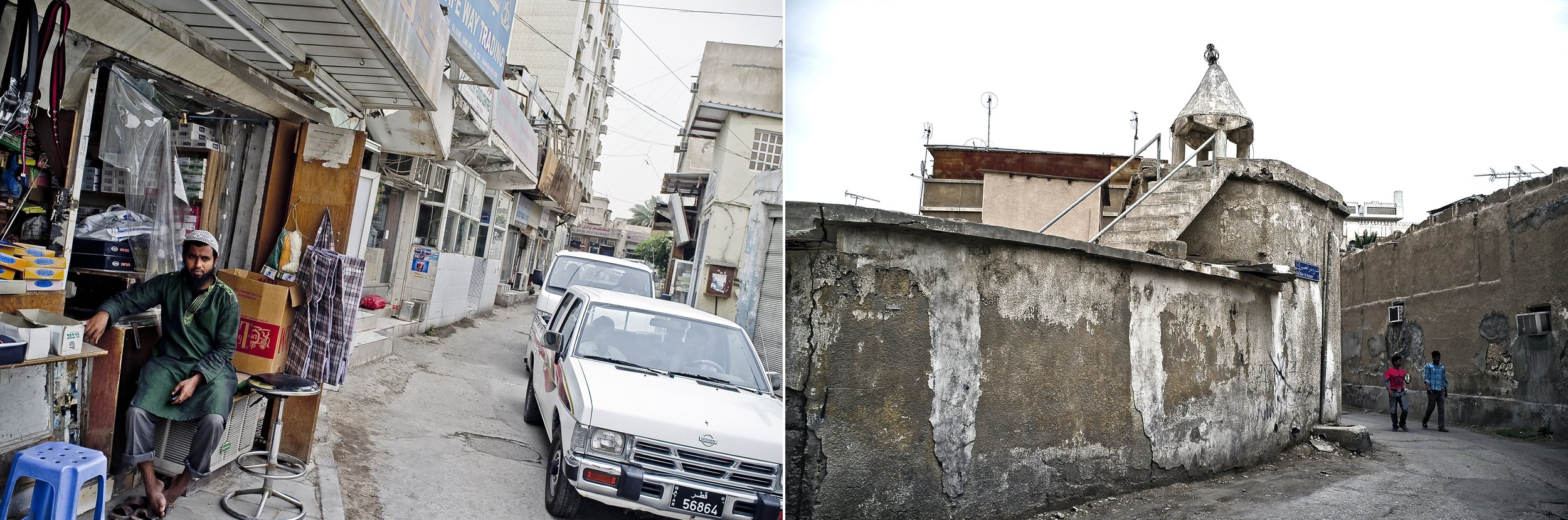
Najada (Elsheshtawy)
Msheireb (Elsheshtawy)
Fortunately, Doha occasionally offers another narrative.
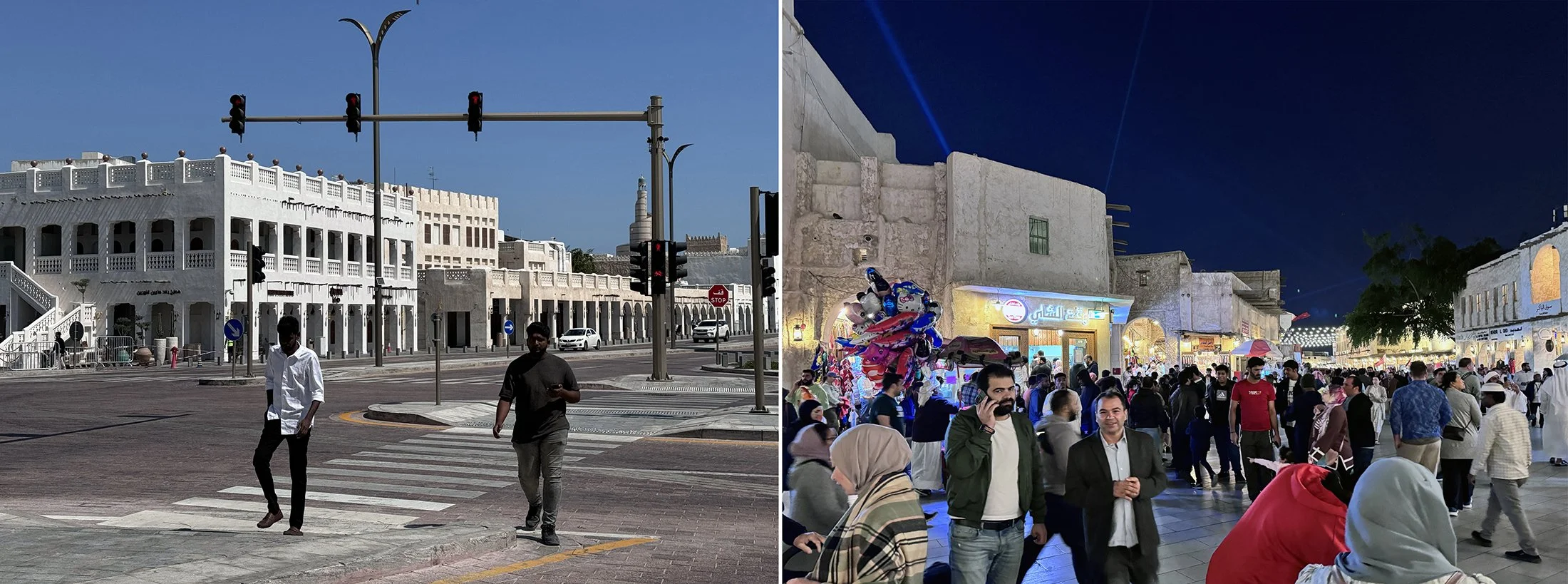
One evening I wandered from Msheireb into Souq Waqif. Critics often dismiss the souq as little more than an elaborate reconstruction, arguing that its historic appearance masks an essentially contemporary creation. There is truth in that criticism. Yet cities are ultimately judged less by the authenticity of their buildings than by the authenticity of the lives unfolding within them. The market was filled with Qataris, tourists, migrant workers, families, and street vendors sharing the same public space. After purchasing a traditional Yemeni jambiya, I followed the shopkeeper through a maze of narrow lanes to an ATM hidden deep within the market. It was a small encounter, almost insignificant, yet it reminded me that genuine urbanity is rarely produced by architecture alone. It emerges through chance meetings, informal exchanges, and the countless ordinary interactions that no master plan can ever fully anticipate.
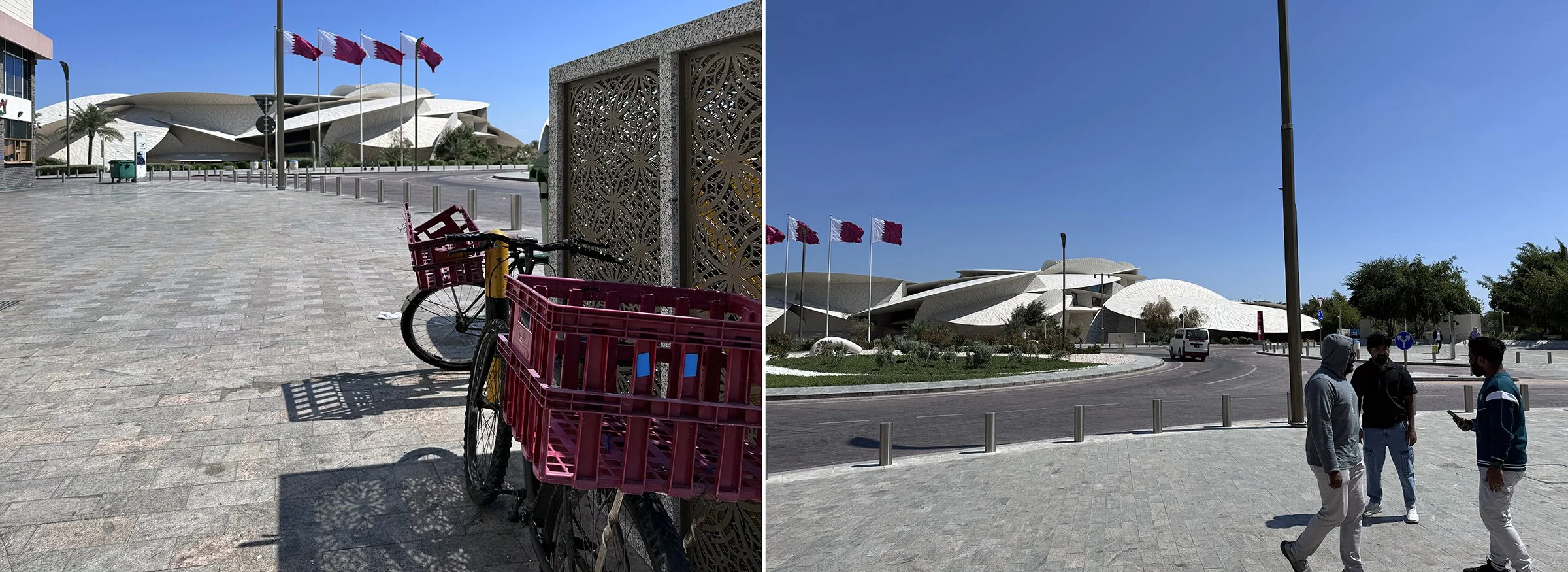
Later, I continued walking toward the National Museum of Qatar. The building itself is undeniably spectacular, Jean Nouvel's desert rose rising dramatically from the landscape. Yet what remains most vivid in my memory is not the architecture but the route leading there. The streets were empty, while scattered groups of migrant workers walked quietly toward their accommodations. Their presence recalled an observation by John McManus in Inside Qatar: these are the men who built the country, yet they remain largely invisible within its official image. Looking at the museum, then looking back toward the workers, I was reminded once again of the teddy bear waiting patiently inside the airport.
Souk Waqif (Elsheshtawy)
Qatar National Museum (Elsheshtawy)
Perhaps that is why writing about Doha has always been more difficult than writing about other Gulf cities. Its remarkable skyline, museums, and public spaces deserve admiration, but they also invite uncomfortable questions. Who belongs? Who remains visible? Who is remembered? And who eventually disappears? These questions linger long after one leaves the city, much like the giant bear watching silently over an airport terminal filled with people forever arriving, forever departing, and forever wondering where home might actually be.
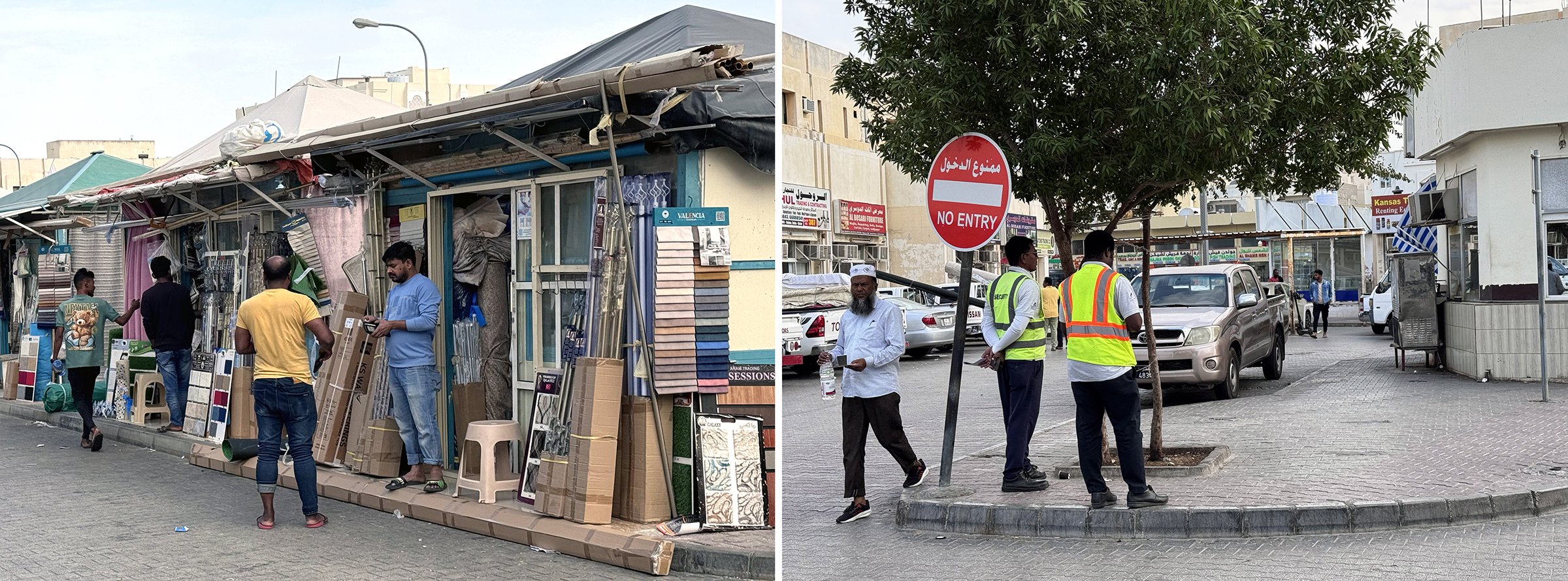
These encounters reminded me that Doha possesses two parallel urban lives. One is the city of architectural magazines, international conferences, spectacular museums, luxury hotels, and global sporting events. It is the Doha that appears in promotional films and airline advertisements, the city that seeks to project confidence, prosperity, and cultural sophistication. The other Doha is modest and can be found in neighborhoods such as the former Najada, in cafés, informal markets, labor accommodations, and the everyday routines of the migrant majority whose work has made these spectacular visions possible. It is this second city that I increasingly found myself searching for. During my visits I was drawn toward places where ordinary life resisted becoming spectacle. One such place was the used-items market, Souq Al-Haraj. Unlike the gleaming shopping malls that have come to define Gulf consumer culture, the market was chaotic, noisy, and refreshingly unpredictable. Furniture, appliances, clothing, electronics, and countless objects whose histories were impossible to trace changed hands between people from every imaginable background. Food stalls filled the air with familiar aromas, while conversations drifted effortlessly between Arabic, Urdu, Hindi, Bengali, Tagalog, and English. Although security guards ensured that shoppers did not linger too long in certain areas, the market nevertheless possessed something increasingly absent from Doha's more polished environments: spontaneity.
Used Items Market (Elsheshtawy)
None of this should obscure what Doha has achieved. The Corniche remains one of the finest waterfront promenades anywhere in the Gulf. Stretching along the bay between the Museum of Islamic Art and West Bay, it is one of the few places where the city's social divisions become momentarily less rigid. On any evening one encounters expatriate families, Qatari youth, migrant workers, joggers, fishermen, tourists, and office workers sharing the same public landscape. The inequalities remain, of course, but for a brief moment the city begins to resemble what cities have always done best: bringing strangers together. This perhaps explains why writing about Doha has left me more conflicted than writing about almost any other city in Arab Modernism(s). It would be easy either to celebrate its remarkable architectural achievements or to condemn the injustices that underpin them. Both responses would contain elements of truth, yet neither would capture the city in its entirety. Doha is simultaneously generous and exclusionary, ambitious and fragile, forward-looking and haunted by what it has erased along the way.
Coda: The Unfinished Promise of Modernity
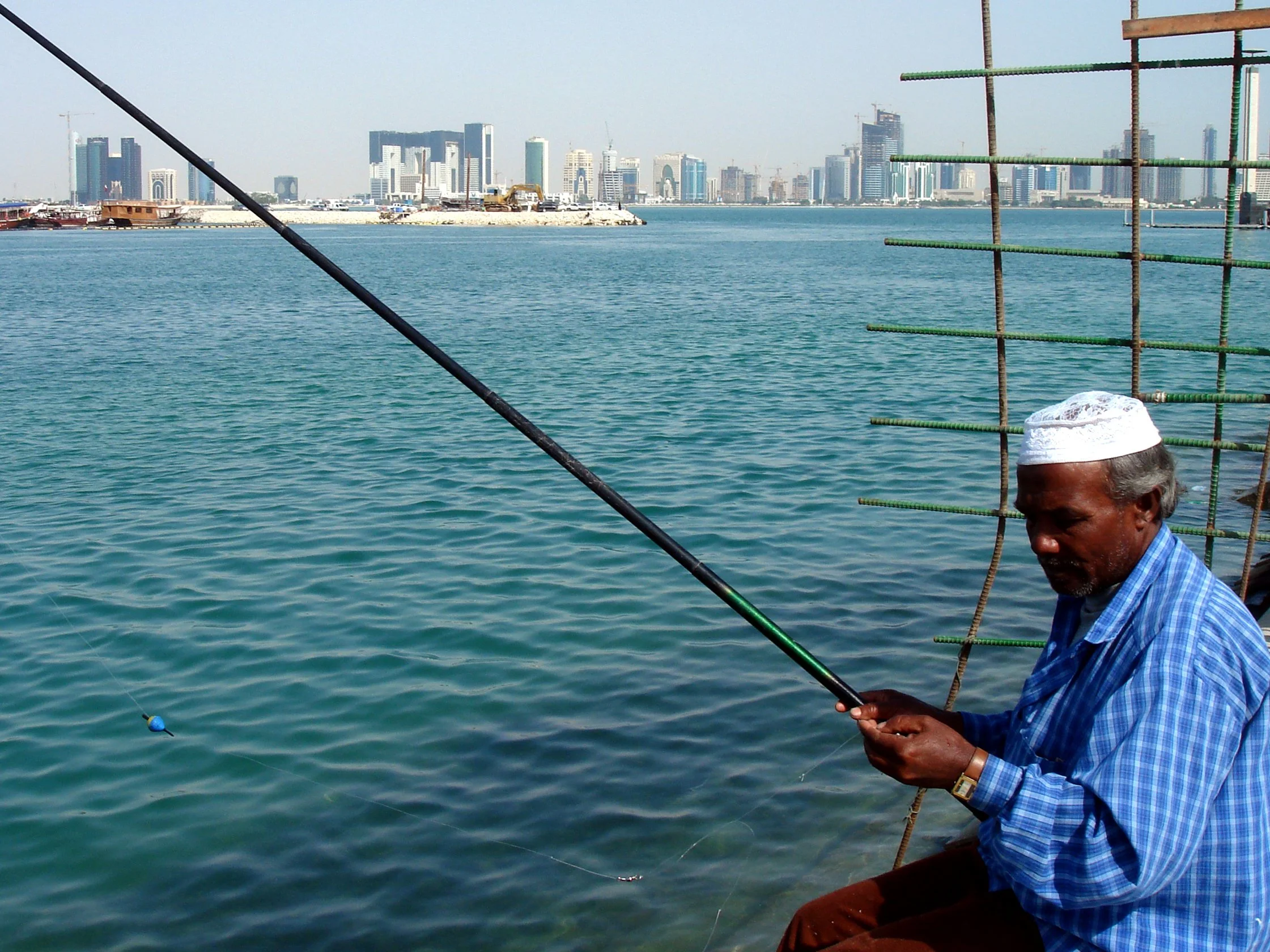
Migrant Worker. Doha Corniche (Elsheshtawy)
John McManus, whose observations on Qatar are among the most perceptive I have encountered, offers a sobering reminder that the true measure of any society lies not in how it treats its visitors or privileged residents, but in how it cares for its most vulnerable. Walking through Doha, those words were never far from my mind. Everywhere I looked I saw evidence of extraordinary ambition, but I also saw the quiet presence of those whose labor had made that ambition possible while remaining largely absent from its official story.
“And everywhere there are men. They sit in clusters on the faded grass and stand in the arcades. They wander in twos and threes, arms round each other’s shoulders. They survey posters advertising music concerts and line up in huge queues at cash machines. These are the men who have built Qatar .... We are separated by walls – walls circling construction sites, and walls around camps.”
-- John McManus. Inside Qatar: Hidden Stories from one of the richest Nations on Earth
Perhaps that is why my thoughts continue returning to the teddy bear in the airport. What initially appeared to be a whimsical piece of public art gradually became, for me, an unintended metaphor for the Gulf itself. It speaks of childhood, comfort, and home, yet it sits inside a building defined by movement, impermanence, and departure. It welcomes travelers while quietly reminding them that they are only passing through.
Doha’s modernity remains an unresolved project. Its skyline may signal ambition, and its cultural investments suggest an eagerness to be seen. But the soul of the city—its public spaces, its social ecologies, its modes of everyday life—tells a more complicated story. One where the promise of the future is entangled with the ghosts of inequality and the persistent question of who gets to belong
