The Sounds of Cairo

Among my most cherished recollections of Cairo are its distinctive sounds. From our home in Maadi, I remember waking before dawn to the adhan drifting through the stillness of the morning. Soon afterward came the sounds that announced the beginning of another day: vendors pushing carts or driving pickup trucks slowly through the neighborhood, each proclaiming his trade in a voice instantly recognizable to residents. Among them was the rubabikya collector, loudly calling out "Bikya!" as he searched for unwanted household goods. Then came the sounds of people walking to work, children making their way to school, dogs barking in the distance, and traffic gradually filling the streets. Like so many Cairenes, I learned to tell time not by the clock but by the city's unfolding soundtrack.
“How can you hear silence in the midst of Cairo's noise?”
This question comes from Tamer El Said's remarkable 2016 semi-autobiographical film In the Last Days of the City. It is spoken by one of the protagonists while the camera glides over an aerial view of Downtown Cairo, where modernist buildings stand beside older neighborhoods, their histories layered upon one another. The film is a nostalgic meditation on Cairo and its uncertain future, following a filmmaker wandering through a city on the eve of the 2011 Revolution. Yet what has remained with me most is not only its images but its attention to sound.
Cairo is a city of dausha, that uniquely Egyptian word describing noise, commotion, and the dense layering of sounds that define everyday urban life. Car horns compete with revving engines. People shout across streets. Vendors advertise their produce and household goods. The familiar cry of the rubabikya collector echoes through residential neighborhoods. Then, almost unexpectedly, comes the adhan, momentarily rising above the urban cacophony before dissolving once more into the city's constant rhythm. This soundscape extends across much of metropolitan Cairo, giving the city an unmistakable acoustic identity.
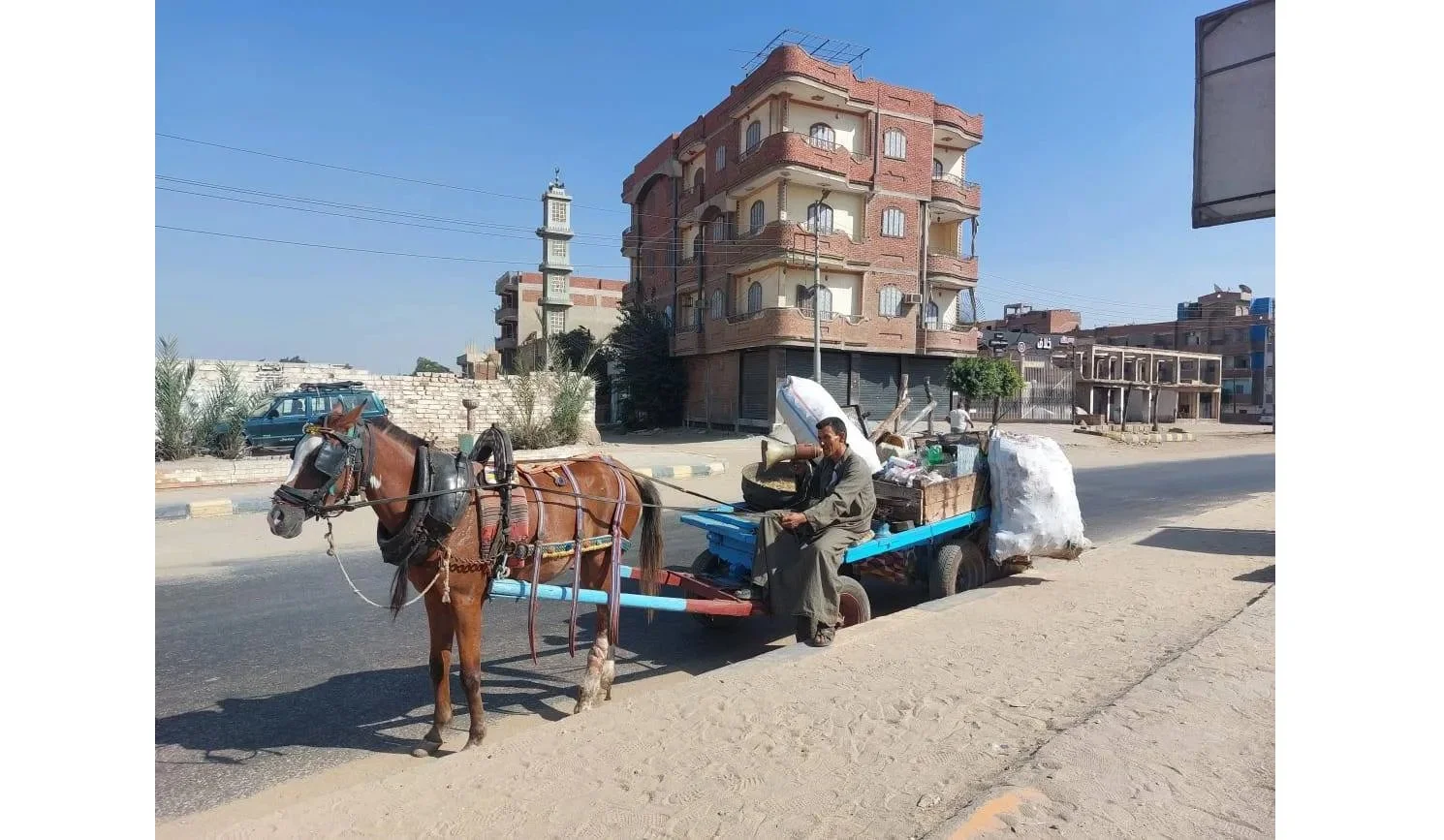
Rubabikya Cart
Over the past two decades, however, Cairo has expanded dramatically. To the east lie New Cairo, Madinaty, and the New Administrative Capital; to the west, Sixth of October City and Sheikh Zayed City. These developments consist largely of gated communities designed for the upper middle classes and the wealthy. The motivations for leaving the Nile Valley are many, echoing what David Sims famously described as Desert Dreams. Residents seek escape from congestion, dust, perceived crime, and urban disorder in favor of environments marketed as clean, orderly, secure, and green.
They are also escaping something less frequently discussed: noise.
In these new developments, silence itself has become an amenity. Instead of street vendors, one hears birdsong and the gentle rustling of carefully irrigated gardens. Traffic is muted. Streets remain largely empty. Commercial life takes place inside air-conditioned shopping malls rather than along bustling sidewalks. Ironically, these verdant landscapes exist only through the intensive use of Nile water in the middle of the desert, further exacerbating Egypt's already severe water crisis. Silence, then, has become another form of privilege, distinguishing the residents of these exclusive enclaves from those who remain in the older city.
If one were to map Cairo's soundscape, a remarkably clear pattern would emerge. The historic core, the informal settlements or the ashwa’iyyat, public housing, middle class neighborhoods, would register the highest levels of sound, generated by extraordinary population densities, crowded streets, informal markets, workshops, tuk-tuks, buses, and the continuous movement of people and vehicles. Moving outward toward the desert suburbs, the acoustic landscape changes dramatically. Sounds become subdued. Human interaction shifts indoors. Streets are quieter, retail activity takes place inside shopping centers, and everyday life unfolds behind walls and gates.
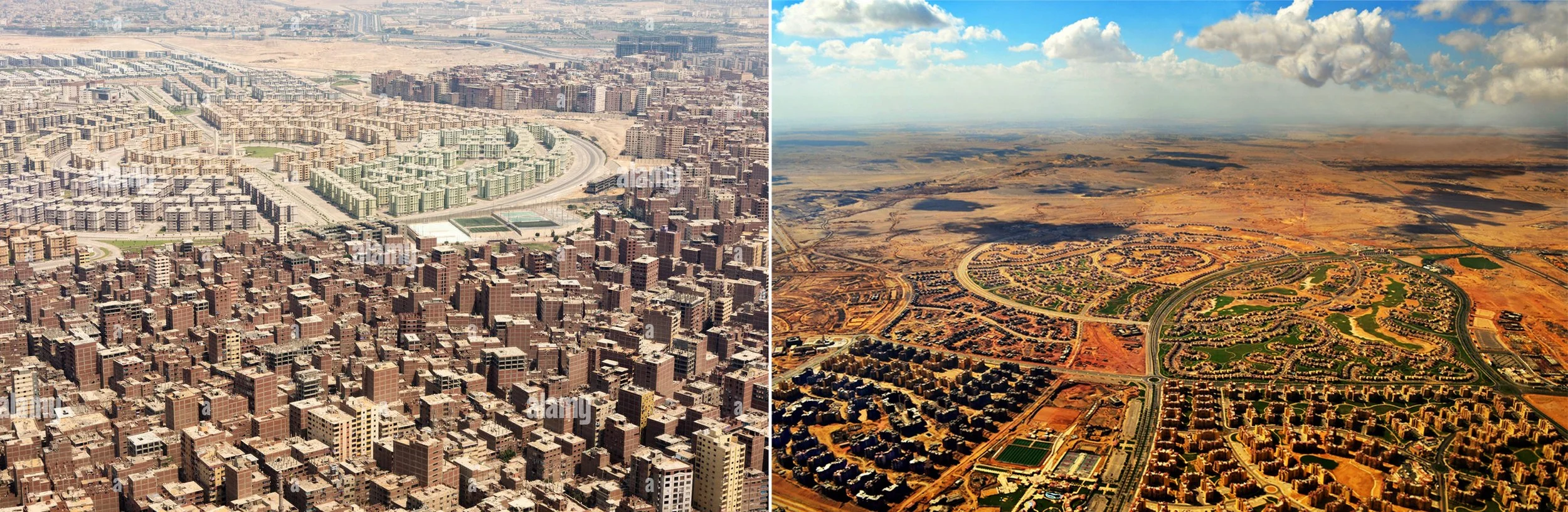
L: Informal Settlements R: Gated Community
What emerges is yet another expression of Cairo's increasingly divided urban condition: one city for the privileged and another for everyone else.
This, to me, is an unfortunate development. Any visitor to Cairo soon realizes that its noise—its dausha, its unmistakable soundscape—is part of what makes the city unlike any other. There are, of course, limits beyond which noise becomes harmful. Yet below those thresholds, these sounds are not simply pollution to be eliminated. They are expressions of everyday urban life, evidence of encounter, commerce, conversation, improvisation, and community. They are the soundtrack of a living city.
Perhaps the real question, then, is not how to silence Cairo, but how to preserve the vitality that its sounds represent while making the city more livable for everyone. In the end, Cairo without its dausha would still be a city—but it would no longer sound like Cairo.
