The House That Never Left Me
This personal essay traces my long relationship with the UAE’s Sha’abi house, from my first encounters with these modest homes in Al Ain in 1997 to years of research, photography, exhibitions, and fieldwork across the country. Moving between memory, architecture, and everyday life, the piece reveals how these houses became living archives of belonging, adaptation, hospitality, and social transformation—offering a deeply human counterpoint to the spectacle of Gulf urbanism.
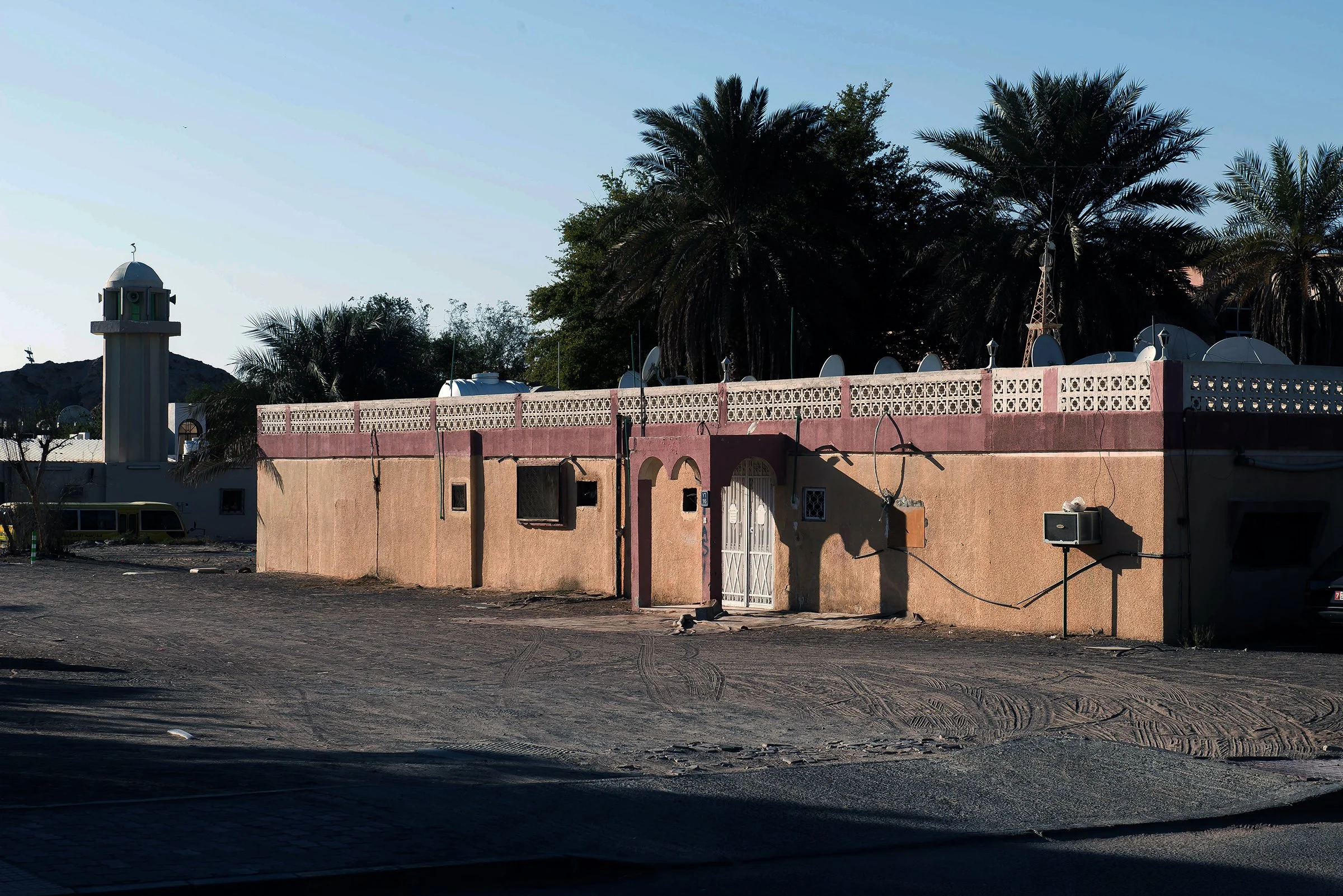
A Sha’abi House in Al-Ain
I still remember my first encounter with the Sha’abi house.
When I arrived in Al Ain in 1997, the city appeared to me as a strange urban landscape suspended between worlds. There were modern roads, roundabouts, shopping centers, and carefully planned neighborhoods spreading across the desert. Yet embedded within this modern urban order were modest single-story houses that seemed almost out of place—quiet compounds with shaded courtyards, boundary walls, satellite dishes, improvised extensions, water tanks, gardens, parked cars, and traces of everyday life spilling gently into the street.
At first glance they appeared ordinary.
But I could not stop looking at them.
These were the UAE’s Sha’abi houses—the “People’s Houses”—introduced during the formative years of the federation under Sheikh Zayed as part of an ambitious social and political project. Intended to settle Bedouin communities and provide citizens with dignified modern housing, they represented far more than a state housing program. They embodied a promise: that modernity could coexist with belonging, family, memory, and everyday life.
What fascinated me most was not their architectural form alone, but what happened to them afterwards.
Over time, these houses were transformed by their inhabitants. Walls shifted. Rooms were added. Courtyards were enclosed. Majlis spaces expanded. Decorative details appeared. Kitchens relocated. Staircases emerged where none had existed before. Gardens became social worlds. The houses adapted to changing families, aspirations, economic realities, and personal desires.
They became living archives.
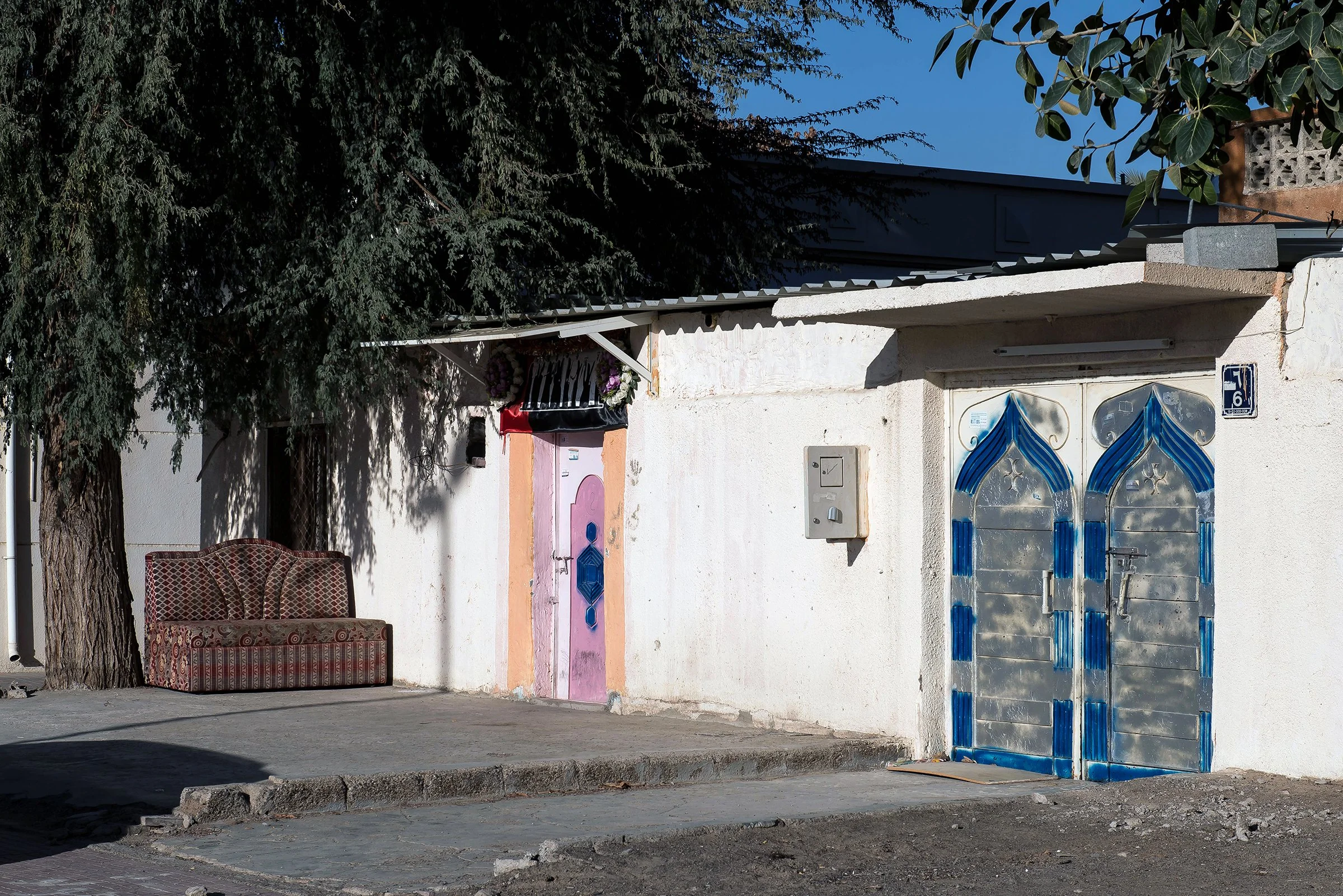
Entrances & a Sofa. Al-Ain
In many ways, the Sha’abi house resisted the rigidity of modernist planning. While the state imagined a standardized dwelling, residents slowly individualized and reinterpreted these homes through everyday acts of occupation and modification. The result was something profoundly moving: a form of architecture that was neither entirely planned nor entirely improvised, but constantly negotiated between official vision and lived reality.
For years, I carried these observations within me, promising myself that one day I will explore these houses further. I was particularly interested in the work of German photographers and artists Bernd and Hilla Becher. Over a span of 40 years they captured what they referred to as “anonymous sculpture”: extensive series of water towers, blast furnaces, coal mine tipples, framework houses of mine workers, and other vernacular industrial architecture. The Bechers produced impeccable black and white photographs, recording shadowless front and side elevation views of their subjects. Arranging these matched photographs in a grid, they produced what they called “typologies,” which grouped buildings by function, underscoring the similarities and differences between structures. I wanted to do something similar for the UAE’s Sha’abi homes
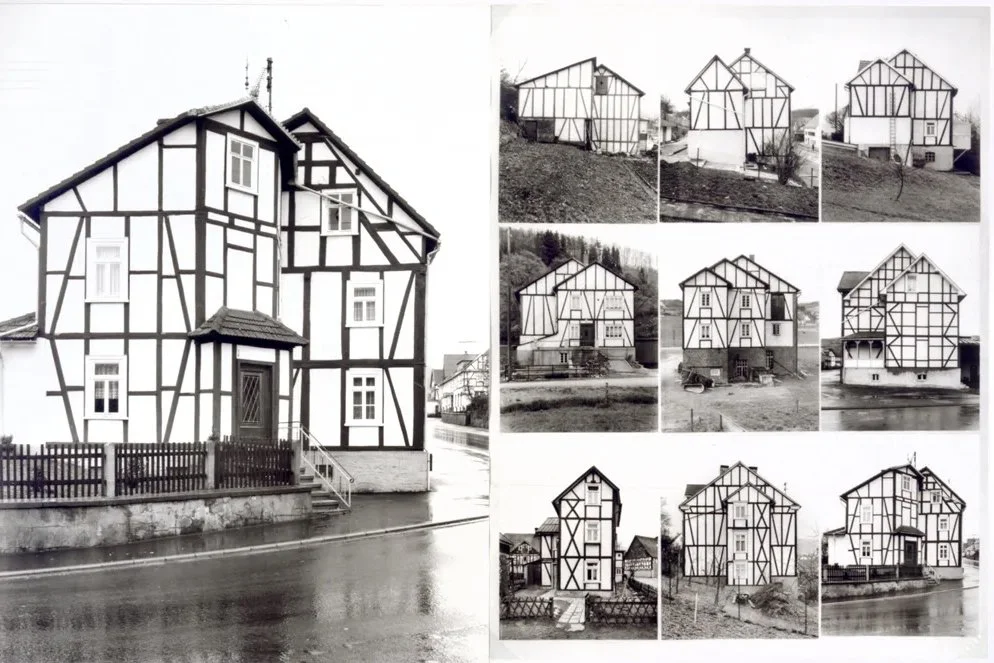
Fachwerkhauser (Timbered Houses), 1973
I photographed neighborhoods. I walked through streets at different times of the day. I spoke to residents. I observed details that others overlooked—the texture of walls exposed to decades of desert heat, the layering of additions, the careful placement of chairs outside entrances during the evening, the rhythms of family life unfolding behind gates. Slowly, I began to realize that the Sha’abi house was not simply a housing typology. It was a lens through which one could understand the social and cultural transformation of the UAE itself.
That long journey eventually led to the UAE National Pavilion at the Venice Architecture Biennale in 2016.
The exhibition attempted to capture the essence of the Sha’abi house not as a nostalgic artifact, but as a living and evolving environment. Visitors moved through the pavilion as though moving through the rooms of a house itself. Scaled models revealed the accumulated layers of occupation and transformation. Analytic diagrams mapped spatial evolution. Typological studies examined patterns of adaptation. Translucent massing models suggested both fragility and permanence.
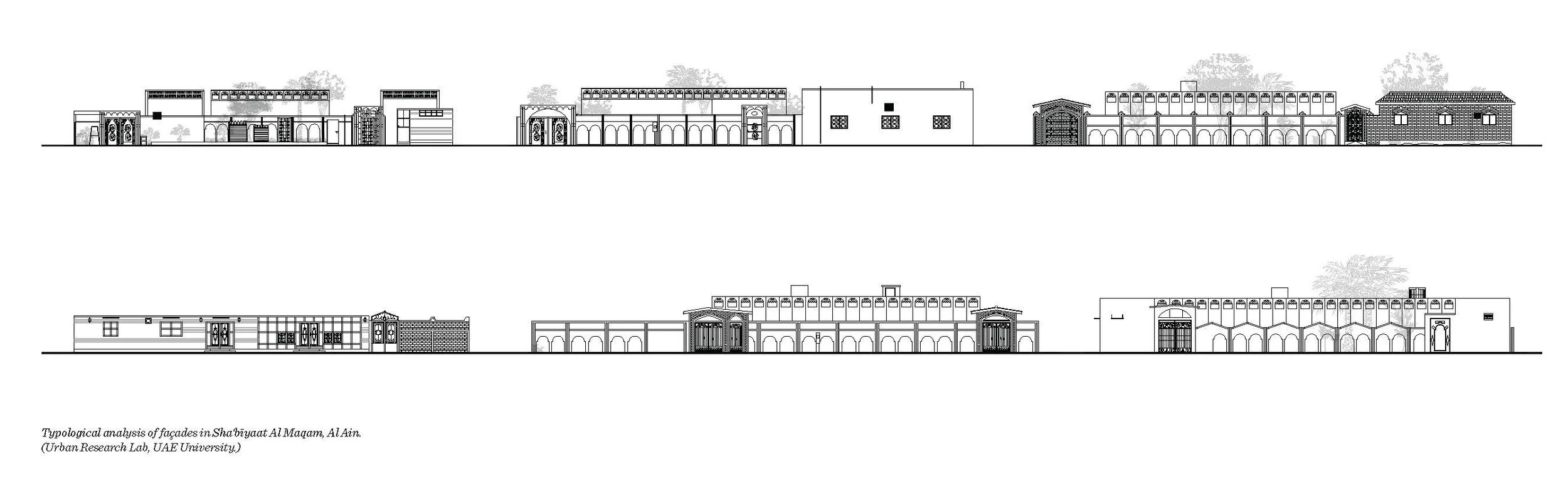
Elevation Study of homes in Sha’abiya Defa’a. Al-Ain
Yet what moved people most were not the drawings or diagrams alone.
It was the recognition that these modest houses carried stories.
Stories of migration from desert settlements into planned urban environments. Stories of newly formed families. Stories of social mobility, adaptation, hospitality, and memory. Stories embedded within architecture itself.
Years later, in 2024, I returned once again to these neighborhoods through a research grant supported by the Zayed National Museum.
But this return felt different.
The UAE had changed dramatically since my first arrival. Entire districts had disappeared. Cities had become denser, taller, faster, and more spectacular. Urban discourse increasingly revolved around iconic skylines, global branding, museums, luxury developments, and artificial islands. Yet amid all this transformation, the Sha’abi neighborhoods remained present—sometimes neglected, sometimes threatened, sometimes transformed beyond recognition, but still deeply embedded within the emotional geography of the country.
Revisiting them after nearly three decades became an intensely personal experience.
Some houses had vanished. Others stood frozen in time. Many had been further subdivided, expanded, or adapted to accommodate multiple generations. Many were in various states of demolition, their colorful interior walls exposed as if they are an architectural cross section, revealing traces of hidden rooms. Again and again, I encountered houses that revealed how deeply architecture and everyday life had become intertwined. Rooms had been added gradually over time, courtyards enclosed, entrances modified, and outdoor spaces transformed to accommodate changing family structures, social expectations, and daily rituals. What emerged was not simply a collection of buildings, but biographies written through architecture itself.
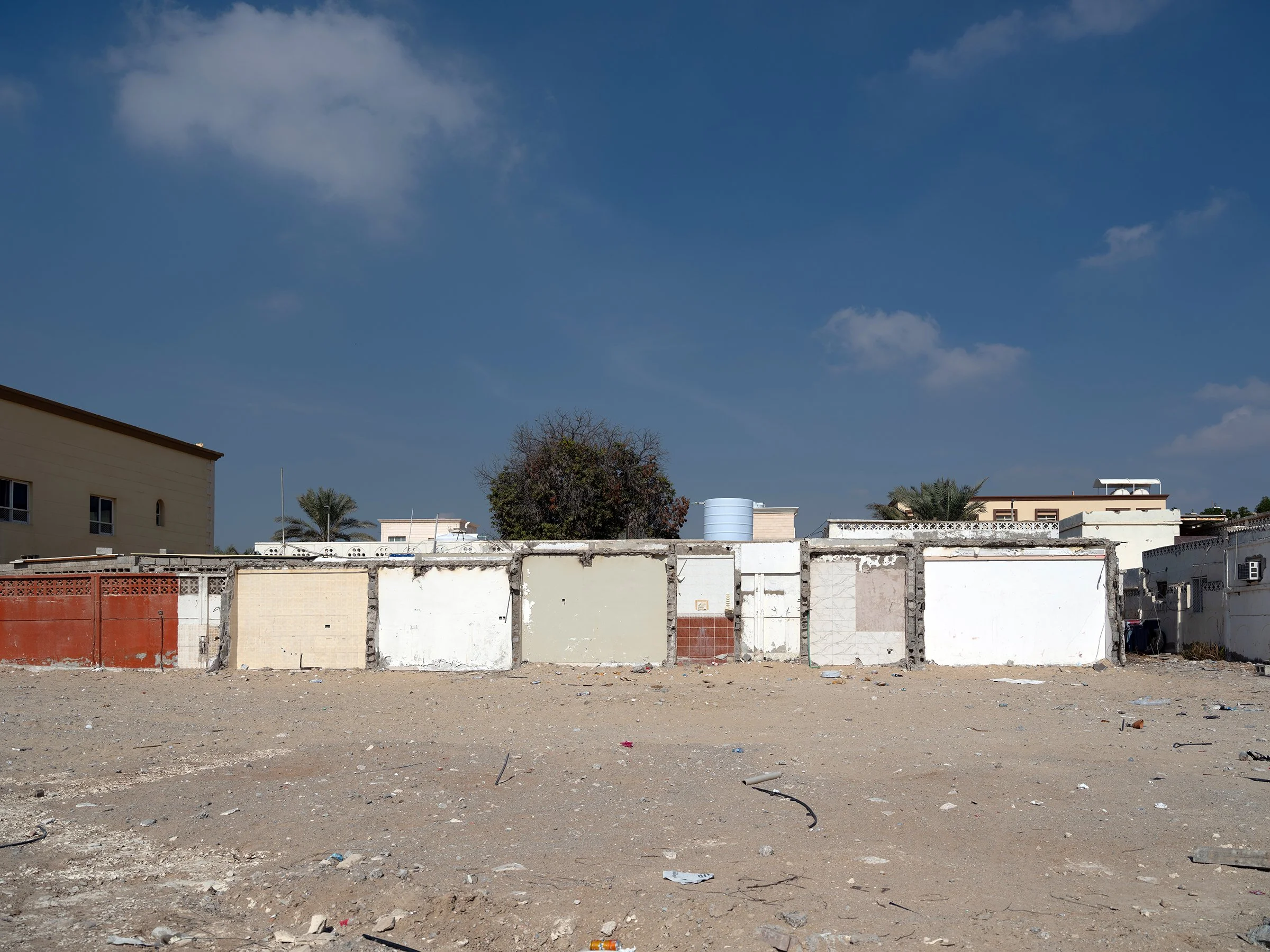
Exposed inner wall of a Sha’abi Home. Baniyas Sha’abiya. Abu Dhabi.
This website grows out of that journey.
It is not merely an archive.
Nor is it simply a research project.
It is an attempt to preserve, document, and understand a disappearing urban and architectural world before it fades completely beneath the pressure of redevelopment, nostalgia, and selective memory.
As you move through the pages, you will encounter photographs, drawings, maps, essays, films, interviews, and field observations collected over many years. You will see houses in different states of transformation. You will encounter stories of residents and neighborhoods. You will witness the tension between permanence and change, between official planning and lived adaptation.
But more importantly, I hope you will begin to see these houses differently.
The Sha’abi house is often dismissed as modest, repetitive, or architecturally insignificant when compared to the spectacle of Gulf skylines and global mega-projects. Yet its true importance lies precisely in its ordinariness. It is within these everyday spaces that identity is negotiated, memory is formed, and belonging takes root.
In many ways, this project is also about my own relationship with cities.
For decades I have written about modernism, urban transformation, spectacle, and erasure across the Arab world—from Cairo and Beirut to Riyadh, Doha, Dubai, and Abu Dhabi. Again and again, I found myself returning to a simple question: how do ordinary people inhabit and reshape the spaces imposed upon them?
The Sha’abi house offers one of the clearest and most beautiful answers.
Its story is not one of architectural perfection but a story of adaptation and improvisation. Of families creating their own spaces within standardized plans and architecture becoming human.
And perhaps that is why these houses never left me.
Even after all the years, exhibitions, books, research projects, and travels, I still find myself drawn back to them—not only as an architect and urban researcher, but as someone searching for traces of how cities become meaningful through everyday life.
One encounter in particular stayed with me.
During my fieldwork I met Rashad, a resident who welcomed me warmly into his majlis. Inside, surrounded by his friends, the room became more than an architectural space; it became a social world. Conversation, hospitality, memory, and companionship filled the majlis, revealing how the Sha’abi house continued to sustain rituals of gathering and belonging even as the city around it changed.

Rashad and his Falcon. Sha’abiya Baniyas. Abu Dhabi. 2024
What stayed with me most was the moment I photographed Rashad in his majlis with his falcons. The scene carried a quiet intensity: the host with his treasured possession, looking proudly into the camera revealing the accumulated presence of a life lived within and through the house. It captured something I had been searching for throughout this entire journey: the inseparability of architecture, memory, identity, and everyday life. The Sha’abi house was never merely shelter. It was a setting for rituals, hospitality, friendship, family histories, and deeply personal attachments that could not be measured through plans or diagrams alone.
Rashad told me as I was about to leave that whenever I am in Abu Dhabi, this is my home too. It was a humble gesture of generosity that showed me the essence of Emirati culture, and how dignity and humanity pervade these ordinary landscapes.
In a region often obsessed with spectacle, speed, and constant reinvention, the Sha’abi house reminds us that cities are ultimately shaped not by iconic skylines, but by the quiet accumulation of everyday life. Behind boundary walls and improvised additions lies an urban history rarely celebrated in glossy brochures or global headlines—a history of adaptation, intimacy, resilience, and memory.
And maybe that is what drew me to these houses from the very beginning.
Not simply their form.
But the multitude of stories they contained.
If this interests you further I invite you to explore the story through a website dedicated to preserving the memory of this fading architecture.
